
Lesson overview
A starting point geometry skill that routes expect you to justify.
GCSE angle questions are not just about finding a number. They also test whether you can explain which angle fact you used and why the diagram allows it.
Visual summary
Before viewing
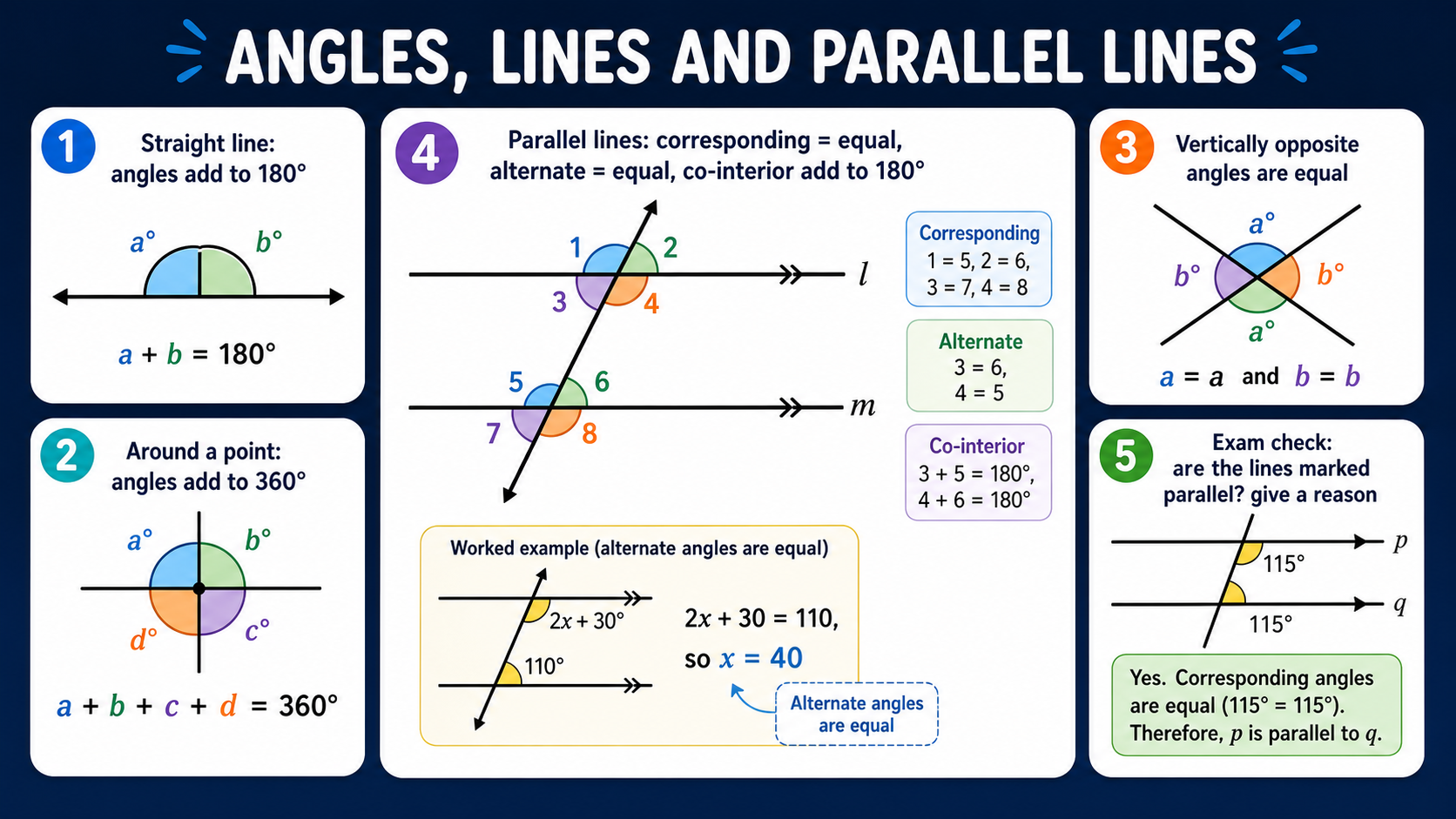
Before viewing, find one equal-angle relationship and one pair that sums to 180 degrees.
After viewing
After viewing, calculate one missing angle and write the reason beside it.
What you will learn
Key facts before you start
Why this matters
Angle facts are used in polygons, bearings, constructions, circle theorems, trigonometry and proof. A tidy angle reason can turn a guessed-looking answer into a full-mark method.
Prior knowledge
You should already be comfortable with:
Clear explanation
Three facts you use constantly
Parallel-line angle facts
When a line crosses two parallel lines, it creates repeatable patterns. Many pupils remember these by shape:
In exams, the reason matters. Write something like alternate angles are equal because the lines are parallel. If the lines are not marked parallel, do not use the F, Z or C-shape rules unless the question tells you they are parallel.
Treat the diagram as a clue, not a measuring tool. If the question says the drawing is not to scale, use the angle labels and facts only.
Worked examples
Example 1: Straight line
Two angles on a straight line are 112° and x. Find x.
x = 180° − 112° = 68°Reveal answer
Answer: x = 68° because angles on a straight line add to 180°.
Example 2: Vertically opposite angles
Two straight lines cross. One angle is 47°. Find the vertically opposite angle.
Reveal answer
Answer: 47°, because vertically opposite angles are equal.
Example 3: Co-interior angles
Two co-interior angles between parallel lines are 73° and y. Find y.
y = 180° − 73° = 107°Reveal answer
Answer: y = 107° because co-interior angles add to 180°.
Example 4: Algebra with alternate angles
Two alternate angles on parallel lines are labelled 2x + 18 and 96°. Find x.
2x + 18 = 96 2x = 78 x = 39Reveal answer
Answer: x = 39 because alternate angles are equal on parallel lines.
Example 5: Combine a straight line and a parallel-line fact
A corresponding angle on parallel lines is 118°. Angle z is next to it on a straight line. Find z.
The corresponding angle is 118° because the lines are parallel. z = 180° − 118° = 62°Reveal answer
Answer: z = 62° because angles on a straight line add to 180°.
Quick checks
Choose an answer, then check your thinking.
1. Angles around a point add to:
2. Which parallel-line angles are usually shown by a Z shape?
3. Co-interior angles between parallel lines add to:
Practice questions
Question 1
Angles on a straight line are 39° and x. Find x.
Reveal answer and marking guidance
Answer: x = 141°.
Marking: Use 180° − 39° because angles on a straight line add to 180°.
Question 2
Angles around a point are 82°, 115°, 48° and y. Find y.
Reveal answer and marking guidance
Answer: y = 115°.
Marking: Add the known angles to get 245°, then subtract from 360°.
Question 3
Two straight lines cross. One angle is 128°. Find the vertically opposite angle.
Reveal answer and marking guidance
Answer: 128°.
Marking: State that vertically opposite angles are equal.
Question 4
Two parallel lines are cut by a transversal. An angle is 64°. Find the corresponding angle.
Reveal answer and marking guidance
Answer: 64°.
Marking: Corresponding angles are equal because the lines are parallel.
Question 5
Two alternate angles on parallel lines are labelled 3x + 10 and 85. Find x.
Reveal answer and marking guidance
Answer: x = 25.
Marking: Alternate angles are equal, so 3x + 10 = 85, then 3x = 75.
Question 6
Two co-interior angles on parallel lines are 4x and 68°. Find x.
Reveal answer and marking guidance
Answer: x = 28.
Marking: Co-interior angles add to 180°, so 4x + 68 = 180 and 4x = 112.
Question 7
Two corresponding angles on parallel lines are labelled 5x − 12 and 73°. Find x.
Reveal answer and marking guidance
Answer: x = 17.
Marking: Corresponding angles are equal because the lines are parallel, so 5x − 12 = 73 and 5x = 85.
Question 8
Three angles around a point are 2x, 3x + 20 and 140°. Find x.
Reveal answer and marking guidance
Answer: x = 40.
Marking: Angles around a point add to 360°, so 2x + 3x + 20 + 140 = 360. This gives 5x + 160 = 360, then 5x = 200.
Question 9
Two parallel lines are cut by a transversal. A co-interior angle is labelled 2x + 35 and the other is labelled 3x − 10. Find x and both angles.
Reveal answer and marking guidance
Answer: x = 31; the angles are 97° and 83°.
Marking: Co-interior angles add to 180°, so 2x + 35 + 3x − 10 = 180. This gives 5x + 25 = 180, so x = 31. Substitute back: 2 × 31 + 35 = 97° and 3 × 31 − 10 = 83°.
Question 10
Two alternate angles on parallel lines are labelled 2x + 18 and 5x − 36. Find x and the angle size.
Reveal answer and marking guidance
Answer: x = 18 and each angle is 54°.
Marking: Alternate angles are equal, so 2x + 18 = 5x − 36. This gives 54 = 3x, so x = 18. Substitute back: 2 × 18 + 18 = 54° and 5 × 18 − 36 = 54°.
Answers and marking guidance
The exact practice answers are hidden under each question so you can try first. For angle questions, marks usually come from selecting the correct angle fact, doing the subtraction or equation accurately, and writing a clear reason such as angles on a straight line, vertically opposite angles, corresponding angles, alternate angles or co-interior angles. When angle expressions include x, form the equation from the angle fact before solving. Do not measure a not-to-scale diagram.
Common mistakes
- Measuring the printed diagram: GCSE diagrams are often not drawn accurately unless the question says they are.
- Using a parallel-line rule without parallel lines: corresponding, alternate and co-interior facts need parallel lines.
- Mixing up equal and sum-to-180 facts: corresponding and alternate are equal; co-interior add to 180°.
- Forgetting reasons: write the angle fact, not just the answer.
Extension challenge
A pair of co-interior angles are labelled 2x + 15 and 5x − 10. Find both angles.
Reveal answer
Answer: x = 25, so the angles are 65° and 115°.
Use 2x + 15 + 5x − 10 = 180, so 7x + 5 = 180 and x = 25.
Exam-board guidance
Angle facts and parallel-line reasoning are assessed across GCSE Maths boards. The shared habit is to pair each number with a reason, especially when a question asks you to explain or prove, to say when a rule depends on parallel lines, and to trust written labels over measuring not-to-scale drawings.
AQA GCSE Maths
Focus on the shared method, notation and checking habit; wording and context can vary by route.
OCR GCSE Maths
Show clear method steps and use precise notation; question wording may vary by route.
Pearson Edexcel GCSE Maths
Keep working visible and check units or notation; contexts may vary by route.
Eduqas GCSE Maths
Use the same core skill in practical contexts, with clear reasoning and final checks.
WJEC Wales
Connect the method to the context and state what the result means.
CCEA GCSE Maths
Make each method step visible and keep notation, units and final checks clear.
Next lesson
Next, use angle facts inside shapes in Polygons and Interior/Exterior Angles.