
Lesson overview
Polygon angle facts turn shape diagrams into calculations.
GCSE questions may ask for a missing angle, a number of sides, or a reason why a regular polygon has a particular angle. The core facts are reliable once you know when to use each one, and the method marks usually come from naming the rule before calculating.
What you will learn
Key facts before you start
Why this matters
Polygon angles appear in shape problems, tiling, bearings, construction-style reasoning and proof. The same two totals keep coming back: interior angles are built from triangles, and exterior angles make one full turn.
Prior knowledge
You should already be comfortable with:
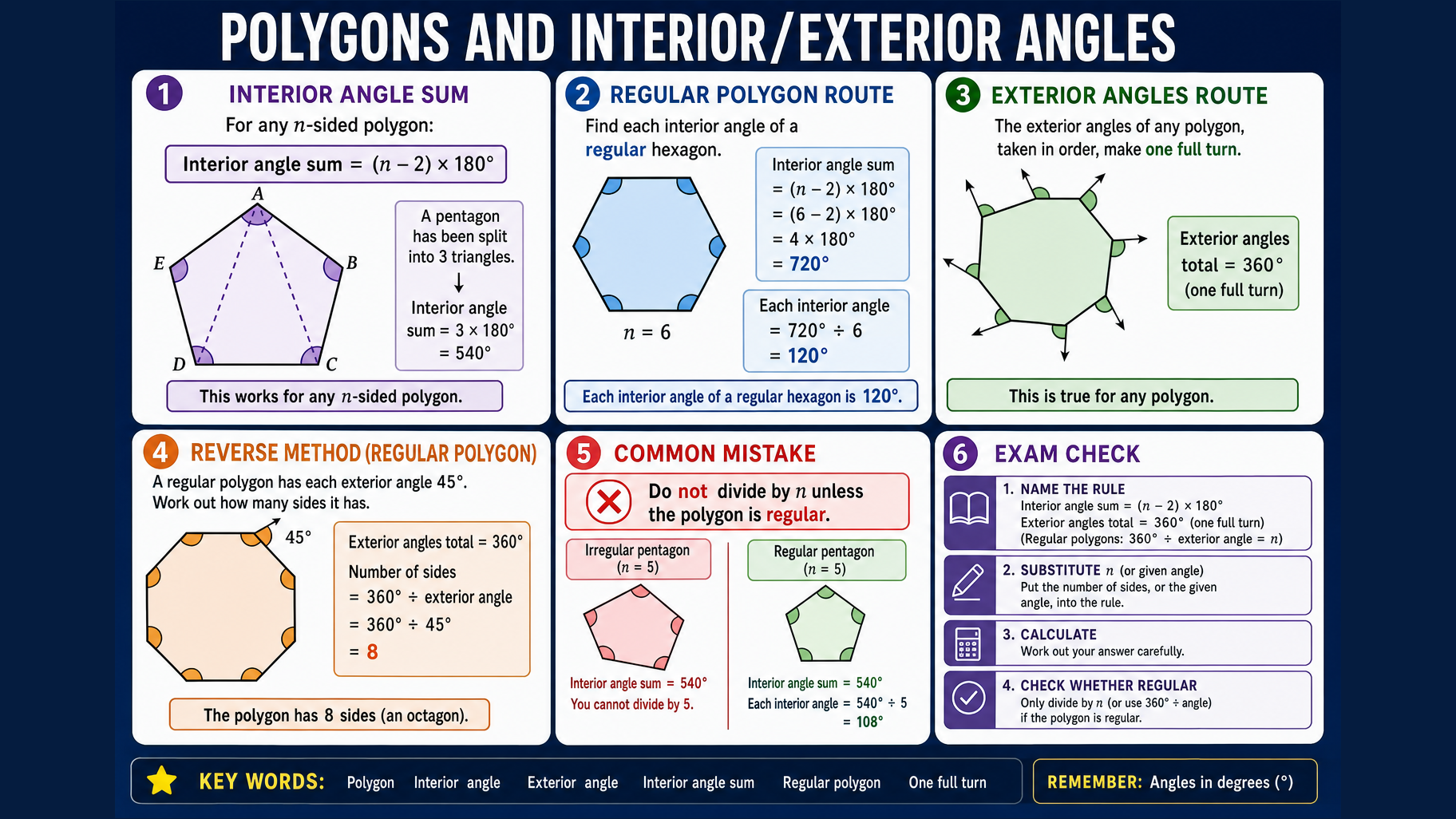
Polygons and interior/exterior angles infographic
Before viewing
Before viewing, identify interior and exterior angles on the polygon.
After viewing
After viewing, calculate either an exterior angle or an interior angle sum.
Clear explanation
Interior angle sums
A polygon with n sides can be split into n − 2 triangles from one vertex. Each triangle has 180°, so:
Interior angle sum = (n − 2) × 180°Regular polygons
A regular polygon has all sides equal and all angles equal. To find one interior angle, find the total interior angle sum and divide by the number of sides.
Exterior angles
One exterior angle at each vertex of any convex polygon adds to 360° in total. In a regular polygon:
One exterior angle = 360° ÷ number of sidesInterior and exterior angles on a straight line add to 180°, so one regular interior angle is 180° minus one exterior angle.
If a diagram is not marked as regular, do not divide the interior angle sum by the number of sides. Look for equal-angle marks, equal-side marks or wording that says the polygon is regular.
Some exam questions use algebraic angle labels such as 3x + 10. Add the angles to the correct polygon total first, then solve the equation. In tiling questions, angles meeting at a point must add to 360°.
Worked examples
Example 1: Interior angle sum
Find the interior angle sum of an octagon.
(8 − 2) × 180° = 6 × 180° = 1080°Reveal answer
Answer: 1080°.
Example 2: One angle in a regular polygon
Find one interior angle of a regular pentagon.
(5 − 2) × 180° = 540° 540° ÷ 5 = 108°Reveal answer
Answer: 108°.
Example 3: Working backwards from an exterior angle
A regular polygon has exterior angle 45°. How many sides does it have?
360° ÷ 45° = 8Reveal answer
Answer: 8 sides.
Quick checks
Choose an answer, then check your thinking.
1. The interior angle sum of a quadrilateral is:
2. Exterior angles of a convex polygon add to:
3. A regular polygon with 10 sides has one exterior angle of:
Practice questions
Question 1
Find the interior angle sum of a hexagon.
Reveal answer and marking guidance
Answer: 720°.
Marking: Use (6 − 2) × 180° = 4 × 180°.
Question 2
Find one interior angle of a regular octagon.
Reveal answer and marking guidance
Answer: 135°.
Marking: The interior sum is 1080°, then 1080° ÷ 8 = 135°.
Question 3
Find one exterior angle of a regular 12-sided polygon.
Reveal answer and marking guidance
Answer: 30°.
Marking: Use 360° ÷ 12.
Question 4
A regular polygon has exterior angle 24°. How many sides does it have?
Reveal answer and marking guidance
Answer: 15 sides.
Marking: Use 360° ÷ 24° = 15.
Question 5
Five angles in a hexagon are 110°, 120°, 130°, 140° and 100°. Find the sixth angle.
Reveal answer and marking guidance
Answer: 120°.
Marking: The hexagon total is 720°. The five known angles add to 600°, so the missing angle is 120°.
Question 6
One interior angle of a regular polygon is 150°. How many sides does it have?
Reveal answer and marking guidance
Answer: 12 sides.
Marking: The exterior angle is 180° − 150° = 30°, then 360° ÷ 30° = 12.
Question 7
The angles in a quadrilateral are x°, 2x°, 3x° and 4x°. Find the largest angle.
Reveal answer and marking guidance
Answer: 144°.
Marking: Quadrilateral angles add to 360°, so x + 2x + 3x + 4x = 360. Then 10x = 360, x = 36 and the largest angle is 4x = 144°.
Question 8
Three regular hexagons meet at a point in a tiling. Show that there is no gap.
Reveal answer and marking guidance
Answer: No gap, because 3 × 120° = 360°.
Marking: Find one interior angle of a regular hexagon as 120°, then show that the three angles around the point make a full turn.
Question 9
Two regular octagons and one regular square meet at a point. Is there a gap or overlap?
Reveal answer and marking guidance
Answer: No gap or overlap, because 135° + 135° + 90° = 360°.
Marking: Find one interior angle of a regular octagon as 135° and one square angle as 90°, then compare the total with 360° around a point.
Question 10
Two regular pentagons and one regular polygon meet at a point with no gap or overlap. How many sides does the third polygon have?
Reveal answer and marking guidance
Answer: 10 sides.
Marking: One regular pentagon angle is 108°, so two use 216°. The third interior angle is 360° − 216° = 144°. Its exterior angle is 180° − 144° = 36°, so the number of sides is 360° ÷ 36° = 10.
Answers and marking guidance
The exact practice answers are hidden under each question so you can try first. For polygon questions, marks usually come from choosing the right total, substituting the number of sides carefully, dividing only when the polygon is regular, forming any algebraic equation clearly, and explaining whether you used interior angles, exterior angles, a straight-line relationship or a full turn around a point. In tiling questions, add the interior angles that meet at the point and compare them with 360°.
Common mistakes
- Dividing too early: only divide the interior angle sum by n if the polygon is regular.
- Using n × 180°: the correct interior sum is (n − 2) × 180°.
- Forgetting exterior angles total 360°: this total does not depend on the number of sides.
- Mixing interior and exterior angles: one interior angle and its adjacent exterior angle add to 180°.
Extension challenge
A regular polygon has an interior angle that is 5 times its exterior angle. How many sides does it have?
Reveal answer
Answer: 12 sides.
If the exterior angle is x, the interior angle is 5x. They add to 180°, so 6x = 180° and x = 30°. Then 360° ÷ 30° = 12.
Exam-board guidance
Polygon angle facts are assessed across GCSE Maths boards. The common exam habit is to identify whether the polygon is regular, then state the formula or exterior-angle fact before calculating.
AQA GCSE Maths
Focus on the shared method, notation and checking habit; wording and context can vary by route.
OCR GCSE Maths
Show clear method steps and use precise notation; question wording may vary by route.
Pearson Edexcel GCSE Maths
Keep working visible and check units or notation; contexts may vary by route.
Eduqas GCSE Maths
Use the same core skill in practical contexts, with clear reasoning and final checks.
WJEC Wales
Connect the method to the context and state what the result means.
CCEA GCSE Maths
Make each method step visible and keep notation, units and final checks clear.
Next lesson
Next, continue Geometry and Measures with Perimeter and Area.