
Lesson overview
Perimeter and area are measure skills with different units.
GCSE questions often mix diagrams, worded contexts and missing lengths. Perimeter is a length, so it uses units such as cm or m. Area is space inside a shape, so it uses square units such as cm² or m². If units are mixed, convert them before using a formula.
What you will learn
Key facts before you start
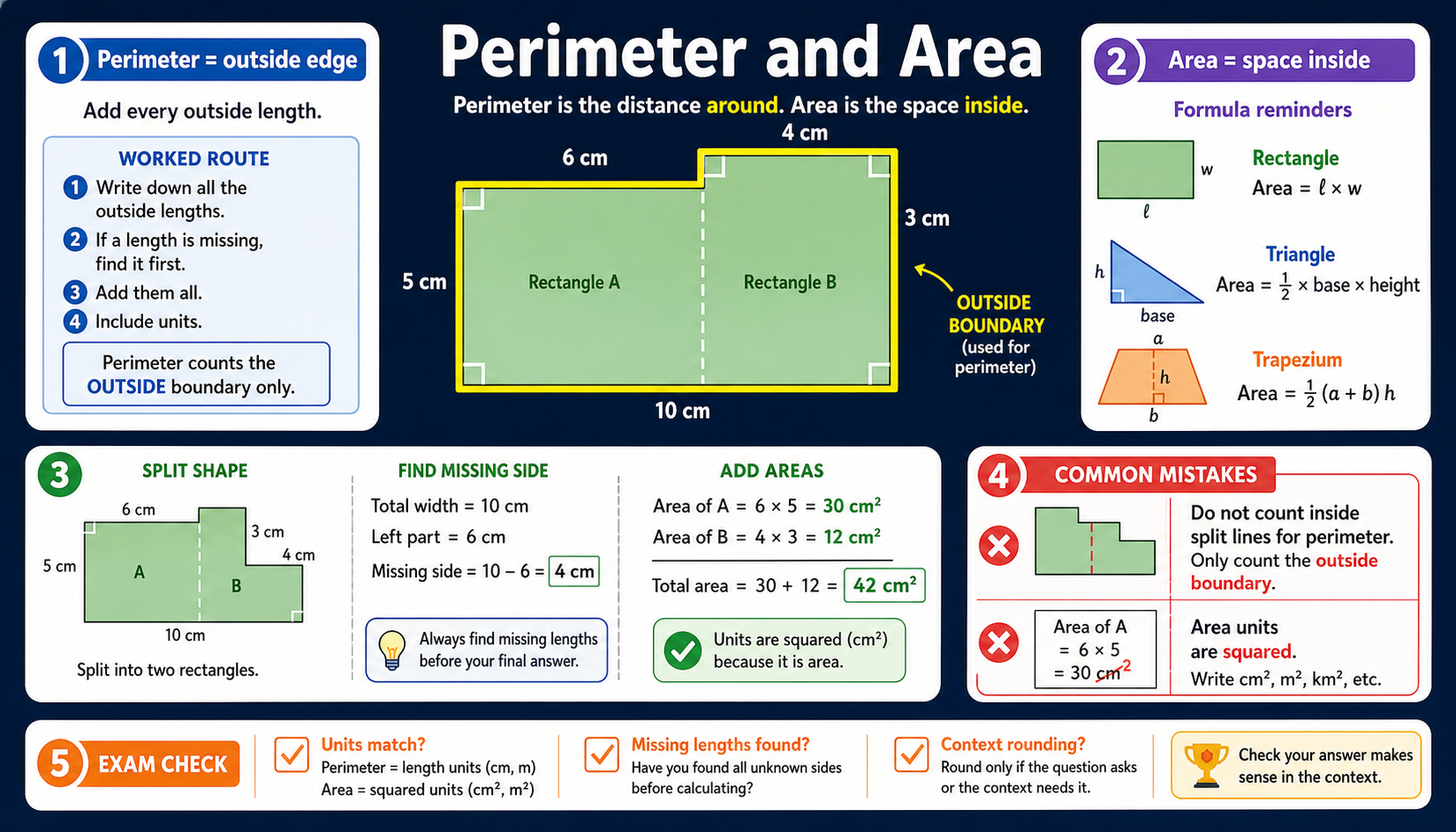
Perimeter and area infographic
Before viewing
Before viewing, trace the outside for perimeter and shade the inside for area.
After viewing
After viewing, decide whether a worded question asks for perimeter or area and justify it.
Why this matters
Perimeter and area appear in fencing, flooring, painting, garden plans, packaging and scale drawings. They are also needed before later work on circles, surface area, volume and similarity.
Prior knowledge
You should already be comfortable with:
Clear explanation
Perimeter means the outside edge
Perimeter is the total distance around a shape. Add every outside edge exactly once. If a side length is missing, use opposite sides, subtraction or shape facts to work it out first.
Perimeter of a rectangle = 2 × length + 2 × widthArea means the space inside
Area counts square units inside the shape. The common GCSE formulae are:
Compound shapes
A compound shape is made from simpler shapes. Split it into rectangles, triangles or trapezia, find each area, then add or subtract. For perimeter, trace only the outside boundary and do not include internal split lines.
For missing lengths, compare the full horizontal or vertical distance with the parts you already know. Write the missing length on the diagram before calculating the final perimeter or area.
Reverse questions work backwards from the area or perimeter. For example, if a rectangle has area 45 cm² and one side is 9 cm, divide 45 by 9 to find the missing side. Keep the unit attached so the final answer is a length, not an area.
If the dimensions use different units, convert them before calculating. For example, 2.5 m by 80 cm should become 250 cm by 80 cm, or 2.5 m by 0.8 m, before you find the area.
Worked examples
Example 1: Rectangle perimeter and area
A rectangle is 9 cm long and 4 cm wide.
Perimeter = 9 + 4 + 9 + 4 = 26 cm Area = 9 × 4 = 36 cm²Reveal answer
Answer: perimeter 26 cm, area 36 cm².
Example 2: Triangle area
A triangle has base 10 m and perpendicular height 6 m.
Area = ½ × 10 × 6 = 30 m²Reveal answer
Answer: 30 m².
Example 3: Compound area
An L-shape fits inside a 12 m by 8 m rectangle, with a 5 m by 3 m corner removed.
Large rectangle area = 12 × 8 = 96 m² Removed corner area = 5 × 3 = 15 m² Compound area = 96 − 15 = 81 m²Reveal answer
Answer: 81 m².
Quick checks
Choose an answer, then check your thinking.
1. Which unit is suitable for area?
2. The area of a triangle with base 8 cm and height 5 cm is:
3. For perimeter of a compound shape, you should add:
Practice questions
Question 1
A rectangle is 8 cm long and 5 cm wide. Find its perimeter and area.
Reveal answer and marking guidance
Answer: perimeter 26 cm; area 40 cm².
Marking: Add all four sides for perimeter, then multiply 8 × 5 for area.
Question 2
A triangle has base 12 cm and perpendicular height 7 cm. Find its area.
Reveal answer and marking guidance
Answer: 42 cm².
Marking: Use ½ × 12 × 7.
Question 3
A parallelogram has base 9 m and perpendicular height 4 m. Find its area.
Reveal answer and marking guidance
Answer: 36 m².
Marking: Use base × perpendicular height, not a sloping side.
Question 4
A trapezium has parallel sides 8 cm and 14 cm, with perpendicular height 5 cm. Find its area.
Reveal answer and marking guidance
Answer: 55 cm².
Marking: Use ½ × (8 + 14) × 5 = 55.
Question 5
An L-shape fits inside a 10 m by 8 m rectangle. A 4 m by 3 m rectangle is removed from one corner. Find the area of the L-shape.
Reveal answer and marking guidance
Answer: 68 m².
Marking: Large rectangle area is 80 m² and removed rectangle area is 12 m², so 80 − 12 = 68.
Question 6
A square has area 81 cm². Find its side length and perimeter.
Reveal answer and marking guidance
Answer: side length 9 cm; perimeter 36 cm.
Marking: The square root of 81 is 9, then 4 × 9 = 36.
Question 7
A rectangle has area 63 cm² and width 7 cm. Find its length and perimeter.
Reveal answer and marking guidance
Answer: length 9 cm; perimeter 32 cm.
Marking: Divide 63 by 7 to find the missing length, then add 9 + 7 + 9 + 7 or use 2 × 9 + 2 × 7.
Question 8
A rectangular noticeboard is 1.2 m wide and 75 cm high. Find its area in cm².
Reveal answer and marking guidance
Answer: 9000 cm².
Marking: Convert 1.2 m to 120 cm first, then calculate 120 × 75 = 9000 cm².
Question 9
A path is 80 cm wide all the way around a rectangular pond measuring 6 m by 4 m. Find the area of the path in m².
Reveal answer and marking guidance
Answer: 18.56 m².
Marking: Convert 80 cm to 0.8 m. The outside rectangle is 7.6 m by 5.6 m, so its area is 42.56 m². Subtract the pond area 6 × 4 = 24 m² to get 18.56 m².
Question 10
A classroom wall is 5.4 m long and 2.8 m high. One tin of paint covers 12 m². How many tins are needed for one coat?
Reveal answer and marking guidance
Answer: 2 tins.
Marking: Wall area = 5.4 × 2.8 = 15.12 m². 15.12 ÷ 12 = 1.26 tins, so round up to 2 tins because one full coat must cover the whole wall.
Answers and marking guidance
The exact practice answers are hidden under each question so you can try first. For perimeter and area questions, marks usually come from identifying the right measurement, writing the formula or split, converting units before calculating, substituting the dimensions accurately, using perpendicular height where needed, and finishing with length units or square units as appropriate.
Common mistakes
- Mixing perimeter and area: perimeter is around the edge; area is inside the shape.
- Missing square units: area answers need units such as cm² or m².
- Using a sloping side as height: triangle, parallelogram and trapezium area formulae need perpendicular height.
- Adding internal split lines: split lines help with area, but they are not part of the outside perimeter.
Extension challenge
A rectangle has area 72 cm². Its length is twice its width. Find its perimeter.
Reveal answer
Answer: 36 cm.
If the width is w, the length is 2w. Area is 2w² = 72, so w² = 36 and w = 6. The length is 12, so perimeter is 6 + 12 + 6 + 12 = 36 cm.
Exam-board guidance
Perimeter and area are core GCSE Maths skills across all boards. The common exam habit is to decide what is being measured first, then write the formula, split or unit conversion before calculating.
AQA GCSE Maths
Focus on the shared method, notation and checking habit; wording and context can vary by route.
OCR GCSE Maths
Show clear method steps and use precise notation; question wording may vary by route.
Pearson Edexcel GCSE Maths
Keep working visible and check units or notation; contexts may vary by route.
Eduqas GCSE Maths
Use the same core skill in practical contexts, with clear reasoning and final checks.
WJEC Wales
Connect the method to the context and state what the result means.
CCEA GCSE Maths
Make each method step visible and keep notation, units and final checks clear.
Next lesson
Next, continue Geometry and Measures with Circles: Circumference and Area.