
Lesson overview
Circle questions use pi, but the first decision is radius or diameter.
GCSE circle questions usually ask for circumference, area, a missing radius or a practical measure such as edging, fencing, wheels or circular lawns. The formula is often simple once you know which length the question has given and whether the answer should stay exact in terms of π.
What you will learn
Key facts before you start
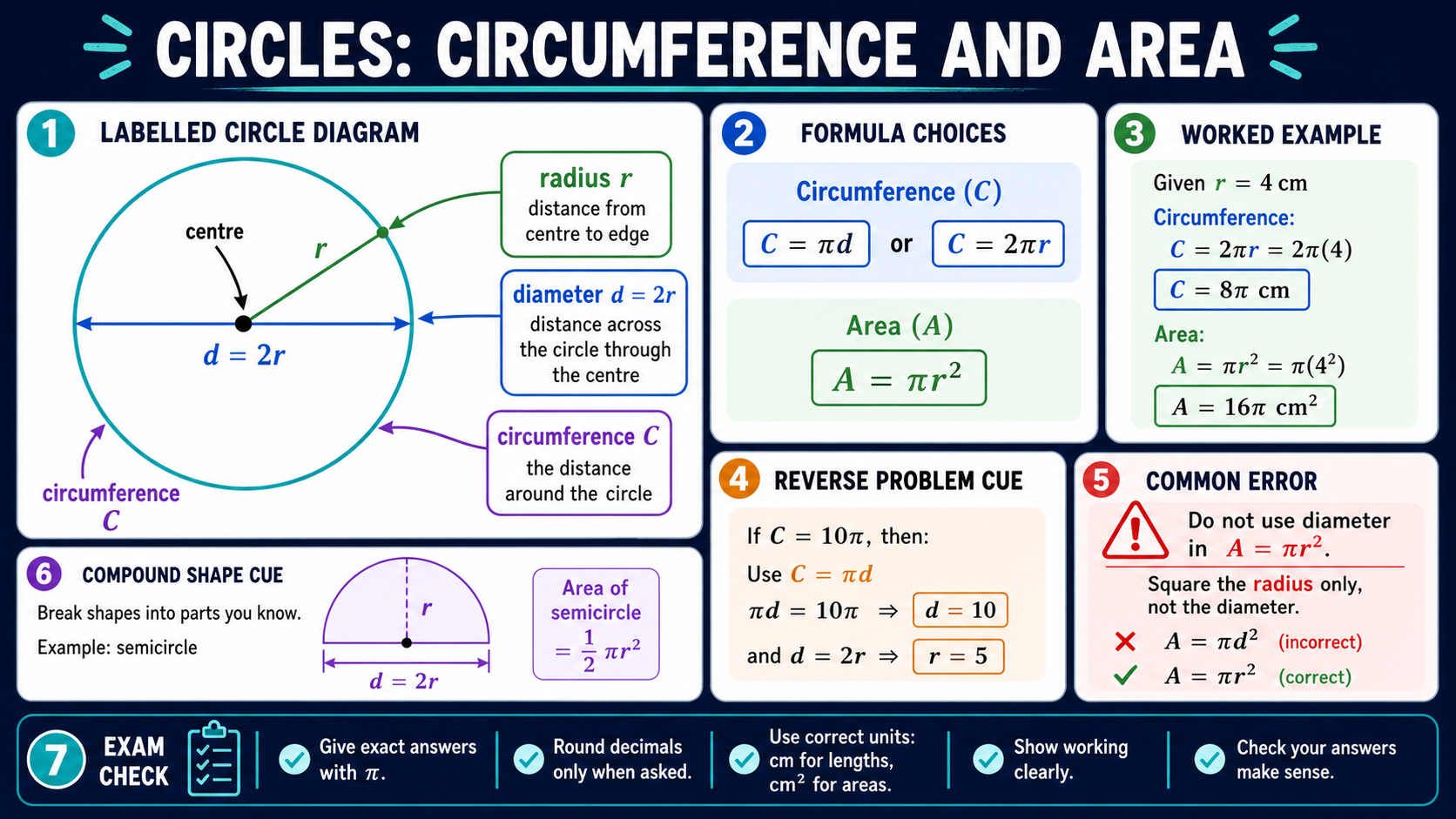
Circles circumference and area infographic
Before viewing
Before viewing, identify the radius, diameter, circumference and area labels.
After viewing
After viewing, decide whether a question needs C = pi d or A = pi r squared.
Why this matters
Circles appear in wheels, clocks, pipes, pizzas, roundabouts, gardens and sports markings. They also prepare you for sectors, arcs, cylinders and later trigonometry.
Prior knowledge
You should already be comfortable with:
Clear explanation
Circle vocabulary
The radius is the distance from the centre to the edge. The diameter goes all the way across the circle through the centre, so it is twice the radius. Circumference means the distance around the outside.
diameter = 2 × radiusCircumference formulae
Circumference is a length, so the answer uses length units such as cm or m.
Area formula
Area is the space inside the circle, so the answer uses square units such as cm² or m².
A = πr²The radius is squared, not the diameter. If the question gives the diameter, halve it before using the area formula.
For reverse questions, undo the formula carefully: divide by π first, then square-root if you are working backwards from an area.
In compound circle questions, decide which parts of the circle are actually included. A semicircle uses half the circumference for its curved edge and half the area for its space; a full diameter may still be part of the straight boundary.
When a question asks for a boundary made from straight edges and curved edges, calculate each part separately before adding. Keep circumference pieces as length units and area pieces as square units.
Worked examples
Example 1: Circumference from diameter
A circle has diameter 10 cm. Find its circumference in terms of π.
C = πd = π × 10 = 10π cmReveal answer
Answer: 10π cm.
Example 2: Area from radius
A circle has radius 6 m. Find its area in terms of π.
A = πr² = π × 6² = 36π m²Reveal answer
Answer: 36π m².
Example 3: Area from diameter
A circular table has diameter 1.2 m. Find its area to 2 decimal places.
radius = 1.2 ÷ 2 = 0.6 m A = π × 0.6² = 1.1309...Reveal answer
Answer: 1.13 m².
Quick checks
Choose an answer, then check your thinking.
1. A circle has radius 4 cm. Its diameter is:
2. A circle has diameter 7 m. Its circumference in terms of π is:
3. A circle has radius 5 cm. Its area in terms of π is:
Practice questions
Question 1
A circle has radius 9 cm. Find its diameter.
Reveal answer and marking guidance
Answer: 18 cm.
Marking: Double the radius: 2 × 9 = 18.
Question 2
A circle has diameter 12 cm. Find its circumference in terms of π.
Reveal answer and marking guidance
Answer: 12π cm.
Marking: Use C = πd with d = 12.
Question 3
A circle has radius 4 m. Find its area in terms of π.
Reveal answer and marking guidance
Answer: 16π m².
Marking: Use A = πr², so A = π × 4² = 16π.
Question 4
A circular plate has diameter 20 cm. Find its area in terms of π.
Reveal answer and marking guidance
Answer: 100π cm².
Marking: First halve the diameter to get radius 10 cm, then use π × 10².
Question 5
A wheel has diameter 0.7 m. How far does it travel in one complete turn? Give your answer to 2 decimal places.
Reveal answer and marking guidance
Answer: 2.20 m.
Marking: One turn is one circumference: C = π × 0.7 = 2.199..., which rounds to 2.20 m.
Question 6
A circular garden has area 49π m². Find its radius and diameter.
Reveal answer and marking guidance
Answer: radius 7 m; diameter 14 m.
Marking: Since πr² = 49π, r² = 49 and r = 7. Double the radius for the diameter.
Question 7
A semicircular window has diameter 8 cm. Find its area in terms of π.
Reveal answer and marking guidance
Answer: 8π cm².
Marking: The radius is 4 cm. Full circle area is π × 4² = 16π cm², so the semicircle area is half of this, 8π cm².
Question 8
A semicircular arch has diameter 10 m. Find the length of its curved edge in terms of π.
Reveal answer and marking guidance
Answer: 5π m.
Marking: The full circumference would be π × 10 = 10π m. The curved edge of a semicircle is half of this, so it is 5π m.
Question 9
A rectangle is 12 cm by 8 cm. A semicircle is attached along one 8 cm side. Find the outside perimeter of the whole shape in terms of π.
Reveal answer and marking guidance
Answer: 32 + 4π cm.
Marking: The three exposed rectangle sides total 12 + 12 + 8 = 32 cm. The semicircle has diameter 8 cm, so its curved edge is half of 8π, which is 4π cm.
Question 10
A running track is made from a rectangle 60 m long with a semicircle of diameter 28 m at each end. Find the total outside distance for one lap in terms of π.
Reveal answer and marking guidance
Answer: 120 + 28π m.
Marking: The two straight sides total 60 + 60 = 120 m. The two semicircles make one full circle of diameter 28 m, so the curved part is 28π m.
Answers and marking guidance
The exact practice answers are hidden under each question so you can try first. For circle questions, marks usually come from identifying radius or diameter, choosing the correct formula, splitting semicircle or compound boundaries into clear parts, substituting accurately, keeping π exact when requested, rounding only at the final step, and using length units for circumference or square units for area.
Common mistakes
- Using diameter as radius: area needs the radius, so halve the diameter first.
- Forgetting to square the radius: A = πr², not πr.
- Rounding too early: keep the calculator value until the final answer unless exact π form is requested.
- Mixing units: circumference is a length, while area uses square units.
Extension challenge
A circular logo has circumference 18π cm. Find its area in terms of π.
Reveal answer
Answer: 81π cm².
C = 2πr, so 18π = 2πr and r = 9. Area = π × 9² = 81π cm².
Exam-board guidance
Circle circumference and area are core GCSE Maths skills across all boards. The common exam habit is to label radius and diameter first, then decide whether the answer is a length, an area, an exact π expression or a rounded decimal.
AQA GCSE Maths
Focus on the shared method, notation and checking habit; wording and context can vary by route.
OCR GCSE Maths
Show clear method steps and use precise notation; question wording may vary by route.
Pearson Edexcel GCSE Maths
Keep working visible and check units or notation; contexts may vary by route.
Eduqas GCSE Maths
Use the same core skill in practical contexts, with clear reasoning and final checks.
WJEC Wales
Connect the method to the context and state what the result means.
CCEA GCSE Maths
Make each method step visible and keep notation, units and final checks clear.
Next lesson
Next, continue Geometry and Measures with 3D Shapes, Surface Area and Volume.