
Lesson overview
3D shape questions are about faces, cross-sections and units.
GCSE questions may ask for the volume inside a solid, the surface area on the outside, or a missing length. The safest approach is to sketch or label the shape, decide whether the question is asking for area or volume, then keep the units under control.
What you will learn
Key facts before you start
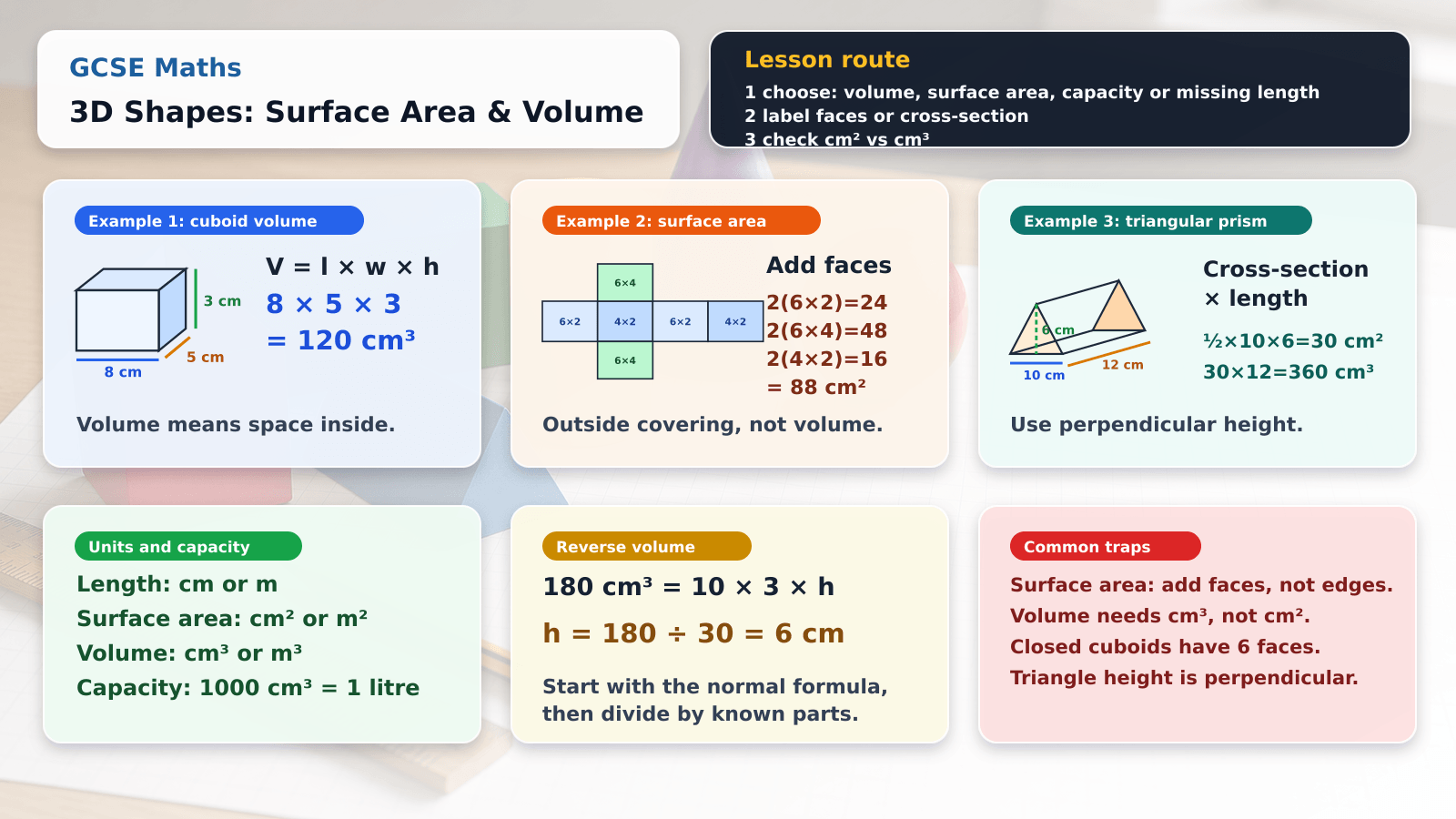
3D shapes surface area and volume infographic
Before viewing
Before viewing, identify which labels are lengths, which are areas and which are volumes.
After viewing
After viewing, choose one 3D shape and state whether the question needs surface area or volume.
Why this matters
Surface area and volume appear in packaging, containers, storage, paint, wrapping, concrete, density and capacity problems. A good face-by-face method stops 3D questions feeling like guesswork.
Prior knowledge
You should already be comfortable with:
Clear explanation
Volume means space inside
Volume measures how much 3D space a solid takes up or can hold. For a cuboid, multiply the three perpendicular lengths.
volume of cuboid = length × width × heightFor any prism, find the area of the constant cross-section, then multiply by the length of the prism.
V = cross-section area × lengthSurface area means outside faces
Surface area is the total area of every outside face. For a cuboid, there are three pairs of matching faces: front and back, top and bottom, left and right.
surface area of cuboid = 2lw + 2lh + 2whYou do not have to memorise that formula if a face list is clearer. Add every outside face once.
Capacity questions use the same volume idea but may change units. Remember that 1 litre = 1000 cm³, so convert before comparing containers, liquids or costs.
In reverse questions, write the normal formula first and then divide by the known parts. In compound-solid questions, split the solid into simple cuboids or prisms, find each volume or face area, and then combine only the parts the question asks for.
Worked examples
Example 1: Volume of a cuboid
A cuboid is 8 cm long, 5 cm wide and 3 cm high. Find its volume.
volume = 8 × 5 × 3 = 120Reveal answer
Answer: 120 cm³.
Example 2: Surface area of a cuboid
A cuboid has length 6 cm, width 4 cm and height 2 cm. Find its surface area.
Reveal answer
Answer: 88 cm².
Example 3: Volume of a triangular prism
A triangular prism has cross-section base 10 cm, triangle height 6 cm and prism length 12 cm. Find its volume.
area of triangle = ½ × 10 × 6 = 30 cm² volume = 30 × 12 = 360 cm³Reveal answer
Answer: 360 cm³.
Quick checks
Choose an answer, then check your thinking.
1. Volume should usually be written in:
2. A cuboid is 4 cm by 3 cm by 5 cm. Its volume is:
3. Surface area is found by:
Practice questions
Question 1
A cube has side length 5 cm. Find its volume.
Reveal answer and marking guidance
Answer: 125 cm³.
Marking: Use 5 × 5 × 5 = 125 and include cubic units.
Question 2
A cuboid is 9 cm long, 4 cm wide and 6 cm high. Find its volume.
Reveal answer and marking guidance
Answer: 216 cm³.
Marking: Multiply the three dimensions: 9 × 4 × 6 = 216.
Question 3
A cuboid has length 7 cm, width 3 cm and height 2 cm. Find its surface area.
Reveal answer and marking guidance
Answer: 82 cm².
Marking: Add pairs of faces: 2 × 7 × 3 + 2 × 7 × 2 + 2 × 3 × 2 = 42 + 28 + 12 = 82.
Question 4
A triangular prism has cross-section base 8 cm, triangle height 5 cm and length 11 cm. Find its volume.
Reveal answer and marking guidance
Answer: 220 cm³.
Marking: Triangle area = ½ × 8 × 5 = 20 cm², then 20 × 11 = 220 cm³.
Question 5
A closed cube has side length 4 m. Find its surface area.
Reveal answer and marking guidance
Answer: 96 m².
Marking: Each face has area 4 × 4 = 16 m². A cube has 6 faces, so 6 × 16 = 96.
Question 6
A cuboid has volume 180 cm³. Its length is 10 cm and its width is 3 cm. Find its height.
Reveal answer and marking guidance
Answer: 6 cm.
Marking: Since 10 × 3 × height = 180, divide 180 by 30 to get height = 6.
Question 7
A rectangular tank has internal dimensions 20 cm, 15 cm and 10 cm. Find its capacity in litres.
Reveal answer and marking guidance
Answer: 3 litres.
Marking: Volume = 20 × 15 × 10 = 3000 cm³. Since 1000 cm³ = 1 litre, 3000 cm³ = 3 litres.
Question 8
A storage box is a cuboid measuring 30 cm by 18 cm by 12 cm. It has no lid. Find the outside area that needs painting.
Reveal answer and marking guidance
Answer: 1692 cm².
Marking: Paint the base and four sides only: 30 × 18 = 540, 2 × 30 × 12 = 720 and 2 × 18 × 12 = 432, giving 540 + 720 + 432 = 1692 cm².
Question 9
A rectangular planter has internal dimensions 80 cm by 50 cm by 40 cm. It is filled to three quarters of its height. How many litres of compost are used?
Reveal answer and marking guidance
Answer: 120 litres.
Marking: Full volume is 80 × 50 × 40 = 160,000 cm³. Three quarters is 120,000 cm³, and 1000 cm³ = 1 litre, so this is 120 litres.
Question 10
A triangular prism has cross-section side lengths 5 cm, 5 cm and 6 cm. The perpendicular height of the triangle is 4 cm and the prism length is 10 cm. Find the total surface area.
Reveal answer and marking guidance
Answer: 184 cm².
Marking: The two triangular ends have total area 2 × ½ × 6 × 4 = 24 cm². The three rectangular faces have total area (5 + 5 + 6) × 10 = 160 cm², so the surface area is 24 + 160 = 184 cm².
Answers and marking guidance
The exact practice answers are hidden under each question so you can try first. For 3D shape questions, marks usually come from choosing whether the task is surface area, volume or capacity, listing the right outside faces or cross-section, substituting dimensions accurately, using inverse operations for missing lengths, and writing square units for surface area or cubic units for volume.
Common mistakes
- Using area units for volume: volume needs cubic units such as cm³ or m³.
- Missing hidden matching faces: a closed cuboid has six faces, not just the three you can see.
- Multiplying all numbers for surface area: surface area is found by adding face areas.
- Using the wrong triangle height: in a triangular prism, the triangle height must be perpendicular to the base.
Extension challenge
A cuboid has dimensions 12 cm, 5 cm and h cm. Its volume is 420 cm³. Find h and then find the surface area.
Reveal answer
Answer: h = 7 cm and surface area = 358 cm².
12 × 5 × h = 420, so h = 7. Surface area = 2 × 12 × 5 + 2 × 12 × 7 + 2 × 5 × 7 = 120 + 168 + 70 = 358 cm².
Exam-board guidance
Surface area and volume are core GCSE Maths skills across all boards. The common exam habit is to decide whether the question asks for outside area or inside space before starting any calculations.
AQA GCSE Maths
Focus on the shared method, notation and checking habit; wording and context can vary by route.
OCR GCSE Maths
Show clear method steps and use precise notation; question wording may vary by route.
Pearson Edexcel GCSE Maths
Keep working visible and check units or notation; contexts may vary by route.
Eduqas GCSE Maths
Use the same core skill in practical contexts, with clear reasoning and final checks.
WJEC Wales
Connect the method to the context and state what the result means.
CCEA GCSE Maths
Make each method step visible and keep notation, units and final checks clear.
Next lesson
Next, continue Geometry and Measures with Units, Metric Conversions and Measures.