
Lesson overview
Unit conversions are a place-value skill, not a guessing skill.
GCSE Maths questions often hide a unit conversion inside area, volume, scale, speed, density, pressure or real-life measure work. The safest habit is to write the conversion fact, decide whether you are converting length, area or volume, then keep the unit attached to the number.
What you will learn
Key facts before you start
Why this matters
Unit errors can make a correct method look wrong. In exams, conversions appear in questions about maps, packaging, recipes, construction, travel, liquids and compound measures, so confident unit work protects marks across several topics.
Prior knowledge
You should already be comfortable with:
Units, metric conversions and measures infographic
Before viewing
Before viewing, identify whether the conversion is length, area or volume.
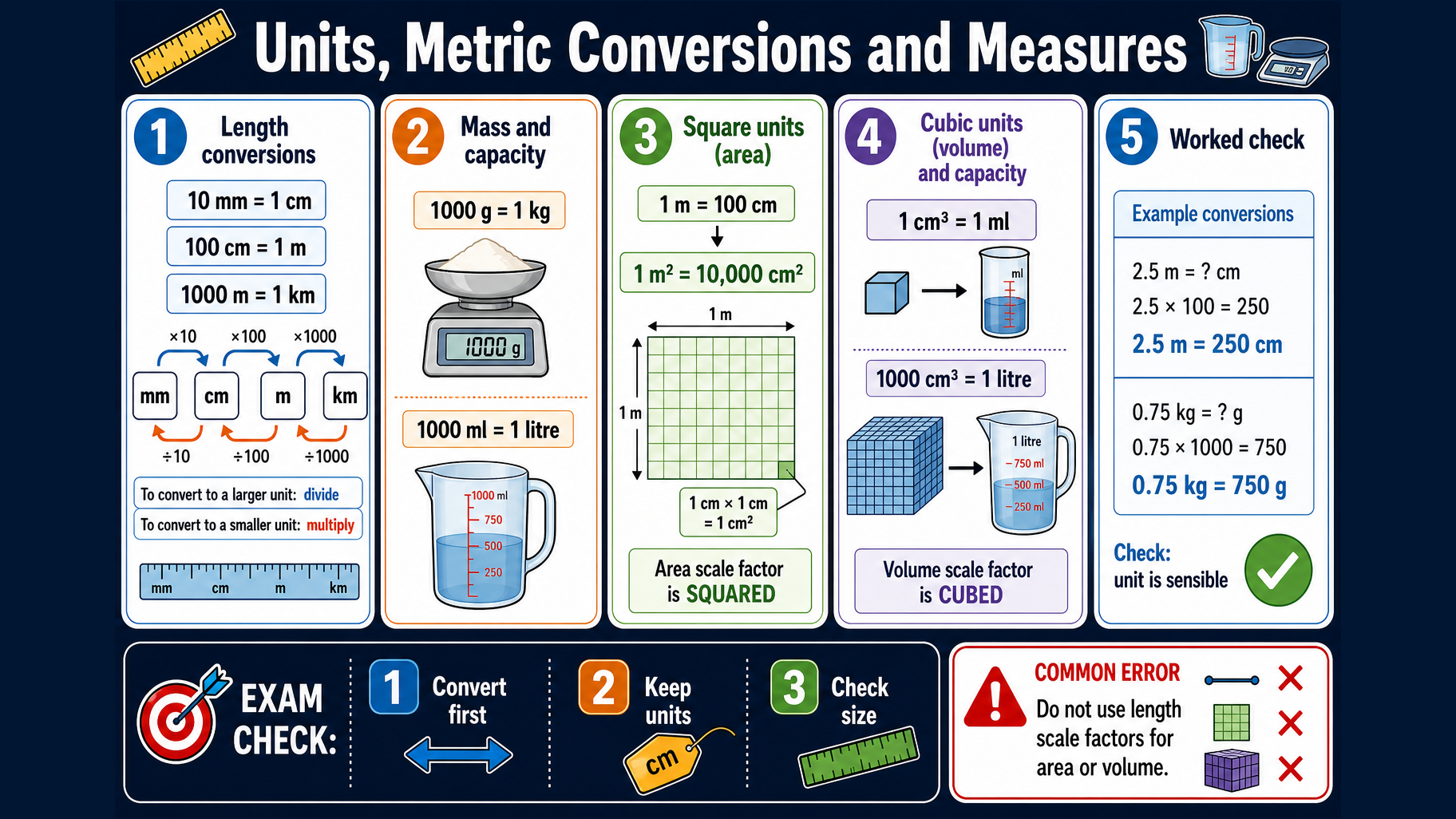
After viewing
After viewing, convert one measure and explain whether the number should get larger or smaller.
Clear explanation
Common metric facts
These are the conversion facts that appear most often. Write the one you need before doing the calculation.
Length conversions
When the unit gets smaller, the number gets bigger because you need more smaller units to make the same measurement. When the unit gets bigger, the number gets smaller.
3.6 m = 3.6 × 100 = 360 cm 4500 m = 4500 ÷ 1000 = 4.5 kmArea and volume conversions
Area is two-dimensional, so both length directions change. Since 1 m = 100 cm, one square metre is 100 cm by 100 cm.
1 m² = 10 000 cm²Volume is three-dimensional, so three directions change.
1 m³ = 1 000 000 cm³This is why you must not use the same multiplier for cm, cm² and cm³.
Capacity and volume links
Capacity questions may connect litres, millilitres and cubic centimetres. A useful GCSE fact is that 1 cm³ holds 1 ml, so 1000 cm³ holds 1000 ml, which is 1 litre.
1 cm³ = 1 ml 1000 cm³ = 1 litreConversions inside longer questions
Many exam questions do not say "convert" in the first sentence. If a length is in metres but an area must be in cm², or a volume is in cm³ but the answer asks for litres, convert before comparing, substituting or rounding.
Worked examples
Example 1: Convert metres to centimetres
Convert 2.75 m into centimetres.
1 m = 100 cm 2.75 m = 2.75 × 100 = 275 cmReveal answer
Answer: 275 cm.
Example 2: Convert grams to kilograms
Convert 640 g into kilograms.
1000 g = 1 kg 640 g = 640 ÷ 1000 = 0.64 kgReveal answer
Answer: 0.64 kg.
Example 3: Convert square metres to square centimetres
Convert 0.35 m² into cm².
1 m² = 10 000 cm² 0.35 m² = 0.35 × 10 000 = 3500 cm²Reveal answer
Answer: 3500 cm².
Quick checks
Choose an answer, then check your thinking.
1. 5.4 m is:
2. 2300 g is:
3. 1 m² is:
Practice questions
Question 1
Convert 4.8 km into metres.
Reveal answer and marking guidance
Answer: 4800 m.
Marking: Use 1 km = 1000 m, then 4.8 × 1000 = 4800.
Question 2
Convert 76 mm into centimetres.
Reveal answer and marking guidance
Answer: 7.6 cm.
Marking: Use 10 mm = 1 cm, then 76 ÷ 10 = 7.6.
Question 3
Convert 0.45 kg into grams.
Reveal answer and marking guidance
Answer: 450 g.
Marking: Use 1 kg = 1000 g, then 0.45 × 1000 = 450.
Question 4
Convert 2.5 litres into millilitres.
Reveal answer and marking guidance
Answer: 2500 ml.
Marking: Use 1 litre = 1000 ml, then 2.5 × 1000 = 2500.
Question 5
Convert 3.2 m² into cm².
Reveal answer and marking guidance
Answer: 32 000 cm².
Marking: Use 1 m² = 10 000 cm², then 3.2 × 10 000 = 32 000.
Question 6
A container holds 18 500 cm³ of water. How many litres is this?
Reveal answer and marking guidance
Answer: 18.5 litres.
Marking: Use 1000 cm³ = 1 litre, then 18 500 ÷ 1000 = 18.5.
Question 7
Convert 0.008 m³ into cm³.
Reveal answer and marking guidance
Answer: 8000 cm³.
Marking: Use 1 m³ = 1 000 000 cm³, then 0.008 × 1 000 000 = 8000.
Question 8
A runner travels 750 m in 3 minutes. Write this speed in metres per second.
Reveal answer and marking guidance
Answer: 4.17 m/s to 3 significant figures, or exactly 4.1666... m/s.
Marking: Convert 3 minutes to 180 seconds, then use speed = distance ÷ time = 750 ÷ 180 = 4.1666... m/s.
Question 9
A cuboid tank measures 80 cm by 45 cm by 30 cm. Find its capacity in litres.
Reveal answer and marking guidance
Answer: 108 litres.
Marking: Volume = 80 × 45 × 30 = 108 000 cm³. Use 1000 cm³ = 1 litre, so 108 000 ÷ 1000 = 108 litres.
Question 10
A metal block has volume 250 cm³ and mass 1.95 kg. Find its density in g/cm³.
Reveal answer and marking guidance
Answer: 7.8 g/cm³.
Marking: Convert 1.95 kg to 1950 g first. Then density = mass ÷ volume = 1950 ÷ 250 = 7.8 g/cm³.
Answers and marking guidance
The exact practice answers are hidden under each question so you can try first. For unit-conversion questions, marks usually come from writing the correct conversion fact, choosing multiplication or division sensibly, keeping place value accurate, and using the final unit. For area, volume, capacity and rate questions, show the squared, cubed or time conversion before substituting into the main calculation.
Common mistakes
- Multiplying when you should divide: think about whether the new unit is smaller or larger.
- Using 100 for every conversion: metres to centimetres use 100, but kilometres to metres use 1000.
- Forgetting squared units: 1 m² is 10 000 cm², not 100 cm².
- Dropping the unit: 450 could mean grams, kilograms, millilitres or metres unless you write the unit.
Extension challenge
A rectangular garden is 8 m by 3.5 m. A plan of the garden is drawn in centimetres. Convert the garden area into cm².
Reveal answer
Answer: 280 000 cm².
The area is 8 × 3.5 = 28 m². Since 1 m² = 10 000 cm², 28 m² = 280 000 cm².
Exam-board guidance
Metric units and measures are core GCSE Maths skills across all boards. The wording may appear in pure conversion questions or inside geometry, ratio, proportion and real-life contexts.
AQA GCSE Maths
Focus on the shared method, notation and checking habit; wording and context can vary by route.
OCR GCSE Maths
Show clear method steps and use precise notation; question wording may vary by route.
Pearson Edexcel GCSE Maths
Keep working visible and check units or notation; contexts may vary by route.
Eduqas GCSE Maths
Use the same core skill in practical contexts, with clear reasoning and final checks.
WJEC Wales
Connect the method to the context and state what the result means.
CCEA GCSE Maths
Make each method step visible and keep notation, units and final checks clear.
Next lesson
Next, continue Geometry and Measures with Time, Money and Real-Life Measures.