
Lesson overview
Real-life measure questions reward organised working.
GCSE Maths often asks you to use time, money or everyday measures inside a worded problem. The key skill is to convert units first, calculate carefully, then write a final answer that makes sense in the situation.
What you will learn
Key facts before you start
Why this matters
Time and money questions appear in travel, timetables, pay, shopping, bills, budgets and rates. They are not usually difficult because of one hard calculation; they are difficult because the units change and the question expects a decision.
Prior knowledge
You should already be comfortable with:
Time, money and real-life measures infographic
Before viewing
Before viewing, identify the units and any conversion needed before calculation.
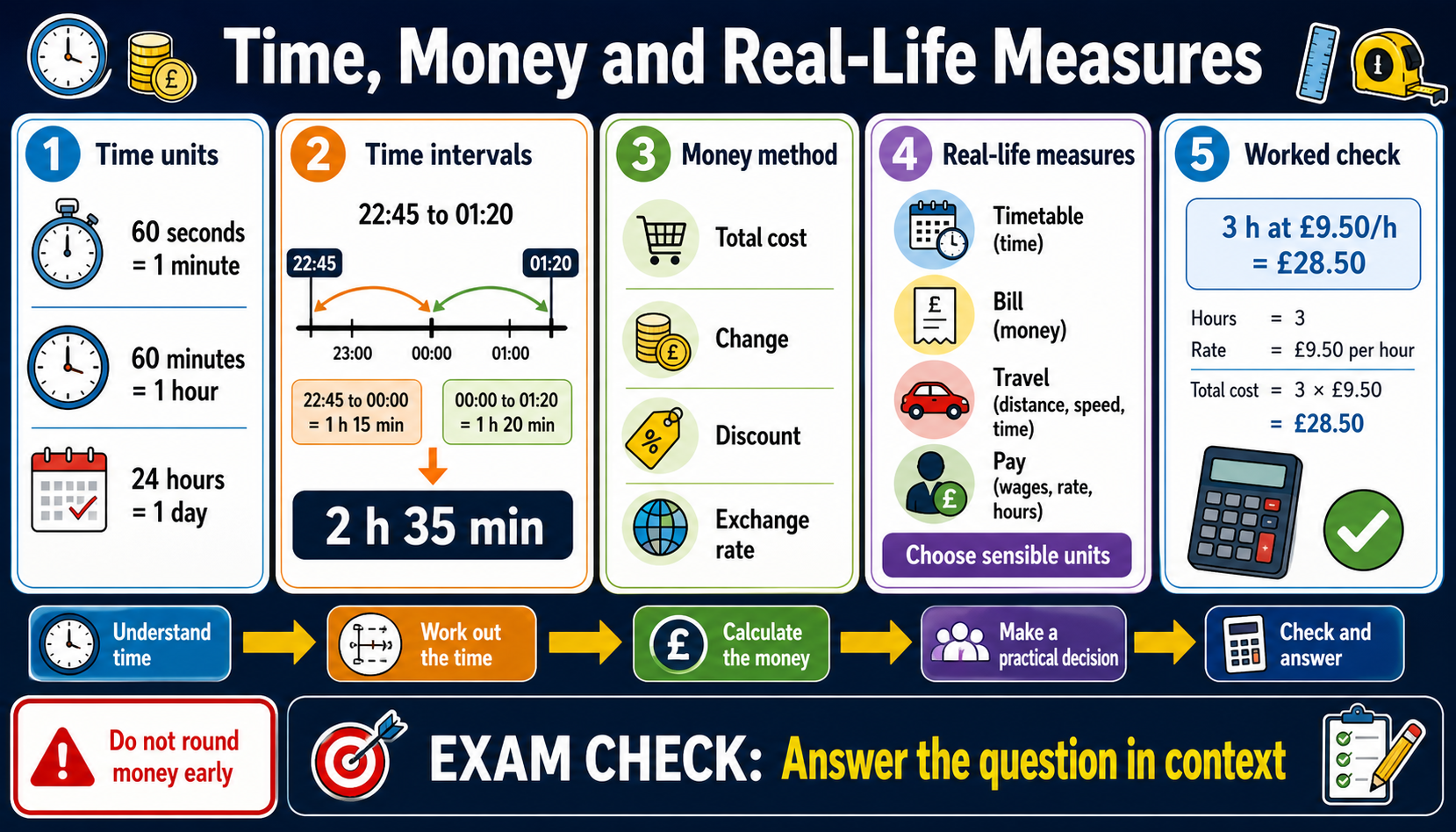
After viewing
After viewing, solve one real-life measure problem and state the unit in the answer.
Clear explanation
Time conversions
Time does not use place value like metric units. One hour is 60 minutes, not 100 minutes, so convert before calculating.
Clock times and intervals
For intervals, count to a helpful boundary such as the next hour, noon or midnight. Then add the parts.
22:40 to midnight = 1 hour 20 minutes midnight to 01:15 = 1 hour 15 minutes total = 2 hours 35 minutesMoney and real-life answers
Money answers normally need two decimal places because pounds and pence use hundredths. If a question involves wages, exchange rates, bills or tickets, write what the answer means.
£12.60 ÷ 3 = £4.20 each 8 hours at £9.50 per hour = 8 × £9.50 = £76.00Rates with awkward times
If a wage, parking charge or hire cost is per hour, convert mixed time into hours before multiplying. For example, 3 hours 45 minutes is 3.75 hours because 45 minutes is three quarters of an hour.
3 hours 45 minutes = 3.75 hoursIf the question asks whether something is possible, affordable or on time, the final mark may need a sentence. Compare your calculated value with the limit in the question, then answer the real-life question directly.
Worked examples
Example 1: Convert hours to minutes
A film lasts 1.75 hours. How many minutes is this?
1 hour = 60 minutes 1.75 × 60 = 105Reveal answer
Answer: 105 minutes.
Example 2: Find a time interval
A train leaves at 09:48 and arrives at 12:17. How long is the journey?
09:48 to 10:00 = 12 minutes 10:00 to 12:00 = 2 hours 12:00 to 12:17 = 17 minutesReveal answer
Answer: 2 hours 29 minutes.
Example 3: Use an exchange rate
An exchange rate is £1 = €1.18. How many euros do you get for £85?
85 × 1.18 = 100.30Reveal answer
Answer: €100.30.
Quick checks
Choose an answer, then check your thinking.
1. 3.5 hours is:
2. 14:25 is the same as:
3. Four tickets cost £7.50 each. The total cost is:
Practice questions
Question 1
Convert 2 hours 35 minutes into minutes.
Reveal answer and marking guidance
Answer: 155 minutes.
Marking: Convert 2 hours to 120 minutes, then add 35 minutes.
Question 2
Write 18:45 using the 12-hour clock.
Reveal answer and marking guidance
Answer: 6:45 pm.
Marking: Subtract 12 from the hour because 18:45 is after midday.
Question 3
A bus leaves at 07:56 and arrives at 09:21. How long is the journey?
Reveal answer and marking guidance
Answer: 1 hour 25 minutes.
Marking: Count 4 minutes to 08:00, 1 hour to 09:00, then 21 minutes to 09:21.
Question 4
Three notebooks cost £2.80 each. How much change is there from £10?
Reveal answer and marking guidance
Answer: £1.60.
Marking: Find 3 × £2.80 = £8.40, then £10.00 − £8.40 = £1.60.
Question 5
A worker earns £11.25 per hour for 6 hours. How much do they earn?
Reveal answer and marking guidance
Answer: £67.50.
Marking: Multiply the hourly rate by the number of hours: 11.25 × 6 = 67.50.
Question 6
A worker earns £9.80 per hour. They work for 3 hours 45 minutes. How much do they earn?
Reveal answer and marking guidance
Answer: £36.75.
Marking: Convert 3 hours 45 minutes to 3.75 hours, then 3.75 × £9.80 = £36.75.
Question 7
A bill is split equally between 5 people. The bill is £68.00 and a 10% service charge is added first. How much does each person pay?
Reveal answer and marking guidance
Answer: £14.96 each.
Marking: Add 10% to get £68.00 × 1.10 = £74.80, then divide by 5 to get £14.96 each.
Question 8
A cinema starts adverts at 19:35. The adverts last 18 minutes and the film lasts 2 hours 7 minutes. What time does the film finish?
Reveal answer and marking guidance
Answer: 22:00, or 10:00 pm.
Marking: 19:35 + 18 minutes = 19:53. Then add 2 hours 7 minutes to reach 22:00.
Question 9
A family parks from 10:42 to 14:18. Parking costs £2.40 per hour, charged to the nearest whole hour rounded up. They have £10 for parking. Do they have enough money?
Reveal answer and marking guidance
Answer: Yes. The parking costs £9.60, so they have enough money.
Marking: The time is 3 hours 36 minutes, which rounds up to 4 charged hours. Calculate 4 × £2.40 = £9.60, then compare with £10 and answer the decision.
Question 10
A jacket costs €72. The exchange rate is £1 = €1.20. A 15% discount is applied before paying. What is the discounted price in pounds?
Reveal answer and marking guidance
Answer: £51.00.
Marking: Apply the discount first: €72 × 0.85 = €61.20. Then convert to pounds using €1.20 = £1, so €61.20 ÷ 1.20 = £51.00.
Answers and marking guidance
The exact practice answers are hidden under each question so you can try first. For time, money and real-life measure questions, marks usually come from converting units before calculating, showing interval steps clearly, using correct currency notation, rounding to a sensible accuracy, and writing a final answer that matches the context or decision being asked.
Common mistakes
- Treating time like metric units: 1.5 hours is 90 minutes, not 150 minutes.
- Forgetting midnight or midday: split intervals at 00:00 or 12:00 if that makes the counting clearer.
- Dropping pence: write £4.20 rather than £4.2 in final money answers.
- Rounding too early: keep calculator values until the final step unless the question tells you otherwise.
Extension challenge
A taxi charges £3.20 plus £1.85 per kilometre. A journey is 7.6 km and starts at 23:50, finishing at 00:08. Find the fare and the journey time.
Reveal answer
Answer: £17.26 and 18 minutes.
The distance cost is 7.6 × £1.85 = £14.06. Add £3.20 to get £17.26. The time from 23:50 to midnight is 10 minutes, then midnight to 00:08 is 8 minutes.
Exam-board guidance
Time, money and real-life measures are core GCSE Maths skills across all boards. They often appear as worded problems where the final mark depends on interpreting the calculation in context.
AQA GCSE Maths
Focus on the shared method, notation and checking habit; wording and context can vary by route.
OCR GCSE Maths
Show clear method steps and use precise notation; question wording may vary by route.
Pearson Edexcel GCSE Maths
Keep working visible and check units or notation; contexts may vary by route.
Eduqas GCSE Maths
Use the same core skill in practical contexts, with clear reasoning and final checks.
WJEC Wales
Connect the method to the context and state what the result means.
CCEA GCSE Maths
Make each method step visible and keep notation, units and final checks clear.
Next lesson
Next, continue Geometry and Measures with Pythagoras' Theorem.