
Lesson overview
Pythagoras is for right-angled triangles only.
GCSE Maths uses Pythagoras' theorem to connect the three side lengths of a right-angled triangle. Once you have found the right angle and the hypotenuse, the method is reliable and repeatable.
What you will learn
Key facts before you start
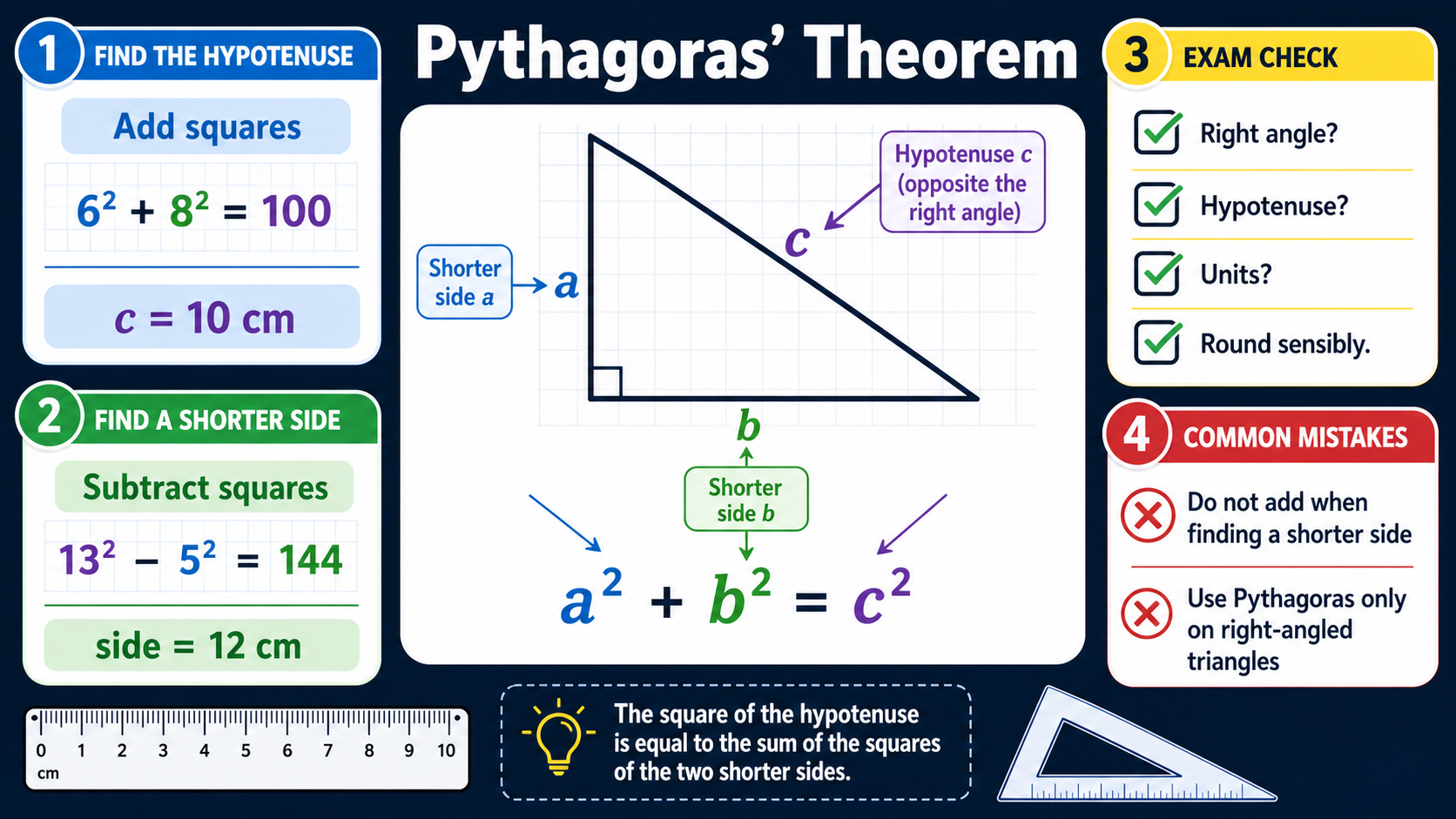
Pythagoras' theorem infographic
Before viewing
Before viewing, identify the right angle and the hypotenuse.
After viewing
After viewing, choose whether to add squares or subtract squares for a missing side.
Why this matters
Pythagoras appears in ladders, diagonals, maps, coordinate distances, 3D shapes and later trigonometry. It is one of the main bridges between number skills and geometry problem solving.
Prior knowledge
You should already be comfortable with:
Clear explanation
The side names
The hypotenuse is the longest side of a right-angled triangle. It is always opposite the right angle. The other two sides are the shorter sides.
The formula
If a and b are the shorter sides and c is the hypotenuse, then:
a² + b² = c²To find the hypotenuse, add the squares of the shorter sides, then take the square root.
c = √(a² + b²)To find a shorter side, subtract the known shorter-side square from the hypotenuse square, then take the square root.
a = √(c² − b²)Coordinates and exact answers
Coordinate questions create a right-angled triangle from the horizontal and vertical changes. extension questions may also ask for an exact answer such as √74 before any decimal rounding.
distance = √(horizontal change² + vertical change²)Worked examples
Example 1: Find the hypotenuse
A right-angled triangle has shorter sides 6 cm and 8 cm. Find the hypotenuse.
c² = 6² + 8² c² = 36 + 64 = 100 c = √100 = 10Reveal answer
Answer: 10 cm.
Example 2: Find a shorter side
A right-angled triangle has hypotenuse 13 m and one shorter side 5 m. Find the other shorter side.
a² + 5² = 13² a² + 25 = 169 a² = 144 a = 12Reveal answer
Answer: 12 m.
Example 3: Give a rounded answer
A rectangle is 9 cm by 12 cm. Find the diagonal length to 1 decimal place.
d² = 9² + 12² = 81 + 144 = 225 d = √225 = 15Reveal answer
Answer: 15.0 cm to 1 decimal place.
Quick checks
Choose an answer, then check your thinking.
1. The hypotenuse is:
2. A right-angled triangle has shorter sides 3 cm and 4 cm. The hypotenuse is:
3. To find a shorter side when the hypotenuse is known, you usually:
Practice questions
Question 1
A right-angled triangle has shorter sides 5 cm and 12 cm. Find the hypotenuse.
Reveal answer and marking guidance
Answer: 13 cm.
Marking: Use c² = 5² + 12² = 25 + 144 = 169, then c = √169 = 13.
Question 2
A right-angled triangle has hypotenuse 17 m and one shorter side 8 m. Find the other shorter side.
Reveal answer and marking guidance
Answer: 15 m.
Marking: Subtract squares: 17² − 8² = 289 − 64 = 225, so the side is √225 = 15.
Question 3
A rectangle measures 7 cm by 24 cm. Find the diagonal length.
Reveal answer and marking guidance
Answer: 25 cm.
Marking: The diagonal is the hypotenuse: d² = 7² + 24² = 49 + 576 = 625, so d = 25.
Question 4
A ladder is 6.5 m long and reaches a point 6 m up a wall. How far is the foot of the ladder from the wall?
Reveal answer and marking guidance
Answer: 2.5 m.
Marking: The ladder is the hypotenuse: distance² = 6.5² − 6² = 42.25 − 36 = 6.25, so distance = 2.5.
Question 5
Points A(2, 3) and B(10, 9) are joined by a straight line. Find AB.
Reveal answer and marking guidance
Answer: 10 units.
Marking: The horizontal change is 8 and the vertical change is 6, so AB² = 8² + 6² = 100 and AB = 10.
Question 6
A right-angled triangle has shorter sides 5 cm and 7 cm. Give the hypotenuse exactly, then to 1 decimal place.
Reveal answer and marking guidance
Answer: √74 cm, which is 8.6 cm to 1 decimal place.
Marking: c² = 5² + 7² = 25 + 49 = 74, so c = √74 = 8.602... cm.
Question 7
Points A(−2, 3) and B(6, 7) are joined by a straight line. Find AB exactly, then to 1 decimal place.
Reveal answer and marking guidance
Answer: √80 units = 4√5 units, which is 8.9 units to 1 decimal place.
Marking: The horizontal change is 8 and the vertical change is 4, so AB² = 8² + 4² = 80 and AB = √80 = 4√5.
Question 8
An isosceles triangle has equal sides of 13 cm and a base of 10 cm. Find its perpendicular height.
Reveal answer and marking guidance
Answer: 12 cm.
Marking: Split the base into two 5 cm halves. The height is a shorter side, so height² = 13² − 5² = 169 − 25 = 144 and height = 12.
Question 9
A rectangular screen is 32 cm wide and 18 cm high. Find the diagonal of the screen to 1 decimal place.
Reveal answer and marking guidance
Answer: 36.7 cm.
Marking: The diagonal is the hypotenuse: d² = 32² + 18² = 1024 + 324 = 1348, so d = √1348 = 36.715... cm.
Question 10
A square has a diagonal of 20 cm. Find the side length exactly, then to 1 decimal place.
Reveal answer and marking guidance
Answer: 10√2 cm, which is 14.1 cm to 1 decimal place.
Marking: If each side is s, then s² + s² = 20², so 2s² = 400 and s² = 200. Therefore s = √200 = 10√2 = 14.142... cm.
Answers and marking guidance
The exact practice answers are hidden under each question so you can try first. For Pythagoras questions, marks usually come from identifying the hypotenuse, writing the correct squared equation, adding or subtracting the squared lengths in the right order, taking the square root, and giving the answer with suitable units and rounding.
Common mistakes
- Using Pythagoras on a non-right-angled triangle: the theorem only works when there is a right angle.
- Adding when finding a shorter side: subtract from the hypotenuse square instead.
- Forgetting the square root: c² = 100 means c = 10, not 100.
- Rounding too early: keep the square-root value until the final answer unless exact form is requested.
Extension challenge
A cuboid is 8 cm long, 6 cm wide and 12 cm high. Find the length of the space diagonal from one corner to the opposite corner to 1 decimal place.
Reveal answer
Answer: 15.6 cm.
First find the base diagonal: 8² + 6² = 100, so the base diagonal is 10 cm. Then use 10 cm and 12 cm: space diagonal² = 10² + 12² = 244, so the space diagonal is √244 = 15.620... cm.
Exam-board guidance
Pythagoras' theorem is a core GCSE Maths geometry skill across all boards. It may be tested directly or hidden inside diagrams, coordinates, 3D shapes and worded measure problems.
AQA GCSE Maths
Focus on the shared method, notation and checking habit; wording and context can vary by route.
OCR GCSE Maths
Show clear method steps and use precise notation; question wording may vary by route.
Pearson Edexcel GCSE Maths
Keep working visible and check units or notation; contexts may vary by route.
Eduqas GCSE Maths
Use the same core skill in practical contexts, with clear reasoning and final checks.
WJEC Wales
Connect the method to the context and state what the result means.
CCEA GCSE Maths
Make each method step visible and keep notation, units and final checks clear.
Next lesson
Next, continue right-angled triangle geometry with Trigonometry in Right-Angled Triangles.