
Lesson overview
Right-angled trigonometry starts with the chosen angle.
GCSE Maths uses sine, cosine and tangent to find missing sides and angles in right-angled triangles. The side names change depending on the angle you are using, so careful labelling is the first mark-winning habit.
Visual summary
Before viewing
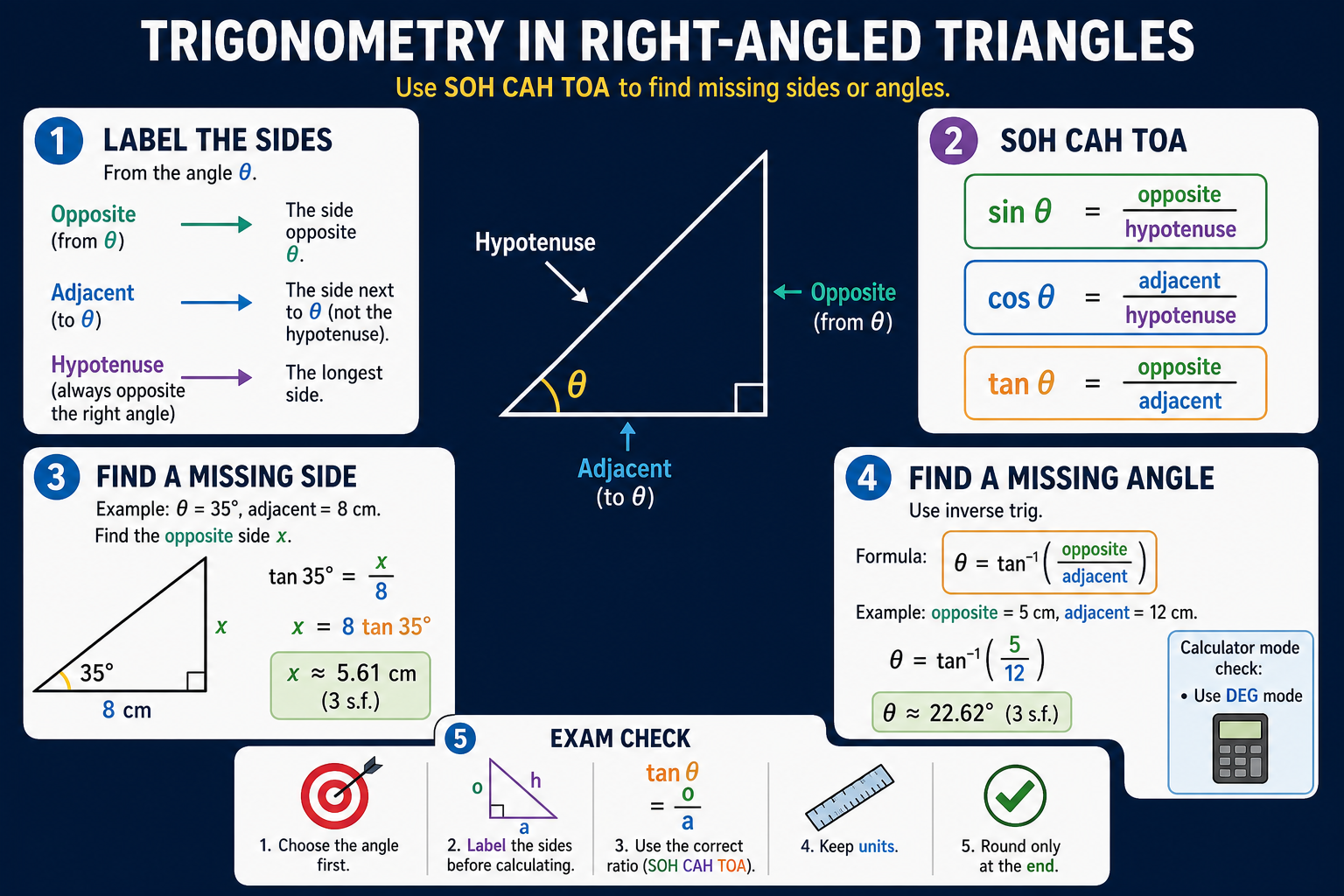
Before viewing, label O, A and H on the triangle before choosing a ratio.
After viewing
After viewing, choose the correct trig ratio for one missing side or angle.
What you will learn
Key facts before you start
Why this matters
Trigonometry lets you solve triangles when Pythagoras is not enough. It is used in ramps, ladders, surveying, navigation, bearings, 3D shapes and many calculator-paper geometry questions.
Prior knowledge
You should already be comfortable with:
Clear explanation
Label from the angle you are using
The hypotenuse is still the longest side, opposite the right angle. The opposite side is across from your chosen angle. The adjacent side is next to your chosen angle but is not the hypotenuse.
SOH CAH TOA
The three right-angled trigonometry ratios are:
Choose the ratio that uses the two sides in your question. If the question asks for an angle, use the inverse function on your calculator: sin⁻¹, cos⁻¹ or tan⁻¹.
For missing sides, decide whether the unknown is being divided by the known side or multiplied by it. Writing the equation before touching the calculator helps avoid the common mistake of dividing when you should multiply.
Worked examples
Example 1: Find an opposite side
A right-angled triangle has angle 40° and hypotenuse 10 cm. Find the side opposite the angle.
sin 40° = opposite ÷ 10 opposite = 10 × sin 40° opposite = 6.427...Reveal answer
Answer: 6.4 cm to 1 decimal place.
Example 2: Find a hypotenuse
A right-angled triangle has angle 25° and adjacent side 8 m. Find the hypotenuse.
cos 25° = 8 ÷ hypotenuse hypotenuse = 8 ÷ cos 25° hypotenuse = 8.827...Reveal answer
Answer: 8.8 m to 1 decimal place.
Example 3: Find an angle
A right-angled triangle has opposite side 6 cm and adjacent side 8 cm. Find the angle between the adjacent side and the hypotenuse.
tan θ = 6 ÷ 8 θ = tan⁻¹(6 ÷ 8) θ = 36.869...Reveal answer
Answer: 36.9° to 1 decimal place.
Quick checks
Choose an answer, then check your thinking.
1. Which ratio connects opposite and hypotenuse?
2. From a chosen angle, the adjacent side is:
3. To find an angle using opposite and adjacent, use:
Practice questions
Question 1
A right-angled triangle has opposite side 7 cm and adjacent side 24 cm from angle θ. Find θ to 1 decimal place.
Reveal answer and marking guidance
Answer: 16.3°.
Marking: Use tan θ = 7 ÷ 24, then θ = tan⁻¹(7 ÷ 24) = 16.260...°, which rounds to 16.3°.
Question 2
A right-angled triangle has hypotenuse 12 cm and angle 35°. Find the side opposite the angle to 1 decimal place.
Reveal answer and marking guidance
Answer: 6.9 cm.
Marking: Use sin 35° = opposite ÷ 12, so opposite = 12 × sin 35° = 6.882... cm.
Question 3
A right-angled triangle has adjacent side 9 m and angle 28°. Find the hypotenuse to 1 decimal place.
Reveal answer and marking guidance
Answer: 10.2 m.
Marking: Use cos 28° = 9 ÷ hypotenuse, so hypotenuse = 9 ÷ cos 28° = 10.192... m.
Question 4
A right-angled triangle has opposite side 5 cm and hypotenuse 13 cm from angle θ. Find θ to 1 decimal place.
Reveal answer and marking guidance
Answer: 22.6°.
Marking: Use sin θ = 5 ÷ 13, then θ = sin⁻¹(5 ÷ 13) = 22.619...°.
Question 5
A 5 m ladder makes an angle of 70° with the ground. How high up the wall does it reach? Give your answer to 1 decimal place.
Reveal answer and marking guidance
Answer: 4.7 m.
Marking: The height is opposite the 70° angle and the ladder is the hypotenuse, so height = 5 × sin 70° = 4.698... m.
Question 6
A boat is seen from a cliff 30 m above sea level. The angle of depression is 12°. Find the horizontal distance from the cliff to the boat to 3 significant figures.
Reveal answer and marking guidance
Answer: 141 m.
Marking: Use the equal angle of elevation at the boat. tan 12° = 30 ÷ distance, so distance = 30 ÷ tan 12° = 141.171... m.
Question 7
A ship travels 12 km on a bearing of 035°. How far east of its starting point is it, to 1 decimal place?
Reveal answer and marking guidance
Answer: 6.9 km east.
Marking: The eastward distance is opposite the 35° angle from north, so east = 12 × sin 35° = 6.882... km.
Question 8
A right-angled triangle has hypotenuse 18 cm and an angle of 30°. Find the side opposite the 30° angle exactly.
Reveal answer and marking guidance
Answer: 9 cm.
Marking: sin 30° = opposite ÷ 18 and sin 30° = 1/2, so opposite = 18 × 1/2 = 9 cm.
Question 9
A kite string is 25 m long and makes an angle of 52° with the ground. Find the horizontal distance from the person to the point below the kite, to 1 decimal place.
Reveal answer and marking guidance
Answer: 15.4 m.
Marking: The horizontal distance is adjacent to the 52° angle and the string is the hypotenuse, so distance = 25 × cos 52° = 15.391... m.
Question 10
A ladder is 6.5 m long and reaches 5.8 m up a wall. Find the angle the ladder makes with the ground, to 1 decimal place.
Reveal answer and marking guidance
Answer: 63.2°.
Marking: The height is opposite the ground angle and the ladder is the hypotenuse, so sin θ = 5.8 ÷ 6.5 and θ = sin⁻¹(5.8 ÷ 6.5) = 63.192...°.
Answers and marking guidance
The exact practice answers are hidden under each question so you can try first. For trigonometry questions, marks usually come from labelling the sides from the correct angle, choosing the matching ratio, writing a valid equation, using inverse trig only when finding an angle, keeping the calculator in degree mode, and rounding with units at the final step.
Common mistakes
- Labelling from the wrong angle: opposite and adjacent change when the chosen angle changes.
- Mixing up sine, cosine and tangent: write SOH CAH TOA before substituting values.
- Using inverse trig for a side: inverse functions are for finding angles, not lengths.
- Calculator in radians: GCSE angle answers should normally use degree mode unless stated otherwise.
- Rounding too early: keep full calculator values until the final answer.
Extension challenge
A ramp rises 1.2 m over a horizontal distance of 4.8 m. Find the angle the ramp makes with the ground, then find the ramp length to 2 decimal places.
Reveal answer
Answer: angle = 14.0° and ramp length = 4.95 m.
tan θ = 1.2 ÷ 4.8, so θ = tan⁻¹(0.25) = 14.036...°. The ramp length is the hypotenuse: 4.8 ÷ cos 14.036...° = 4.947... m.
Exam-board guidance
Right-angled trigonometry is a core GCSE Maths geometry tool across the supported boards. It may appear as a direct triangle question or inside bearings, ramps, ladders, heights, distances and 3D shape problems.
AQA GCSE Maths
Focus on the shared method, notation and checking habit; wording and context can vary by route.
OCR GCSE Maths
Show clear method steps and use precise notation; question wording may vary by route.
Pearson Edexcel GCSE Maths
Keep working visible and check units or notation; contexts may vary by route.
Eduqas GCSE Maths
Use the same core skill in practical contexts, with clear reasoning and final checks.
WJEC Wales
Connect the method to the context and state what the result means.
CCEA GCSE Maths
Make each method step visible and keep notation, units and final checks clear.
Next lesson
Next, use angle and distance skills in Bearings, Loci and Constructions.