
Lesson overview
Accurate drawing is part of the maths.
Bearings, loci and constructions test whether you can turn geometry instructions into an accurate diagram. You need the right angle direction, the right distance rule and enough construction evidence for the method marks.
What you will learn
Key facts before you start
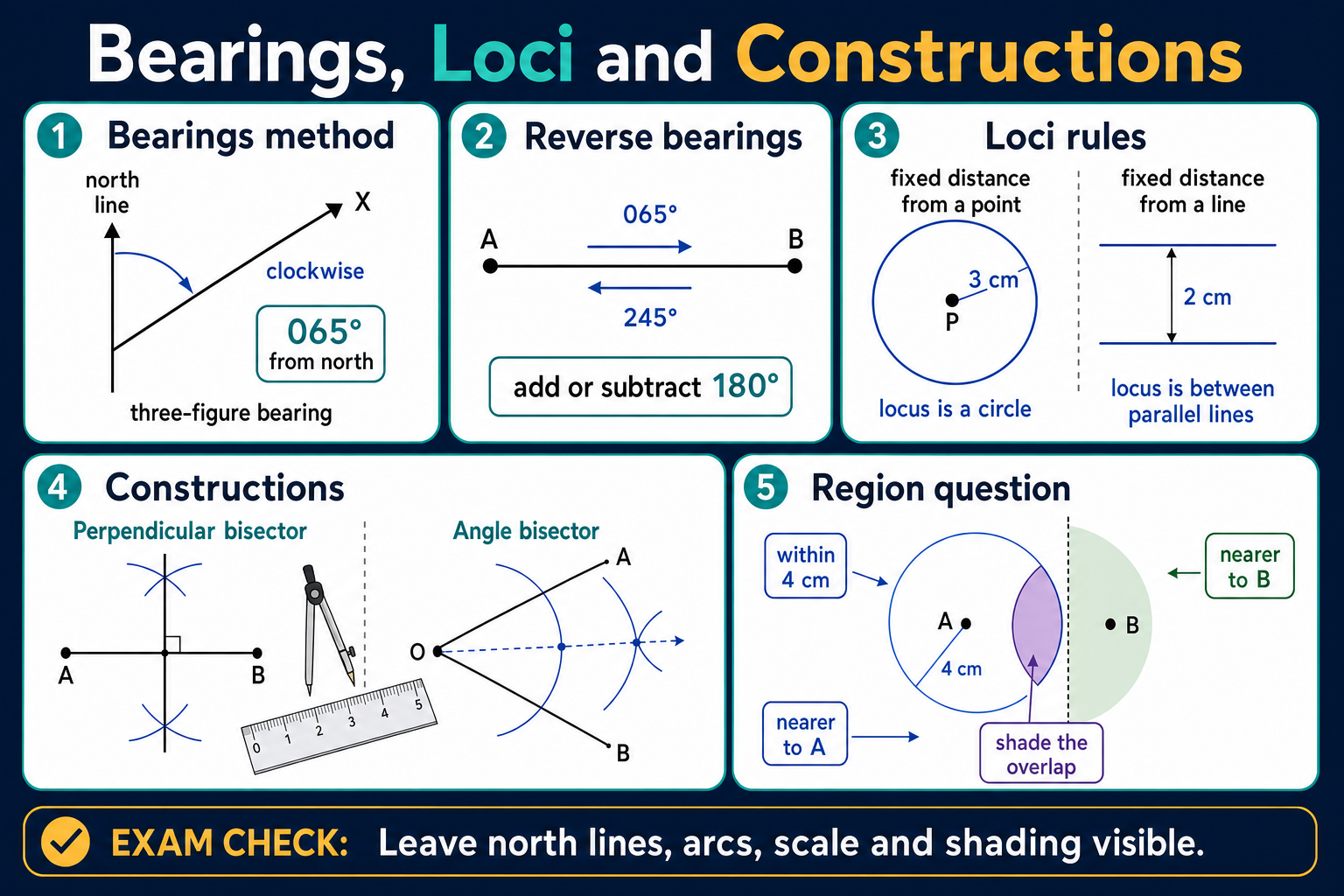
Bearings, loci and constructions infographic
Before viewing
Before viewing, identify north, the clockwise angle and any construction arcs.
After viewing
After viewing, write one bearing using three digits and explain the reference direction.
Why this matters
These skills turn written instructions into precise diagrams. They appear in map routes, safety zones, mobile-signal regions, treasure-map problems, navigation and construction-style exam questions.
Prior knowledge
You should already be comfortable with:
Clear explanation
Bearings are measured clockwise from north
A bearing is always written as three digits. Draw a north line at the starting point, measure clockwise, then draw the route line. For example, a bearing of 065° means 65° clockwise from north.
Reverse bearings are 180° different because the direction has turned to face back along the same line. Add 180° if the bearing is less than 180°; subtract 180° if it is greater than 180°.
1. Draw the bearing
Measure clockwise from north at A.
2. Draw the fixed-distance locus
Every point on the circle is 4 km from A.
3. Construct the perpendicular bisector
The bisector crosses AB at 90° and halves it.
4. Mark the intersection
C is where both rules are true.
Loci are sets of possible positions
A locus is a path or region that follows a rule. Points a fixed distance from one point form a circle. Points a fixed distance from a straight line form two parallel lines. Points equal distance from two points lie on the perpendicular bisector. Points equal distance from two lines lie on the angle bisector.
Region questions usually add words such as less than, more than, within, outside, nearer to or equal distance from. Draw the boundary first, decide whether the boundary line should be included, then shade only the part that satisfies every rule in the question.
Angle bisectors are easy to miss because they are not always drawn between two named points. If a question says equal distance from two intersecting lines, construct the angle bisector of the angle or angles that fit the region. If the question says nearer to one point than another, the perpendicular bisector is the boundary and the correct side of it is the answer.
Constructions need visible arcs
Use compasses without changing the radius when the construction needs equal distances. Keep the arcs on the page: they show how the bisector or perpendicular line was made. On a scale diagram, label the scale length you used before measuring the final real distance.
Worked examples
Example 1: Draw a bearing
From point A, draw a line on a bearing of 130°.
Draw a north line at A. Measure 130° clockwise from north. Draw the route line through the mark.Reveal answer
Answer: a line 130° clockwise from north, labelled 130°.
Example 2: Describe a locus
Describe the locus of points exactly 5 cm from point P.
All points must be the same distance from P. A circle contains every point a fixed distance from its centre.Reveal answer
Answer: a circle with centre P and radius 5 cm.
Example 3: Use a scale diagram
A ship sails 6 km on a bearing of 070°. On a scale of 1 cm : 2 km, how long should the drawn line be?
6 km ÷ 2 km per cm = 3 cmReveal answer
Answer: draw a 3 cm line at 070° from north.
Quick checks
Choose an answer, then check your thinking.
1. Which bearing is written correctly?
2. Points equal distance from A and B lie on:
3. Points exactly 3 cm from a straight line form:
Practice questions
Question 1
Write 38° as a three-figure bearing.
Reveal answer and marking guidance
Answer: 038°.
Marking: Bearings use three digits, so add a leading zero before 38°.
Question 2
A point B is 8 km from A on a bearing of 120°. The scale is 1 cm : 2 km. How long is AB on the scale drawing?
Reveal answer and marking guidance
Answer: 4 cm.
Marking: Divide 8 km by 2 km per cm, so the drawn line is 4 cm at a bearing of 120°.
Question 3
Describe the locus of points exactly 6 cm from point C.
Reveal answer and marking guidance
Answer: a circle with centre C and radius 6 cm.
Marking: State both the centre and the radius because the fixed-distance rule is measured from point C.
Question 4
Describe the locus of points equal distance from two points P and Q.
Reveal answer and marking guidance
Answer: the perpendicular bisector of PQ.
Marking: The line must cross PQ at 90° and pass through the midpoint of PQ.
Question 5
A route goes from A to B on a bearing of 075°. What is the bearing of A from B?
Reveal answer and marking guidance
Answer: 255°.
Marking: The return bearing is 180° different: 075° + 180° = 255°. Check that it is still written as a three-figure bearing.
Question 6
Describe the locus of points inside a field that are less than 4 m from a straight fence.
Reveal answer and marking guidance
Answer: the region inside the field between the fence and a parallel line 4 m from the fence.
Marking: Use a parallel boundary at 4 m, then shade the side closer to the fence and restrict it to the field.
Question 7
A path from P to Q has a bearing of 292°. What is the bearing of P from Q?
Reveal answer and marking guidance
Answer: 112°.
Marking: The reverse bearing is 180° different. Since 292° is greater than 180°, calculate 292° − 180° = 112°.
Question 8
Describe the locus of points equal distance from two straight lines that meet at point A.
Reveal answer and marking guidance
Answer: the angle bisector of the angle between the two lines.
Marking: Equal distance from two intersecting lines means an angle bisector, not a perpendicular bisector. Use the bisector that lies in the required region.
Question 9
Describe the region of points that are more than 3 cm from A and closer to B than to A.
Reveal answer and marking guidance
Answer: outside the circle with centre A and radius 3 cm, on the B side of the perpendicular bisector of AB.
Marking: Use the circle as the fixed-distance boundary from A, the perpendicular bisector as the equal-distance boundary between A and B, then shade the outside-of-circle and nearer-to-B overlap.
Question 10
Town B is 15 km from town A on a bearing of 042°. The scale is 1 cm : 3 km. How long should AB be on the scale drawing, and what is the bearing of A from B?
Reveal answer and marking guidance
Answer: draw AB as 5 cm, and the bearing of A from B is 222°.
Marking: Divide 15 km by 3 km per cm to get 5 cm. The reverse bearing is 180° different, so 042° + 180° = 222°.
Answers and marking guidance
The exact practice answers are hidden under each question so you can try first. For bearings, loci and constructions, marks usually come from drawing a north line at the correct point, measuring clockwise, handling reverse bearings as 180° changes, using the stated scale, naming the correct locus rule, deciding which side or region satisfies the wording, keeping compass arcs visible, and labelling the final route, line, circle or shaded region clearly.
Common mistakes
- Measuring from the wrong place: the north line belongs at the starting point of the bearing.
- Measuring anticlockwise: GCSE bearings are measured clockwise from north.
- Writing two-digit bearings: use 038°, not 38°.
- Rubbing out construction arcs: arcs are evidence of the compass method.
- Mixing up loci: fixed distance from a point is a circle; equal distance from two points is a perpendicular bisector.
- Hiding the working diagram: leave north lines, construction arcs, scale labels and boundary lines visible unless the question tells you otherwise.
Extension challenge
On a map, town B is 10 km from town A on a bearing of 060°. Town C is 6 km from A and is equal distance from A and B. Describe how to construct the possible positions of C.
Reveal answer
Answer: draw AB using the map scale on a bearing of 060°, construct the perpendicular bisector of AB, then draw a circle centre A with radius 6 km. C is at the intersection of the circle and the perpendicular bisector.
This combines a fixed-distance locus from A with the equal-distance locus from A and B.
Exam-board guidance
Bearings, loci and constructions are core GCSE Maths geometry skills across the supported boards. They may appear as direct drawing tasks or as map, route, region and scale-diagram problems.
AQA GCSE Maths
Focus on the shared method, notation and checking habit; wording and context can vary by route.
OCR GCSE Maths
Show clear method steps and use precise notation; question wording may vary by route.
Pearson Edexcel GCSE Maths
Keep working visible and check units or notation; contexts may vary by route.
Eduqas GCSE Maths
Use the same core skill in practical contexts, with clear reasoning and final checks.
WJEC Wales
Connect the method to the context and state what the result means.
CCEA GCSE Maths
Make each method step visible and keep notation, units and final checks clear.
Next lesson
Next, move from accurate drawing to moving shapes in Transformations.