
Lesson overview
A transformation must be described completely.
Transformation questions test accuracy on coordinate grids and precise language. A shape may be translated, reflected, rotated or enlarged, and each type needs different information in the answer.
Visual summary
Before viewing
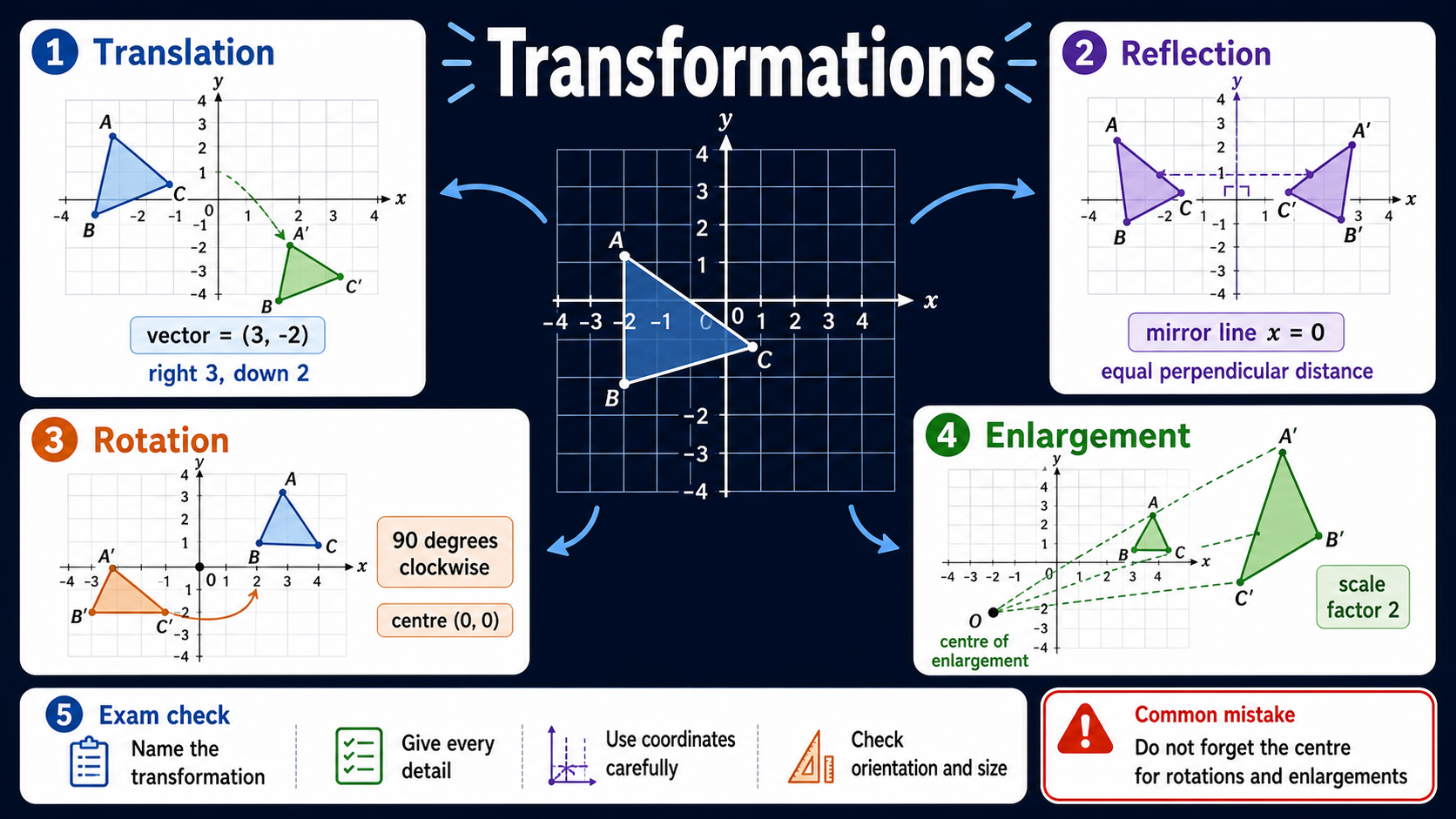
Before viewing, identify the transformation type and the information needed to complete it.
After viewing
After viewing, describe one transformation fully using the correct mathematical details.
What you will learn
Key facts before you start
Why this matters
Transformations are used in maps, computer graphics, design patterns, plans, animation and geometry proof. In exams, they also check whether you can read coordinates carefully and communicate a method clearly.
Prior knowledge
You should already be comfortable with:
Clear explanation
Translations slide every point the same way
A translation moves a shape without turning or resizing it. Use a column vector to describe the movement. The top number is the horizontal move and the bottom number is the vertical move.
Vector 3−2 means 3 right and 2 down.Reflections flip a shape in a mirror line
Each point and its image must be the same perpendicular distance from the mirror line. Common mirror lines include x = 0, y = 0, x = 2 and y = x.
Rotations need three pieces of information
A rotation must state the centre, the angle and the direction. For example: rotate 90° clockwise about (0, 0). If the angle is 180°, clockwise and anticlockwise give the same result, but the centre is still needed.
Enlargements change size from a centre
An enlargement has a scale factor and a centre of enlargement. If the scale factor is greater than 1, the image is bigger. If it is between 0 and 1, the image is smaller. extension questions may use negative or fractional scale factors.
A negative scale factor places the image on the opposite side of the centre of enlargement. A fractional scale factor moves each point closer to the centre. The centre still matters because the same scale factor from a different centre gives a different image.
Reflections and rotations can change orientation, while translations do not. Enlargements preserve shape but change size unless the scale factor is 1, and a negative scale factor also places the image through the centre on the opposite side.
If a question gives more than one transformation, do them in the order written. The second transformation acts on the image from the first step, not on the original shape again.
Worked examples
Example 1: Translation vector
A point A(−1, 4) is translated by 5−3. Find the image of A.
x-coordinate: −1 + 5 = 4 y-coordinate: 4 − 3 = 1Reveal answer
Answer: A' is (4, 1).
Example 2: Reflection in the y-axis
Reflect B(3, −2) in the y-axis.
The y-axis is x = 0. The x-coordinate changes sign; the y-coordinate stays the same.Reveal answer
Answer: B' is (−3, −2).
Example 3: Enlargement
A triangle has side lengths 3 cm, 4 cm and 5 cm. It is enlarged by scale factor 2.
3 × 2 = 6 4 × 2 = 8 5 × 2 = 10Reveal answer
Answer: the image has side lengths 6 cm, 8 cm and 10 cm.
Example 4: Fractional enlargement
A triangle has side lengths 8 cm, 10 cm and 12 cm. It is enlarged by scale factor 12.
8 × 12 = 4 10 × 12 = 5 12 × 12 = 6Reveal answer
Answer: the image has side lengths 4 cm, 5 cm and 6 cm.
Example 5: Combined transformations
Point C(−2, 3) is translated by 4−5, then reflected in the y-axis.
Translate first: (−2 + 4, 3 − 5) = (2, −2) Reflect in the y-axis: change the sign of the x-coordinate.Reveal answer
Answer: the final image is C' (−2, −2).
Quick checks
Choose an answer, then check your thinking.
1. Which detail is needed to fully describe a rotation?
2. A translation by −42 means:
3. What extra detail does an enlargement need as well as scale factor?
Practice questions
Question 1
Translate P(2, −1) by −35.
Reveal answer and marking guidance
Answer: P' is (−1, 4).
Marking: Add −3 to the x-coordinate and add 5 to the y-coordinate.
Question 2
Reflect A(−4, 3) in the x-axis.
Reveal answer and marking guidance
Answer: A' is (−4, −3).
Marking: Reflection in the x-axis keeps the x-coordinate and changes the sign of the y-coordinate.
Question 3
A shape is rotated 90° clockwise about (0, 0). What three details make this description complete?
Reveal answer and marking guidance
Answer: angle 90°, direction clockwise, centre (0, 0).
Marking: A full rotation description must include all three of these details.
Question 4
A rectangle is 5 cm by 7 cm. It is enlarged by scale factor 3. Find the image dimensions.
Reveal answer and marking guidance
Answer: 15 cm by 21 cm.
Marking: Multiply every length by the scale factor: 5 × 3 = 15 and 7 × 3 = 21.
Question 5
Describe the single transformation from triangle T to triangle T' if every point moves 6 squares right and 2 squares down.
Reveal answer and marking guidance
Answer: translation by vector 6−2.
Marking: State that it is a translation and give the vector with horizontal movement on top.
Question 6
A triangle is reflected in the line x = 2. What must be true about each point and its image?
Reveal answer and marking guidance
Answer: each point and its image are the same perpendicular distance from the line x = 2, on opposite sides unless the point lies on the line.
Marking: Mention equal perpendicular distance and the mirror line x = 2.
Question 7
A shape is enlarged from centre C by scale factor −2. What happens to each image point compared with its original point?
Reveal answer and marking guidance
Answer: each image point is on the opposite side of C from the original point, and its distance from C is doubled.
Marking: State both effects: the negative sign puts the image through the centre onto the opposite side, and the scale factor 2 doubles distances from C.
Question 8
Reflect point A(−2, 5) in the line y = x.
Reveal answer and marking guidance
Answer: A' is (5, −2).
Marking: Reflection in y = x swaps the coordinates, so (−2, 5) becomes (5, −2).
Question 9
Point B(1, −3) is translated by 42 and then reflected in the x-axis. Find the final coordinates.
Reveal answer and marking guidance
Answer: (5, 1).
Marking: Translate first: (1 + 4, −3 + 2) = (5, −1). Reflecting in the x-axis changes the y-coordinate sign, giving (5, 1).
Question 10
Point C(−2, 3) is enlarged by scale factor 3 from centre (1, −1). Find the image coordinates.
Reveal answer and marking guidance
Answer: C' is (−8, 11).
Marking: From the centre to C is (−3, 4). Multiply by 3 to get (−9, 12), then add this to the centre: (1 − 9, −1 + 12) = (−8, 11).
Answers and marking guidance
The exact practice answers are hidden under each question so you can try first. For transformations, marks usually come from naming the transformation, using accurate coordinates, keeping vector order correct, giving mirror lines in equation form, applying combined transformations in the written order, and including all required details for rotations and enlargements. For enlargements, make clear whether the scale factor changes size only or also places the image relative to the centre.
Common mistakes
- Swapping vector numbers: the top number is horizontal and the bottom number is vertical.
- Missing the centre: rotations and enlargements both need a centre unless it is already given.
- Using the wrong mirror line: x = 0 is the y-axis, and y = 0 is the x-axis.
- Changing size during a rotation or reflection: translations, reflections and rotations keep the shape congruent.
- Only naming the transformation: "rotation" is not enough without angle, direction and centre.
Extension challenge
Point A has coordinates (2, 1). It is first translated by −53, then reflected in the y-axis. Find the final coordinates of A.
Reveal answer
Answer: after the translation, A is at (−3, 4). Reflecting in the y-axis changes the sign of the x-coordinate, so the final point is (3, 4).
This combines coordinate movement with a reflection rule, so do the transformations in the order given.
Exam-board guidance
Transformations are core GCSE Maths geometry skills across the supported boards. They may appear as grid-drawing tasks, coordinate descriptions, combined transformation problems or similarity questions involving enlargement.
AQA GCSE Maths
Focus on the shared method, notation and checking habit; wording and context can vary by route.
OCR GCSE Maths
Show clear method steps and use precise notation; question wording may vary by route.
Pearson Edexcel GCSE Maths
Keep working visible and check units or notation; contexts may vary by route.
Eduqas GCSE Maths
Use the same core skill in practical contexts, with clear reasoning and final checks.
WJEC Wales
Connect the method to the context and state what the result means.
CCEA GCSE Maths
Make each method step visible and keep notation, units and final checks clear.
Next lesson
Next, connect transformations to shape relationships in Congruence and Similarity.