
Lesson overview
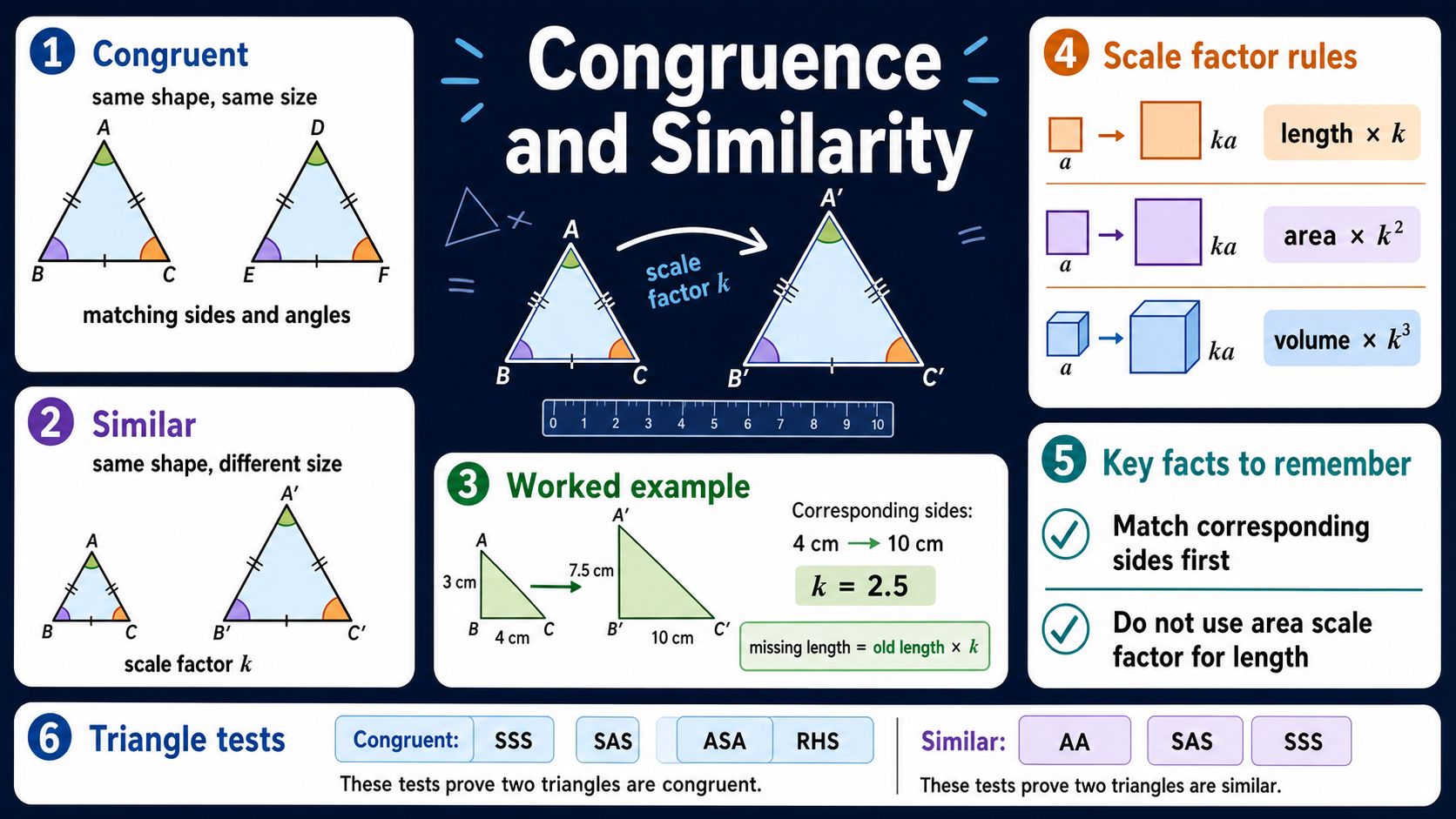
Congruent shapes match exactly; similar shapes match by scale.
Congruence and similarity questions test whether you can match corresponding angles and sides. They often connect to enlargement, ratio, area, volume and proof.
Visual summary
Before viewing
Before viewing, identify whether the shapes are congruent or similar.
After viewing
After viewing, find a length scale factor and use it to calculate a missing side.
What you will learn
Key facts before you start
Why this matters
Similarity is the maths behind scale models, maps, plans, photos, packaging, shadows and enlargement. Congruence is useful when you need to prove that two shapes really are identical, even if one has been moved or rotated.
Prior knowledge
You should already be comfortable with:
Clear explanation
Congruent means same shape and same size
Congruent shapes may have been translated, reflected or rotated, but every matching side length and every matching angle is equal. If you cut one out, it would fit exactly on top of the other.
Similar means same shape but possibly different size
Similar shapes have matching angles and side lengths in the same ratio. The multiplier from one shape to the other is the length scale factor.
Area and volume use different scale factors
If the length scale factor is k, then the area scale factor is k² and the volume scale factor is k³. This is because area has two dimensions and volume has three.
In proof questions, do not just say two shapes "look similar". Name the equal angles, show that matching sides are in the same ratio, or use a recognised triangle similarity test such as AA, SAS or SSS similarity.
For triangle congruence, common GCSE tests are SSS, SAS, ASA and RHS. These prove same shape and same size, not just a matching scale factor.
Worked examples
Example 1: Similar side length
Two similar rectangles have matching sides 6 cm and 15 cm. Another side on the smaller rectangle is 8 cm. Find the matching side on the larger rectangle.
Scale factor = 15 ÷ 6 = 2.5 8 × 2.5 = 20Reveal answer
Answer: the matching side is 20 cm.
Example 2: Area scale factor
Two similar shapes have length scale factor 3. The smaller area is 12 cm². Find the larger area.
Area scale factor = 3² = 9 12 × 9 = 108Reveal answer
Answer: the larger area is 108 cm².
Example 3: Volume scale factor
Two similar solids have length scale factor 2. The smaller volume is 35 cm³.
Volume scale factor = 2³ = 8 35 × 8 = 280Reveal answer
Answer: the larger volume is 280 cm³.
Example 4: Algebraic similar sides
Two similar triangles have matching sides 4 cm and 10 cm. Another pair of matching sides is x + 1 and 15 cm. Find x.
Length scale factor = 10 ÷ 4 = 2.5 (x + 1) × 2.5 = 15 x + 1 = 6Reveal answer
Answer: x = 5.
Quick checks
Choose an answer, then check your thinking.
1. What does congruent mean?
2. If the length scale factor is 4, what is the area scale factor?
3. Similar triangles must have:
Practice questions
Question 1
Two similar triangles have matching sides 5 cm and 12.5 cm. What is the length scale factor from the smaller triangle to the larger triangle?
Reveal answer and marking guidance
Answer: 2.5.
Marking: Divide matching larger side by matching smaller side: 12.5 ÷ 5 = 2.5.
Question 2
A similar shape is enlarged by length scale factor 3. A matching side on the smaller shape is 7 cm. Find the matching larger side.
Reveal answer and marking guidance
Answer: 21 cm.
Marking: Multiply the matching length by the length scale factor: 7 × 3 = 21.
Question 3
Two similar shapes have length scale factor 5. What is the area scale factor?
Reveal answer and marking guidance
Answer: 25.
Marking: Square the length scale factor: 5² = 25.
Question 4
Two similar solids have length scale factor 4. The smaller solid has volume 6 cm³. Find the larger volume.
Reveal answer and marking guidance
Answer: 384 cm³.
Marking: Volume scale factor is 4³ = 64, then 6 × 64 = 384.
Question 5
Are two squares with side lengths 4 cm and 9 cm congruent, similar, both, or neither?
Reveal answer and marking guidance
Answer: similar only.
Marking: All squares have equal matching angles and proportional sides, but these two are not the same size.
Question 6
A triangle has sides 6 cm, 8 cm and 10 cm. A second triangle has sides 9 cm, 12 cm and 15 cm. Are they similar?
Reveal answer and marking guidance
Answer: yes, they are similar with length scale factor 1.5.
Marking: Check matching ratios: 9 ÷ 6 = 1.5, 12 ÷ 8 = 1.5 and 15 ÷ 10 = 1.5.
Question 7
Two triangles have side lengths 5 cm, 7 cm and 9 cm in both triangles. What congruence test proves they are congruent?
Reveal answer and marking guidance
Answer: SSS congruence.
Marking: All three matching side lengths are equal, so the triangles are congruent by side-side-side.
Question 8
Two similar shapes have areas 45 cm² and 80 cm². Find the length scale factor from the smaller shape to the larger shape.
Reveal answer and marking guidance
Answer: 43.
Marking: Area scale factor = 80 ÷ 45 = 16 ÷ 9, so length scale factor = √(16 ÷ 9) = 4 ÷ 3.
Question 9
Two similar triangles have matching sides 6 cm and 15 cm. Another pair of matching sides is 2x − 1 cm and 20 cm. Find x.
Reveal answer and marking guidance
Answer: x = 4.5.
Marking: The length scale factor is 15 ÷ 6 = 2.5, so (2x − 1) × 2.5 = 20. Then 2x − 1 = 8, so 2x = 9 and x = 4.5.
Question 10
Two similar solid models have volumes 54 cm³ and 432 cm³. Find the length scale factor from the smaller model to the larger model.
Reveal answer and marking guidance
Answer: 2.
Marking: The volume scale factor is 432 ÷ 54 = 8. The length scale factor is the cube root of 8, which is 2.
Answers and marking guidance
The exact practice answers are hidden under each question so you can try first. For congruence and similarity, marks usually come from matching corresponding sides, stating the correct scale factor, using squared scale factors for area, cubed scale factors for volume, naming a valid congruence or similarity test when proof is required, and writing units such as cm, cm² or cm³ where needed.
Common mistakes
- Calling all similar shapes congruent: congruent shapes must be the same size.
- Matching the wrong sides: use labels, angles or order around the shape before writing a ratio.
- Using the length scale factor for area: area scale factor is the length scale factor squared.
- Using the area scale factor for volume: volume scale factor is the length scale factor cubed.
- Confusing proof tests: congruence tests such as SSS prove equal size, while similarity tests prove proportional sides or equal angles.
- Judging by the drawing only: GCSE diagrams are not always drawn accurately unless the question says they are.
Extension challenge
Two similar cones have volumes 81 cm³ and 648 cm³. Find the length scale factor from the smaller cone to the larger cone.
Reveal answer
Answer: 2.
The volume scale factor is 648 ÷ 81 = 8. The length scale factor is the cube root of 8, which is 2.
Exam-board guidance
Congruence and similarity are core GCSE Maths geometry skills across the supported boards. Questions may be direct, diagram-based, linked to enlargement, or embedded in area, volume and practical scale problems.
AQA GCSE Maths
Focus on the shared method, notation and checking habit; wording and context can vary by route.
OCR GCSE Maths
Show clear method steps and use precise notation; question wording may vary by route.
Pearson Edexcel GCSE Maths
Keep working visible and check units or notation; contexts may vary by route.
Eduqas GCSE Maths
Use the same core skill in practical contexts, with clear reasoning and final checks.
WJEC Wales
Connect the method to the context and state what the result means.
CCEA GCSE Maths
Make each method step visible and keep notation, units and final checks clear.
Next lesson
Next, use directed line segments in Vectors.