
Lesson overview
Vectors describe a journey using direction and distance.
GCSE vector questions ask you to combine arrows, scale arrows and explain geometric facts such as parallel lines or points on a straight line.
Visual summary
Before viewing
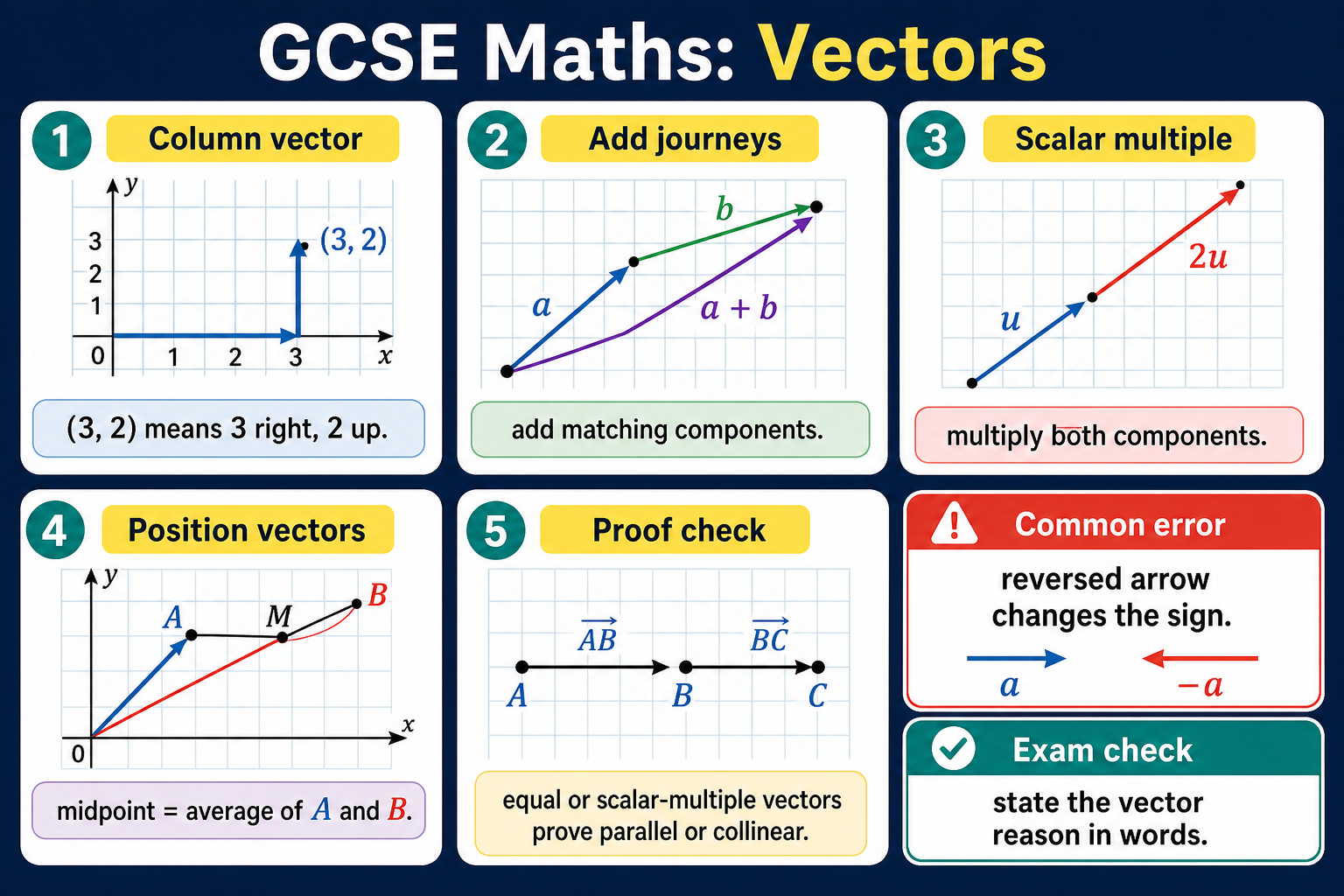
Before viewing, trace the horizontal and vertical movement shown by one vector.
After viewing
After viewing, write one route as a vector expression and simplify it.
What you will learn
Key facts before you start
Why this matters
Vectors are useful whenever direction matters: map movement, forces, velocity, translations and proof in geometry. At GCSE, they help you turn a diagram into exact algebra.
Prior knowledge
You should already be comfortable with:
Clear explanation
Column vectors show horizontal and vertical movement
A column vector tells you how far to move sideways and how far to move up or down. For example, 32 means move 3 units right and 2 units up. A negative number means move left or down.
Vector journeys can be added
If one journey is a and the next journey is b, the whole journey is a + b. Reversing a vector changes its sign, so the reverse of a is −a.
Scalar multiples show parallel vectors
A scalar is an ordinary multiplier. If b = 2a, then b is twice as long as a in the same direction. If b = −2a, it is twice as long in the opposite direction. Non-zero scalar multiples are parallel.
For proof, the route matters as much as the final expression. State the journey you are taking, simplify carefully, then write a sentence such as "these vectors are scalar multiples, so the lines are parallel" or "the equal vectors meet at B, so the points are collinear".
Position-vector questions use the origin as the starting point. If point A has position vector a and point B has position vector b, then AB = b − a. Midpoints and ratio points are weighted averages, so keep the order of the endpoints clear before simplifying.
Worked examples
Example 1: Add column vectors
Add the vectors ( 4 , −1 ) and ( −2 , 5 ).
Horizontal: 4 + (−2) = 2 Vertical: −1 + 5 = 4Reveal answer
Answer: ( 2 , 4 ).
Example 2: Find a route
In a parallelogram, AB = a and AD = b. Find AC.
A to C = A to B + B to C BC is equal to AD, so BC = bReveal answer
Answer: AC = a + b.
Example 3: Parallel vectors
Vector u = ( 2 , 3 ). Explain why v = ( 6 , 9 ) is parallel to u.
v = 3uReveal answer
Answer: v is a scalar multiple of u, so the vectors are parallel.
Example 4: A point in a ratio
Point P has position vector p and point Q has position vector q. R is one quarter of the way from P to Q. Write the position vector of R.
PR = 14(q − p) OR = OP + PR = p + 14(q − p)Reveal answer
Answer: 34p + 14q.
Quick checks
Choose an answer, then check your thinking.
1. What does the vector ( −3 , 4 ) mean?
2. If a = ( 2 , 1 ), what is 3a?
3. Which statement proves two non-zero vectors are parallel?
Practice questions
Question 1
Write the column vector for a movement 5 units right and 2 units down.
Reveal answer and marking guidance
Answer: ( 5 , −2 ).
Marking: Put the horizontal movement first and use a negative vertical component for down.
Question 2
Add ( 7 , 3 ) and ( −4 , 6 ).
Reveal answer and marking guidance
Answer: ( 3 , 9 ).
Marking: Add matching components: 7 + (−4) = 3 and 3 + 6 = 9.
Question 3
If a = ( −2 , 5 ), find −2a.
Reveal answer and marking guidance
Answer: ( 4 , −10 ).
Marking: Multiply both components by −2.
Question 4
In a parallelogram, AB = p and AD = q. Write vector BD in terms of p and q.
Reveal answer and marking guidance
Answer: −p + q, or q − p.
Marking: Travel from B to A using −p, then from A to D using q.
Question 5
Are ( 3 , −6 ) and ( −1 , 2 ) parallel? Explain your answer.
Reveal answer and marking guidance
Answer: yes, because ( 3 , −6 ) = −3( −1 , 2 ).
Marking: Show one vector is a scalar multiple of the other.
Question 6
Point A has position vector a and point B has position vector b. M is the midpoint of AB. Write the position vector of M.
Reveal answer and marking guidance
Answer: (a + b) ÷ 2.
Marking: Average the two position vectors because M is halfway between A and B.
Question 7
Point A has position vector a and point B has position vector b. Write vector AB in terms of a and b.
Reveal answer and marking guidance
Answer: b − a.
Marking: Travel from the origin to A in reverse, then from the origin to B: AB = −a + b = b − a.
Question 8
Points P, Q and R have position vectors p, q and 2q − p. Show that P, Q and R are collinear.
Reveal answer and marking guidance
Answer: PQ = q − p and QR = (2q − p) − q = q − p, so PQ = QR. Therefore P, Q and R are collinear.
Marking: Find two directed line segments and state that equal vectors sharing Q lie on the same straight line.
Question 9
Point A has position vector a and point B has position vector b. Point C is two thirds of the way from A to B. Write the position vector of C.
Reveal answer and marking guidance
Answer: 13a + 23b.
Marking: Start at A and add two thirds of AB: a + 23(b − a) = 13a + 23b.
Question 10
Vector u = 6−4 and vector v = −32. Explain why the two vectors are parallel.
Reveal answer and marking guidance
Answer: They are parallel because u = −2v.
Marking: Multiply v by −2: −2 × −32 = 6−4. A scalar multiple shows the vectors are parallel, with opposite directions because the multiplier is negative.
Answers and marking guidance
The exact practice answers are hidden under each question so you can try first. For vector questions, marks usually come from reading direction correctly, adding matching components, using negative signs when an arrow is reversed, multiplying every component by a scalar, handling position vectors in the right order, and writing a short reason when proving vectors are parallel or collinear.
Common mistakes
- Swapping the components: read horizontal movement first, then vertical movement.
- Forgetting negative directions: left and down are negative in column vectors.
- Only multiplying one component: a scalar multiple changes every part of the vector.
- Using the wrong arrow direction: AB and BA are opposites.
- Claiming parallel without a reason: show one vector is a scalar multiple of the other.
Extension challenge
Points A, B and C have position vectors a, b and 2b − a. Prove that A, B and C lie on a straight line.
Reveal answer
Answer: AB = b − a and BC = (2b − a) − b = b − a, so AB and BC are equal vectors. Therefore A, B and C lie on the same straight line with B between A and C.
Exam-board guidance
Vectors are a GCSE Maths geometry skill across the supported boards, most commonly on extension papers. Questions may use column vectors, labelled diagram vectors, midpoints, ratios, parallel lines or short proof.
AQA GCSE Maths
Focus on the shared method, notation and checking habit; wording and context can vary by route.
OCR GCSE Maths
Show clear method steps and use precise notation; question wording may vary by route.
Pearson Edexcel GCSE Maths
Keep working visible and check units or notation; contexts may vary by route.
Eduqas GCSE Maths
Use the same core skill in practical contexts, with clear reasoning and final checks.
WJEC Wales
Connect the method to the context and state what the result means.
CCEA GCSE Maths
Make each method step visible and keep notation, units and final checks clear.
Next lesson
Next, move on to Circle Theorems.