
Lesson overview
Circle theorems turn a diagram into a chain of angle reasons.
Use angle facts in circles and give clear theorem reasons. Questions may ask for direct calculation, interpretation, explanation or proof-style method in context.
Visual summary
Before viewing
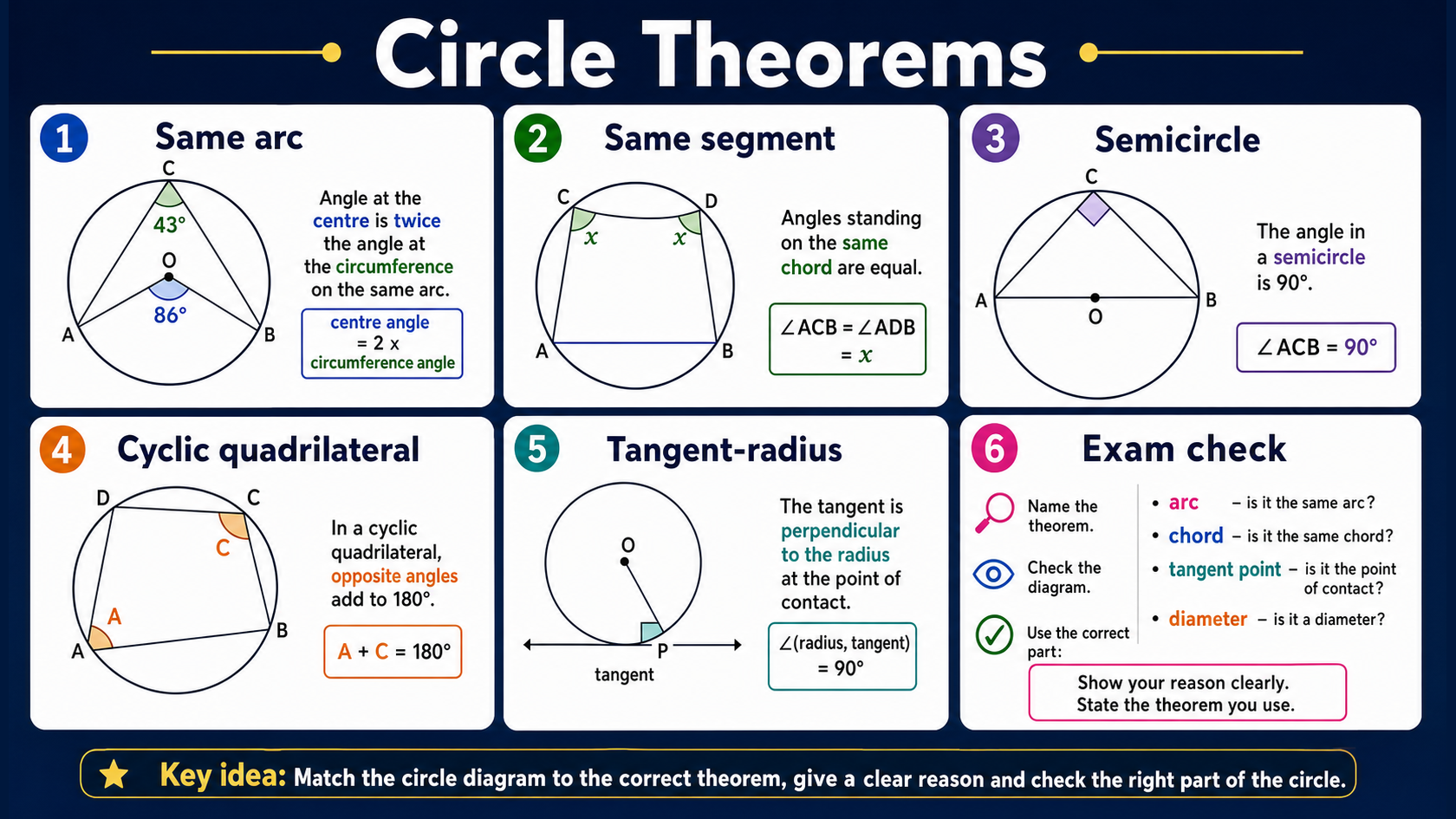
Before viewing, identify which theorem links the marked angles.
After viewing
After viewing, solve one circle-theorem angle and name the theorem used.
What you will learn
Key facts before you start
Why this matters
Circle theorem questions reward accurate reasons. A correct angle without a theorem statement can lose marks, especially in proof questions where the examiner needs to see why each step follows.
Prior knowledge
You should already be comfortable with:
Clear explanation
Main idea
Circle theorems are angle facts that work because points, chords, radii and tangents sit in fixed relationships. Start by naming the centre, tangent point, chord or cyclic quadrilateral before doing arithmetic.
Method
The angle at the centre is twice the angle at the circumference standing on the same arc. Angles in the same segment are equal. Opposite angles in a cyclic quadrilateral add to 180°. The angle in a semicircle is 90° because it stands on a diameter.
Answer tip
A tangent is perpendicular to the radius at the point of contact. The alternate segment theorem links a tangent-chord angle to the angle in the opposite segment. Write the theorem reason beside each angle step, not just at the end.
If a diagram has several circle facts, work one angle at a time. Mark the arc, chord, diameter, tangent point or cyclic quadrilateral you are using, then write a short reason such as "angle at centre is twice angle at circumference" or "opposite angles in a cyclic quadrilateral add to 180°". If two angles look equal but do not stand on the same chord or arc, do not use the same-segment theorem.
Worked examples
Centre theorem
The angle at the centre is 104°. Find the angle at the circumference on the same arc.
Reveal answer
Answer: 104 ÷ 2 = 52°.
Cyclic quadrilateral
One angle in a cyclic quadrilateral is 118°. Find the opposite angle.
Reveal answer
Answer: 180 − 118 = 62°.
Alternate segment theorem
A tangent-chord angle is 39°. Find the angle in the opposite segment standing on the same chord.
Reveal answer
Answer: 39°, because the alternate segment theorem makes the tangent-chord angle equal to the angle in the opposite segment.
Semicircle theorem
AB is a diameter and C is a point on the circumference. Angle ACB is split into 2x + 10° and x + 20°. Find x.
Reveal answer
Answer: Angle ACB is 90° because it stands on a diameter, so 2x + 10 + x + 20 = 90. This gives 3x = 60, so x = 20.
Quick checks
Choose an answer, then check your thinking.
1. The centre angle on an arc is 86°. What is the circumference angle on the same arc?
2. Which reason explains a 90° angle between a radius and a tangent?
Practice questions
Question 1
The angle at the centre is 130°. What is the angle at the circumference standing on the same arc?
Reveal answer and marking guidance
Answer: 65°.
Marking: Centre angle is twice circumference angle, so 130° ÷ 2 = 65°.
Question 2
Two angles stand on the same chord in the same segment. One is 47°. Find the matching angle.
Reveal answer and marking guidance
Answer: 47°.
Marking: Angles in the same segment are equal when they stand on the same chord.
Question 3
One angle in a cyclic quadrilateral is 73°. Find the opposite angle.
Reveal answer and marking guidance
Answer: 107°.
Marking: Opposite angles in a cyclic quadrilateral add to 180°, so 180° − 73° = 107°.
Question 4
A radius meets a tangent at the point of contact. What angle is formed?
Reveal answer and marking guidance
Answer: 90°.
Marking: A tangent is perpendicular to the radius at the point where it touches the circle.
Question 5
A tangent touches a circle at A. Chord AB makes a 54° angle with the tangent. What is the angle in the opposite segment standing on chord AB?
Reveal answer and marking guidance
Answer: 54°.
Marking: Use the alternate segment theorem: the tangent-chord angle equals the angle in the opposite segment on the same chord.
Question 6
A triangle is drawn inside a circle with one side as the diameter. What is the angle opposite the diameter?
Reveal answer and marking guidance
Answer: 90°.
Marking: The angle in a semicircle is a right angle. Name the diameter and the angle standing on it.
Question 7
In a cyclic quadrilateral, two opposite angles are labelled 3x + 10° and 2x + 20°. Find x.
Reveal answer and marking guidance
Answer: x = 30.
Marking: Opposite angles in a cyclic quadrilateral add to 180°, so 3x + 10 + 2x + 20 = 180, giving 5x = 150.
Question 8
A tangent and chord form a 38° angle at the point of contact. The triangle in the opposite segment also has another angle of 71°. Find the third angle in that triangle.
Reveal answer and marking guidance
Answer: 71°.
Marking: The angle in the opposite segment is 38° by the alternate segment theorem, so the third angle is 180° − 38° − 71° = 71°.
Question 9
AB is a diameter of a circle and C lies on the circumference. Angle CAB is 34°. Find angle ABC.
Reveal answer and marking guidance
Answer: 56°.
Marking: Angle ACB is 90° because it stands on diameter AB, so angle ABC is 180° − 90° − 34° = 56°.
Question 10
A, B, C and D lie on a circle in that order. Angle ABC is 4x + 15° and the opposite angle ADC is 2x + 45°. Find x and angle ABC.
Reveal answer and marking guidance
Answer: x = 20 and angle ABC is 95°.
Marking: Opposite angles in a cyclic quadrilateral add to 180°, so 4x + 15 + 2x + 45 = 180. This gives 6x = 120, so x = 20, then 4 × 20 + 15 = 95°.
Answers and marking guidance
The exact practice answers are hidden under each question so you can try first. For circle theorems, marks usually come from identifying the correct theorem, showing the angle calculation and writing a precise reason such as angle at the centre, angles in the same segment, cyclic quadrilateral, angle in a semicircle, tangent-radius or alternate segment theorem. Strong answers also name the relevant arc, chord, diameter, tangent point or opposite angles so the reason matches the diagram.
Common mistakes
- Using a theorem on the wrong arc: check that the centre and circumference angles stand on the same chord or arc.
- Forgetting theorem reasons: a correct number may not get full marks if the proof asks you to explain why.
- Mixing up cyclic facts: opposite angles add to 180°, while angles in the same segment are equal.
- Missing the tangent point: tangent-radius is 90° only at the exact point where the radius meets the tangent.
- Assuming equal-looking angles are equal: same-segment angles need the same chord or arc, not just a similar position in the drawing.
Extension challenge
A cyclic quadrilateral has one angle of 112 degrees. Find the opposite angle and name the circle theorem used.
Reveal answer
Example answer: Opposite angles in a cyclic quadrilateral add to 180 degrees, so the opposite angle is 180 - 112 = 68 degrees.
Exam-board guidance
Circle theorems appear within GCSE Maths geometry content, usually with stronger extension emphasis. Exact wording and theorem combinations vary, but pupils should expect angle chasing, proof-style reasoning, tangent-chord recognition and clear theorem names.
AQA GCSE Maths
Focus on the shared method, notation and checking habit; wording and context can vary by route.
OCR GCSE Maths
Show clear method steps and use precise notation; question wording may vary by route.
Pearson Edexcel GCSE Maths
Keep working visible and check units or notation; contexts may vary by route.
Eduqas GCSE Maths
Use the same core skill in practical contexts, with clear reasoning and final checks.
WJEC Wales
Connect the method to the context and state what the result means.
CCEA GCSE Maths
Make each method step visible and keep notation, units and final checks clear.
Next lesson
Next, continue with Sine Rule, Cosine Rule and Area of a Triangle.