
Lesson overview
These rules solve non-right-angled GCSE triangle problems.
Solve non-right-angled triangles using the sine rule, cosine rule and area formula. Questions may ask for direct calculation, interpretation, explanation or clear method in context.
What you will learn
Key facts before you start
Visual summary
Sine Rule, Cosine Rule and Area visual summary
Before viewing
Before viewing, identify whether the triangle gives ASA, SAS, SSS or a matching pair.
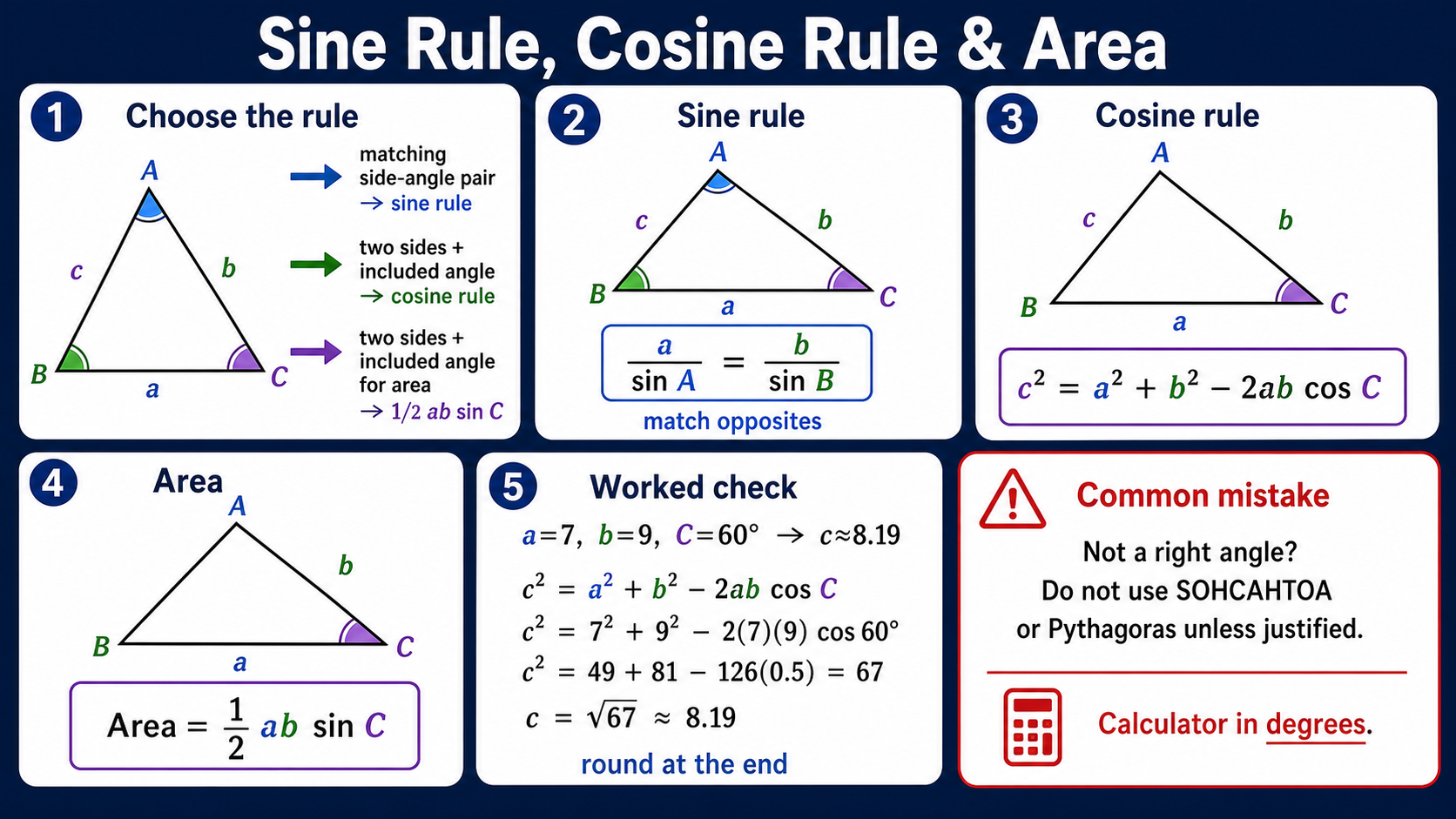
After viewing
After viewing, choose sine rule, cosine rule or area formula for one triangle and explain why.
Why this matters
Not every GCSE triangle has a right angle. These rules extend trigonometry to general triangles.
Prior knowledge
You should already be comfortable with:
Clear explanation
Main idea
Use these rules when the triangle is not right-angled. First label each side opposite its angle, then choose the rule from the known pattern.
Method
Use the sine rule when you know a matching side-angle pair and one more side or angle. Use the cosine rule when you know two sides and the included angle, or when all three sides are known. Use inverse sine or inverse cosine only when the unknown is an angle.
Answer tip
Use area = 1/2 ab sin C when you know two sides and the included angle. Keep your calculator in degrees, write the substituted formula before evaluating, and do not round until the final answer.
For sine-rule angle questions, check the diagram after using inverse sine. If the unknown angle could be obtuse, the calculator's acute answer may need the second possibility, 180° minus that answer. GCSE questions usually give a diagram or context that tells you which angle is sensible.
Worked examples
Sine rule
a/sin A = b/sin B. If a = 10, A = 40° and B = 65°, find b.
Reveal answer
Answer: b = 10 sin65° ÷ sin40° ≈ 14.1.
Sine rule for an angle
A triangle has a = 9 cm, b = 12 cm and A = 41°. Find angle B if the diagram shows B is obtuse.
Reveal answer
Answer: sin B/12 = sin41°/9, so sin B = 0.8747.... The calculator gives 61.0°, but the diagram says B is obtuse, so B = 180° − 61.0° = 119.0°.
Cosine rule
Find c when a = 7, b = 9 and C = 60°.
Reveal answer
Answer: c² = 7² + 9² − 2 × 7 × 9 × cos60° = 67, so c ≈ 8.19.
Cosine rule for an angle
A triangle has sides 7 cm, 9 cm and 11 cm. Find the angle between the 7 cm and 9 cm sides.
Reveal answer
Answer: The 11 cm side is opposite the angle. cos C = (7² + 9² − 11²) ÷ (2 × 7 × 9) = 9/126, so C = cos⁻¹(9/126) ≈ 85.9°.
Area formula
Find the area when two sides are 11 cm and 14 cm and the included angle is 35°.
Reveal answer
Answer: area = 1/2 × 11 × 14 × sin35° ≈ 44.2 cm².
Quick checks
Choose an answer, then check your thinking.
1. You know two sides and the included angle. Which rule usually fits?
2. What must you have before using the sine rule?
Practice questions
Question 1
Use area = 1/2ab sin C with a = 8, b = 10, C = 30°.
Reveal answer and marking guidance
Answer: 20 square units.
Marking: 0.5 × 8 × 10 × sin30° = 20.
Question 2
Which rule for two sides and included angle?
Reveal answer and marking guidance
Answer: Cosine rule.
Marking: This is the SAS case.
Question 3
Which rule for a known side-angle pair?
Reveal answer and marking guidance
Answer: Sine rule.
Marking: A matching pair unlocks the sine rule.
Question 4
Round 14.126 to 3 significant figures.
Reveal answer and marking guidance
Answer: 14.1.
Marking: Keep enough working then round at the end.
Question 5
In triangle ABC, a = 12 cm, A = 35° and B = 80°. Use the sine rule to find b to 3 significant figures.
Reveal answer and marking guidance
Answer: b = 20.6 cm.
Marking: b/sin80° = 12/sin35°, so b = 12 × sin80° ÷ sin35° = 20.604..., which rounds to 20.6 cm.
Question 6
A triangle has sides 6 cm and 9 cm with included angle 120°. Find the third side to 3 significant figures.
Reveal answer and marking guidance
Answer: 13.1 cm.
Marking: c² = 6² + 9² − 2 × 6 × 9 × cos120° = 171, so c = √171 = 13.076... cm.
Question 7
A triangle has sides 8 cm, 10 cm and 13 cm. Find the angle between the 8 cm and 10 cm sides to 1 decimal place.
Reveal answer and marking guidance
Answer: 91.8°.
Marking: Use 13² = 8² + 10² − 2 × 8 × 10 × cos C, so cos C = −5 ÷ 160 = −0.03125 and C = cos⁻¹(−0.03125) = 91.8°.
Question 8
A triangle has sides 9 cm and 12 cm with included angle 42°. Find its area to 3 significant figures.
Reveal answer and marking guidance
Answer: 36.1 cm².
Marking: Area = 1/2 × 9 × 12 × sin42° = 36.132..., so the area is 36.1 cm² to 3 significant figures.
Question 9
Two straight paths from a point are 5 km and 7 km long with an included angle of 110°. Find the distance between their far ends to 3 significant figures.
Reveal answer and marking guidance
Answer: 9.90 km.
Marking: Use the cosine rule: d² = 5² + 7² − 2 × 5 × 7 × cos110° = 97.941..., so d = 9.896... km, which rounds to 9.90 km.
Question 10
In triangle ABC, side AB = 11 cm, side AC = 14 cm and angle A = 38°. Find the area of the triangle to 3 significant figures.
Reveal answer and marking guidance
Answer: 47.4 cm².
Marking: The given angle is included between the two known sides, so use area = 1/2 × 11 × 14 × sin38° = 47.408.... Round only at the end and include cm².
Answers and marking guidance
The exact practice answers are hidden under each question so you can try first. For sine rule, cosine rule and triangle area questions, marks usually come from choosing the rule from the side-angle pattern, labelling the angle opposite the unknown side, substituting accurately, using degree mode, keeping unrounded working and giving the requested units or angle accuracy. When finding an angle with the sine rule, check whether the diagram or context requires the obtuse alternative.
Common mistakes
- Using right-angled trig on a non-right triangle: SOH CAH TOA needs a right angle; these formulae are for general triangles.
- Missing the included angle: cosine rule and area = 1/2 ab sin C use the angle between the two named sides.
- Pairing sides and angles wrongly: in the sine rule, each side must be opposite its matching angle.
- Forgetting the ambiguous sine case: inverse sine gives an acute angle first, so check whether the diagram needs the obtuse alternative.
- Rounding too early: keep calculator values until the final answer, especially in multi-step geometry or bearings questions.
Extension challenge
A triangle has sides 7 cm and 10 cm with included angle 38 degrees. Choose the correct formula for the area and calculate it to 1 decimal place.
Reveal answer
Example answer: Use area = 1/2ab sin C because two sides and the included angle are known. Area = 0.5 x 7 x 10 x sin 38 = 21.5 cm2 to 1 decimal place.
Exam-board guidance
Sine Rule, Cosine Rule and Area of a Triangle appears within extension GCSE Maths geometry and measures content. Exact contexts vary, but pupils should expect calculator work, non-right-angled triangles, bearings, area questions or multi-step diagrams.
AQA GCSE Maths
Focus on the shared method, notation and checking habit; wording and context can vary by route.
OCR GCSE Maths
Show clear method steps and use precise notation; question wording may vary by route.
Pearson Edexcel GCSE Maths
Keep working visible and check units or notation; contexts may vary by route.
Eduqas GCSE Maths
Use the same core skill in practical contexts, with clear reasoning and final checks.
WJEC Wales
Connect the method to the context and state what the result means.
CCEA GCSE Maths
Make each method step visible and keep notation, units and final checks clear.
Next lesson
Next, continue with Probability Language and Scales.