
How to use these lessons
Learn the core idea first, then practise the exam style.
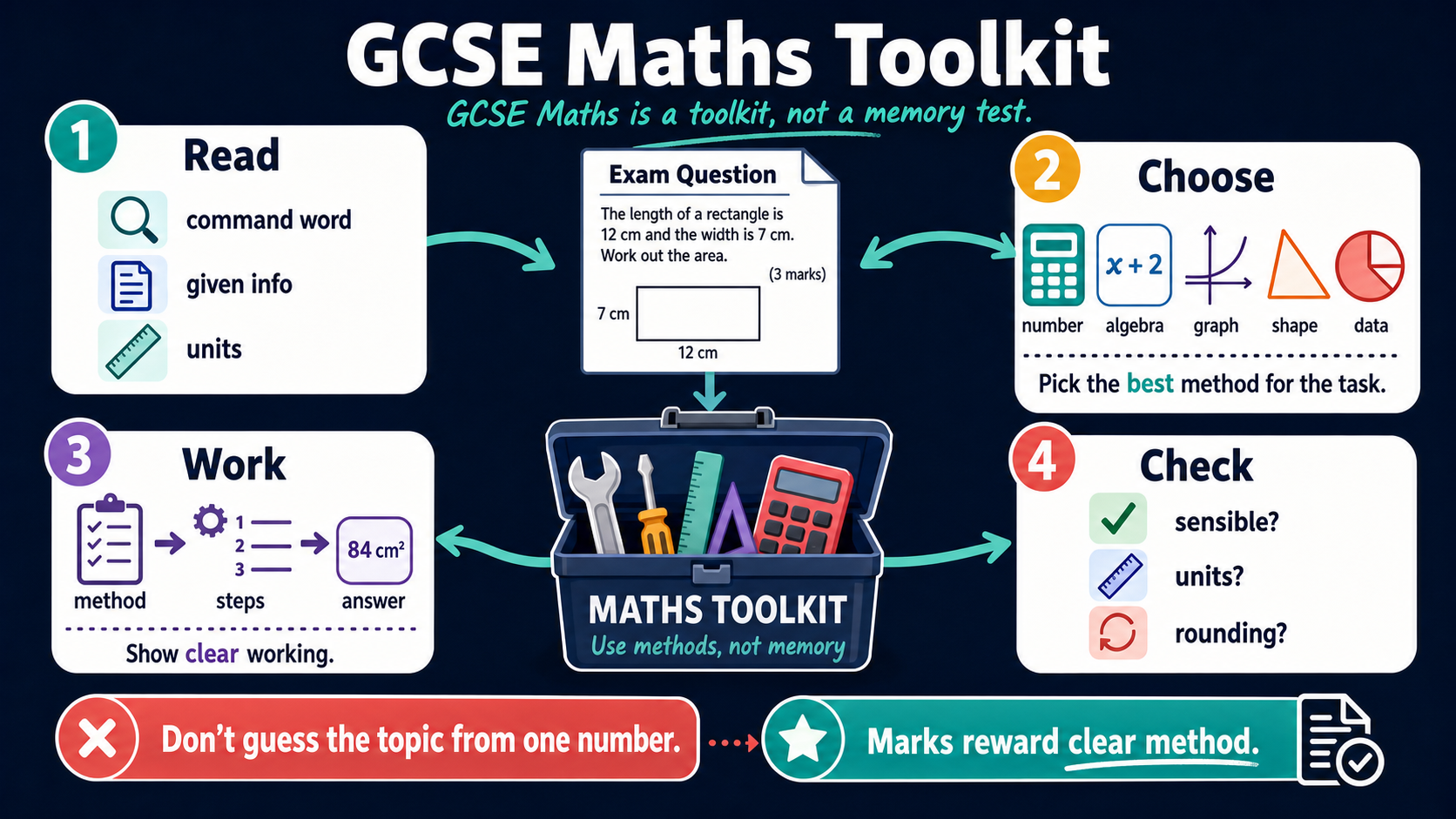
GCSE Maths is not about memorising hundreds of separate tricks. It is more like a toolkit. Each lesson helps you recognise a situation, choose a useful method, and explain your working clearly.
What you will learn
Key habits before you start
Why this matters
Many pupils know more maths than they think. The hard part is often deciding what the question is asking. If you can slow down, spot the command word, and choose a method, the question usually becomes less scary.
This habit also helps in exams because marks are often awarded for clear working, not just final answers.
The five-step GCSE Maths routine
- Read the question slowly. Do not start calculating before you know what is being asked.
- Find the command word. Look for words like work out, show that, estimate, explain or prove.
- Choose the maths tool. This might be a table, diagram, equation, factor tree, formula or simple calculation.
- Show clear working. Write enough steps that another person can follow your thinking.
- Check the answer. Ask: is it the right size, does it answer the question, and have I included units if needed?
GCSE Maths toolkit infographic
Before viewing
Before viewing, choose one recent maths question and decide which toolkit step would have helped most.
After viewing
After viewing, write a five-step checklist you can use before pressing “check answer” or revealing marking guidance.
Command words
Work out
Calculate the answer. Show enough working to support the final result.
Show that
The question already tells you the result. Your job is to write convincing steps.
Estimate
Round sensibly first, then calculate with the rounded numbers.
Explain
Use words as well as maths. Say why your method or conclusion makes sense.
Worked example
Show that 735 is divisible by 15.
The phrase show that means the answer is already suggested. You need to prove it clearly.
15 = 3 × 5735 ends in 5, so it is divisible by 5.
The digit sum is:
7 + 3 + 5 = 1515 is divisible by 3, so 735 is divisible by 3.
Estimate 31.8 × 48.6.
The command word estimate means round first, then calculate with the rounded values.
31.8 ≈ 30 and 48.6 ≈ 50 30 × 50 = 1500Explain why 6.2 × 0.5 is smaller than 6.2.
The command word explain means use a reason, not just an answer.
0.5 = one half 6.2 × 0.5 = 3.1Quick checks
Try these now. The aim is to practise the thinking habit, not to rush.
1. What is the best first step when a question looks wordy?
2. What does “show that” usually mean?
Practice questions
Question 1
Show that 468 is divisible by 12.
Reveal answer and marking guidance
Answer: 468 is divisible by 12 because it is divisible by both 3 and 4.
Marking: Give credit for showing 4 + 6 + 8 = 18, so 468 is divisible by 3, and the last two digits 68 are divisible by 4.
Question 2
Estimate 49.8 × 19.7, showing your rounding.
Reveal answer and marking guidance
Answer: 49.8 × 19.7 is approximately 50 × 20 = 1000.
Marking: Give credit for sensible rounding and for multiplying the rounded values correctly.
Question 3
A question says: “Explain why 0.3 × 0.4 is less than 0.3.” What should your answer include?
Reveal answer and marking guidance
Answer: It should explain that multiplying by 0.4 means taking four tenths of 0.3, so the result is smaller than 0.3.
Marking: Give credit for using words as well as calculation. A useful answer may also show 0.3 × 0.4 = 0.12.
Question 4
A rectangle has area 48 cm² and length 8 cm. Work out the width and include units.
Reveal answer and marking guidance
Answer: 6 cm.
Marking: Give credit for choosing the inverse operation, 48 ÷ 8 = 6, and for including centimetres as the unit of length.
Question 5
A question says: “Work out 18% of 250.” What calculation should you choose?
Reveal answer and marking guidance
Answer: Find 18 ÷ 100 × 250, or find 10% + 5% + 3%. The value is 45.
Marking: Give credit for choosing a percentage method before calculating. The exact answer is 45.
Question 6
A pupil writes only “24” for a perimeter question. What might be missing from the answer?
Reveal answer and marking guidance
Answer: Units may be missing, for example 24 cm, 24 m or 24 mm depending on the question.
Marking: Give credit for noticing that a perimeter is a length, so the final answer should include length units when the question gives units.
Question 7
A question says: “Show that the mean of 6, 8, 10 and 12 is 9.” Write the working you would show.
Reveal answer and marking guidance
Answer: 6 + 8 + 10 + 12 = 36, and 36 ÷ 4 = 9.
Marking: Give credit for showing both the total and the division by the number of values, because “show that” needs convincing steps.
Question 8
Estimate 398 ÷ 19.6, then say why your estimate is sensible.
Reveal answer and marking guidance
Answer: 398 ÷ 19.6 is approximately 400 ÷ 20 = 20, which is sensible because both numbers were rounded only slightly.
Marking: Give credit for sensible rounding, correct division and a short sentence checking the size of the answer.
Question 9
A question says: “Mia buys 3 notebooks at £1.80 each and a pen for 75p. Work out the total cost.” Write a clear method and final answer.
Reveal answer and marking guidance
Answer: 3 × £1.80 = £5.40, then £5.40 + £0.75 = £6.15.
Marking: Give credit for multiplying before adding, converting 75p to £0.75 if using pounds, and giving the final answer as £6.15.
Question 10
A question says: “Show that 36 is a square number and a triangular number.” What working would make the answer convincing?
Reveal answer and marking guidance
Answer: 36 is a square number because 6 × 6 = 36. It is also a triangular number because 1 + 2 + 3 + 4 + 5 + 6 + 7 + 8 = 36.
Marking: Give credit for showing both checks clearly. The word “show” needs evidence, not just the final statement.
Extension challenge
Choose one past lesson question or textbook question. Before solving it, write the command word, the information given, the maths tool you plan to use and one check you will do at the end.
Reveal answer
Example answer: Command word: work out. Given information: the numbers and units in the question. Tool: draw a table, write an equation or choose a calculation. Final check: compare the size of the answer with the context and add units if needed.
Answers and marking guidance
The exact practice answers are hidden under each question so you can try first. For getting-started GCSE Maths questions, marks often come from reading the command word carefully, choosing a clear method, writing enough working for someone else to follow, using units or money notation correctly, and checking that the final answer actually responds to the question.
Common mistakes
- Starting too quickly: read the whole question before choosing a calculation.
- Ignoring the command word: show that, explain and estimate need different styles of answer.
- Hiding your working: write the steps, even if you can do some of the maths in your head.
- Not checking the answer: a quick sense-check can catch simple errors.
Exam-board guidance
This getting-started lesson is useful across GCSE Maths routes. Exam boards can vary question style, but all GCSE pupils benefit from reading carefully, choosing a method and showing clear working.
Next suggested lesson
Start the Number strand with Factors, Multiples and Divisibility. It is a useful first topic because it builds confidence with exact division and clear reasoning.