
Lesson overview
Core GCSE skill first.
Factors, multiples, primes and divisibility are common GCSE Maths number skills. This lesson teaches the shared core before board-level reminders near the end of the lesson.
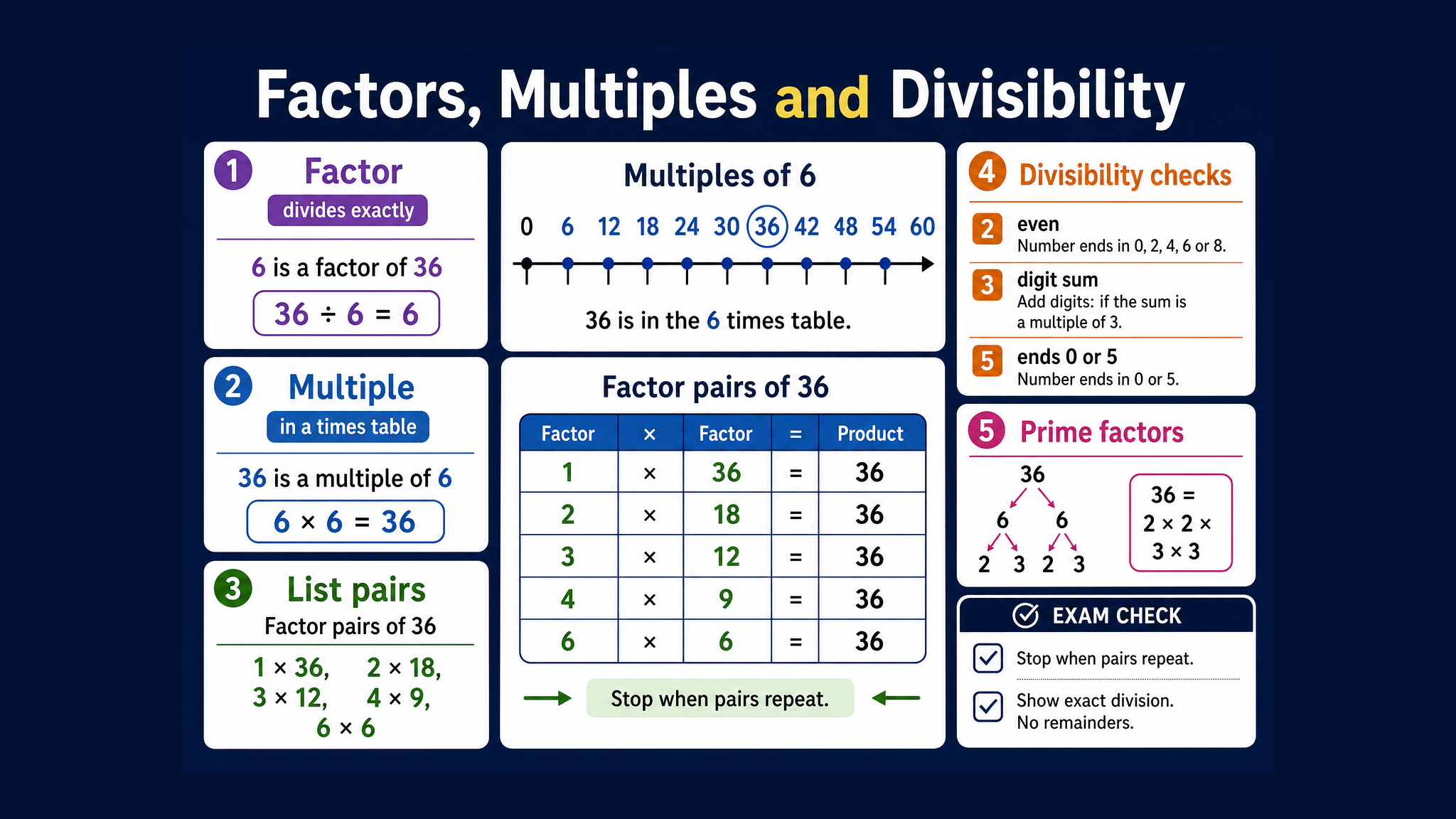
Factors, multiples and divisibility infographic
Before viewing
Before viewing, point to one factor pair, one multiple and one divisibility rule in the infographic.
After viewing
After viewing, choose a number and test whether it is divisible by both 2 and 3, then decide whether it is divisible by 6.
What you will learn
Key facts before you start
Why this matters
Factors and multiples sit underneath lots of GCSE Maths topics. They help with simplifying fractions, finding common denominators, using ratios, factorising algebra and solving number problems.
They also help you work faster. A divisibility test can save you from doing long division when you only need to decide whether a number divides exactly.
Prior knowledge
You will be most comfortable with this lesson if you can already:
Clear explanation
A factor of a number divides into it exactly. For example, 6 is a factor of 42 because:
42 ÷ 6 = 7A multiple is what you get when you multiply a number by a whole number. The first few positive multiples of 6 are:
6, 12, 18, 24, 30, 36, ...
The words are connected. If 6 is a factor of 42, then 42 is a multiple of 6.
For full factor lists, work in pairs from 1 upwards. Stop when the next factor pair would repeat or cross over; that is how you know the list is complete.
Prime numbers and factor trees
A prime number has exactly two factors: 1 and itself. The first few prime numbers are 2, 3, 5, 7, 11 and 13. A factor tree breaks a number down until only prime factors are left.
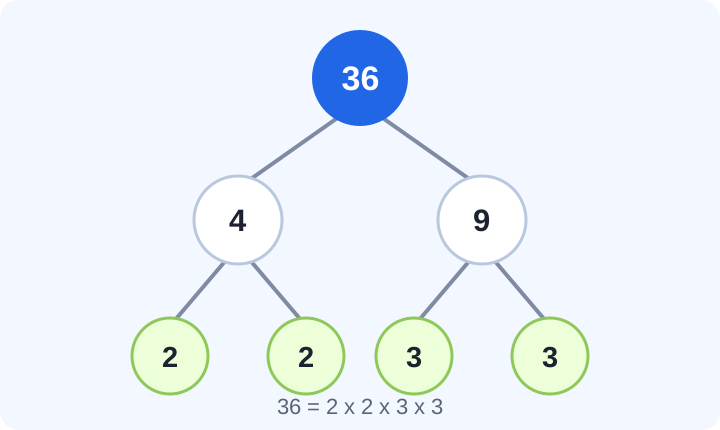
This tree shows:
36 = 2 × 2 × 3 × 3Useful divisibility tests
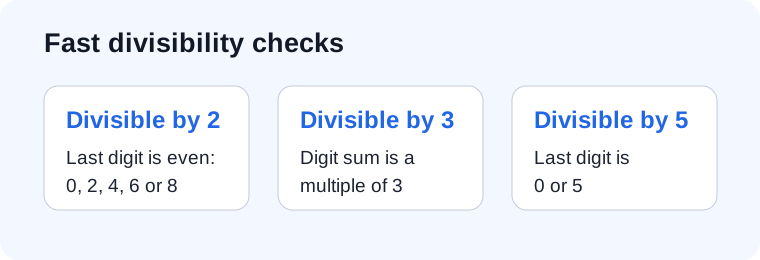
Some divisibility tests combine two simpler tests. For example, a number is divisible by 6 if it is divisible by 2 and 3; it is divisible by 12 if it is divisible by 3 and 4.
Worked examples
Example 1: Is 7 a factor of 84?
Divide 84 by 7.
84 ÷ 7 = 12There is no remainder, so 7 is a factor of 84.
Example 2: List the first five positive multiples of 8.
Multiply 8 by 1, 2, 3, 4 and 5.
8, 16, 24, 32, 40The first five positive multiples of 8 are 8, 16, 24, 32 and 40.
Example 3: Show that 342 is divisible by 6.
A number is divisible by 6 if it is divisible by both 2 and 3.
342 ends in 2, so it is divisible by 2.
The digit sum is:
3 + 4 + 2 = 99 is divisible by 3, so 342 is divisible by 3.
Reveal answer
Answer: 342 is divisible by both 2 and 3, so 342 is divisible by 6.
Quick checks
Try these before you look at the practice answers. You will get instant feedback.
1. Which statement correctly links 9 and 63?
2. What are the next two multiples: 12, 24, 36, ...?
3. Is 728 divisible by 4?
Practice questions
Question 1
List all the factors of 24.
Reveal answer and marking guidance
Answer: 1, 2, 3, 4, 6, 8, 12, 24.
Marking: Award credit for systematic factor pairs: 1 × 24, 2 × 12, 3 × 8, 4 × 6.
Question 2
Write the first six positive multiples of 7.
Reveal answer and marking guidance
Answer: 7, 14, 21, 28, 35, 42.
Marking: The answer should add 7 each time, starting with 7 × 1.
Question 3
Show that 516 is divisible by 3.
Reveal answer and marking guidance
Answer: 516 is divisible by 3.
Marking: The digit sum is 5 + 1 + 6 = 12, and 12 is divisible by 3. The digit-sum test is the important reasoning.
Question 4
Use a factor tree to write 48 as a product of prime factors.
Reveal answer and marking guidance
Answer: 48 = 2 × 2 × 2 × 2 × 3.
Marking: One route is 48 = 6 × 8, then 6 = 2 × 3 and 8 = 2 × 2 × 2.
Question 5
List all the factors of 36 in ascending order.
Reveal answer and marking guidance
Answer: 1, 2, 3, 4, 6, 9, 12, 18, 36.
Marking: Use factor pairs: 1 × 36, 2 × 18, 3 × 12, 4 × 9 and 6 × 6. Include 6 once, not twice.
Question 6
Explain why 1,044 is divisible by 12.
Reveal answer and marking guidance
Answer: 1,044 is divisible by 12.
Marking: A number is divisible by 12 if it is divisible by 3 and 4. The digit sum is 1 + 0 + 4 + 4 = 9, so it is divisible by 3. The last two digits are 44, which is divisible by 4.
Question 7
A pupil says 15 is a multiple of 90. Correct the statement.
Reveal answer and marking guidance
Answer: 15 is a factor of 90, and 90 is a multiple of 15.
Marking: Show the exact division: 90 ÷ 15 = 6. The smaller number is the factor; the larger number is the multiple in this statement.
Question 8
Write 90 as a product of prime factors.
Reveal answer and marking guidance
Answer: 90 = 2 × 3 × 3 × 5 = 2 × 3² × 5.
Marking: One route is 90 = 9 × 10, then 9 = 3 × 3 and 10 = 2 × 5. Do not leave 9 or 10 in the final prime-factor answer.
Question 9
A number is divisible by 4 and by 9. Is it always divisible by 36? Explain your answer.
Reveal answer and marking guidance
Answer: Yes. A number divisible by both 4 and 9 is divisible by 36.
Marking: 4 and 9 have no common factor other than 1, so their combined test gives 4 × 9 = 36. State that both tests must be true for the same number.
Question 10
A number is divisible by 6 and by 10. Is it always divisible by 60? Explain your answer.
Reveal answer and marking guidance
Answer: No. For example, 30 is divisible by 6 and by 10, but 30 is not divisible by 60.
Marking: The tests cannot simply be multiplied because 6 and 10 share a common factor of 2. A counterexample such as 30 is enough if it is checked clearly.
Answers and marking guidance
The practice answers are hidden under each question so you can try the work first. For this topic, marks usually come from systematic factor pairs, correct multiple lists, a valid divisibility test and factor-tree branches that keep splitting until only primes remain. When combining divisibility tests, say why the tests work together instead of just multiplying two rule numbers.
Common mistakes
- Mixing up factors and multiples: factors divide into a number; multiples are made by multiplying.
- Missing factor pairs: work systematically from 1 upwards so you do not skip a pair.
- Using only the last digit for divisibility by 3: for 3, use the sum of the digits.
- Stopping a factor tree too early: keep splitting until every branch ends in a prime number.
- Writing only a final answer for a show that question: GCSE marks often depend on the reasoning.
Extension challenge
Find a three-digit number that is divisible by 2, 3 and 5, but not divisible by 9. Explain how you know.
Reveal one possible answer
One possible answer: 120. It is even, so divisible by 2. It ends in 0, so divisible by 5. Its digit sum is 1 + 2 + 0 = 3, so it is divisible by 3. The digit sum is not divisible by 9, so 120 is not divisible by 9.
Exam-board guidance
Factors, multiples, primes and divisibility tests appear across GCSE Maths specifications as number-fluency skills. Expect exact division checks, factor or multiple lists, prime/composite language and short explanations that justify why a number does or does not divide exactly.
Next suggested lesson
Highest Common Factor and Lowest Common Multiple is the natural next step because it uses factors and multiples to solve comparison and grouping problems.