
Lesson overview
A shared GCSE Number skill.
HCF and LCM build directly from factors, multiples and prime factors. This lesson teaches the core method first, then keeps board-level reminders at the end.
What you will learn
Key facts before you start
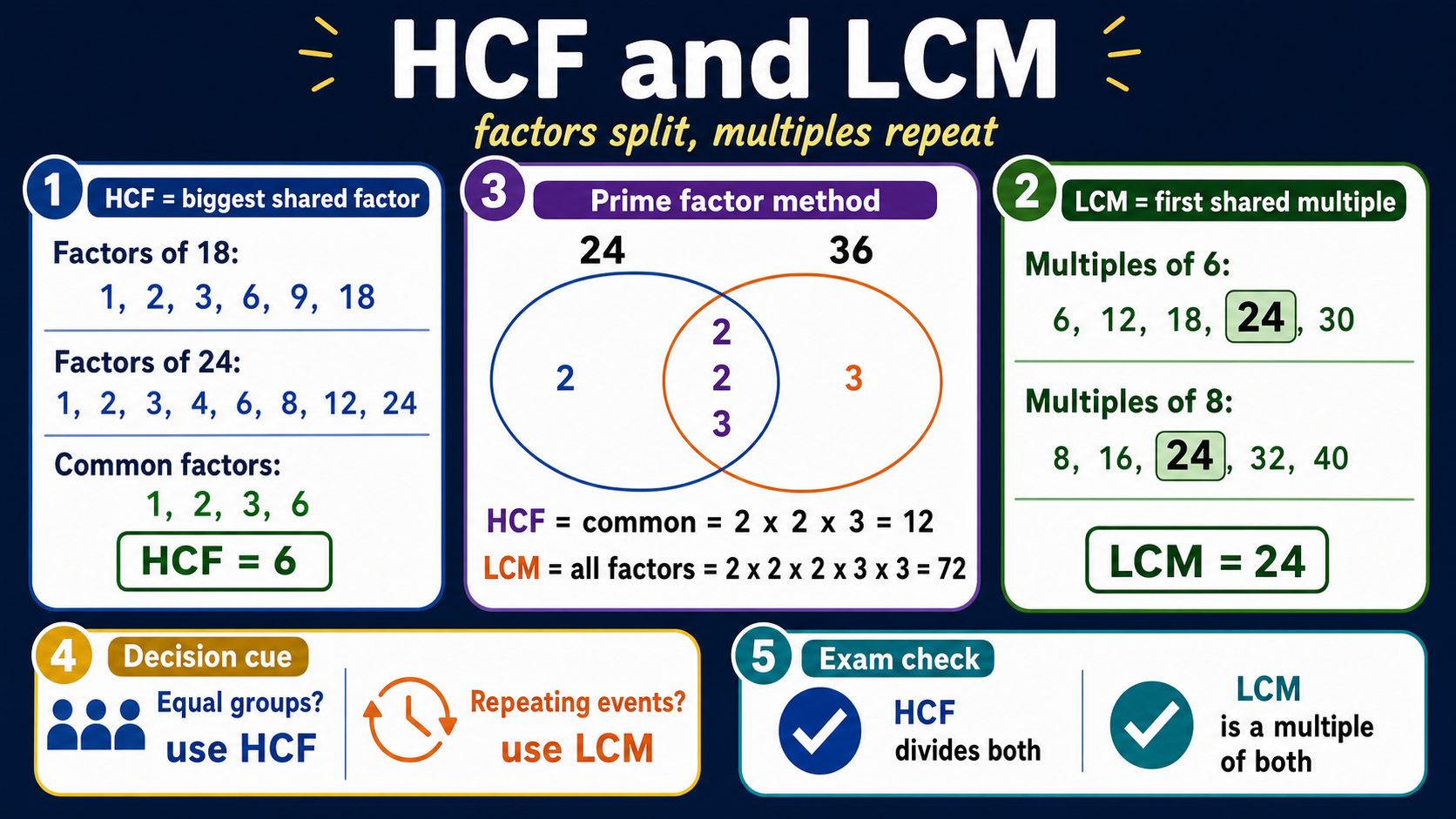
HCF and LCM infographic
Before viewing
Before viewing, decide which part of the visual shows sharing and which part shows repeating cycles.
After viewing
After viewing, write one question that needs HCF and one that needs LCM, then explain the clue.
Why this matters
HCF and LCM questions often look like real-life grouping or timing problems. HCF helps when you are splitting things into the biggest equal groups. LCM helps when cycles meet again at the same time.
These skills also help later with fractions, ratio, algebraic factors and problem solving.
Prior knowledge
You should already be comfortable with:
Clear explanation
The highest common factor is the biggest number that divides exactly into two or more numbers. It is often shortened to HCF.
The lowest common multiple is the smallest positive number that appears in the times tables of two or more numbers. It is often shortened to LCM.
A useful check is that the HCF must divide each original number exactly. The LCM must be divisible by each original number exactly.
Finding HCF by listing factors
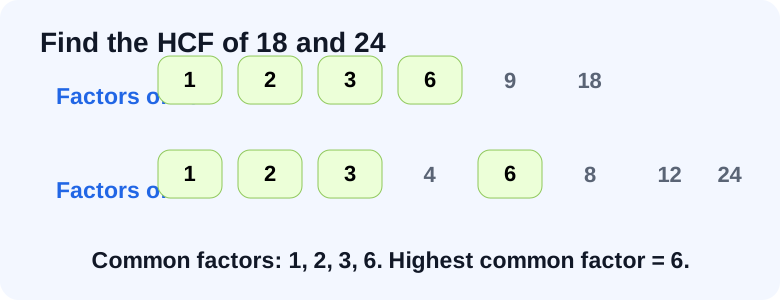
List the factors of both numbers, find the ones that appear in both lists, then choose the biggest common factor.
Finding LCM by listing multiples
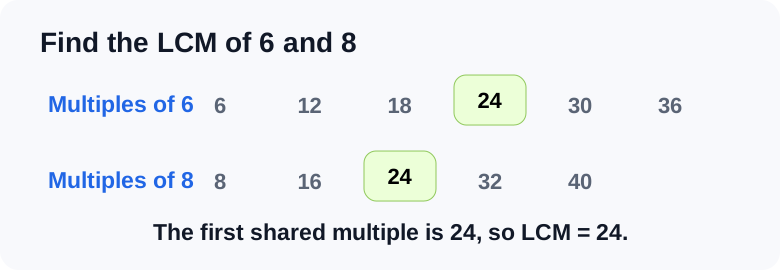
List multiples of both numbers, then choose the first number that appears in both lists.
Using prime factors
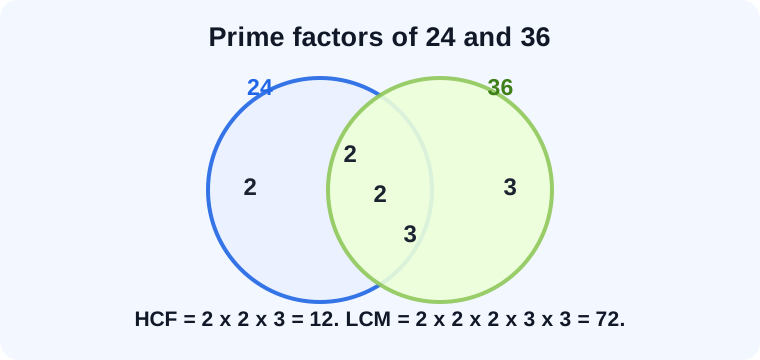
Prime factors are useful when the numbers are larger. Put shared prime factors in the overlap. The HCF uses the overlap. The LCM uses every prime factor shown.
Worked examples
Example 1: Find the HCF of 18 and 24.
Factors of 18:
1, 2, 3, 6, 9, 18Factors of 24:
1, 2, 3, 4, 6, 8, 12, 24The common factors are 1, 2, 3 and 6.
Reveal answer
Answer: The HCF is 6.
Example 2: Find the LCM of 6 and 8.
Multiples of 6:
6, 12, 18, 24, 30, 36, ...Multiples of 8:
8, 16, 24, 32, 40, ...The first shared multiple is 24.
Reveal answer
Answer: The LCM is 24.
Example 3: A grouping problem
A teacher has 30 pens and 45 pencils. They want to make identical packs with no items left over. What is the greatest number of packs they can make?
This asks for the greatest number of equal groups, so use HCF.
Factors of 30: 1, 2, 3, 5, 6, 10, 15, 30 Factors of 45: 1, 3, 5, 9, 15, 45Reveal answer
Answer: The HCF is 15, so they can make 15 packs.
Quick checks
Choose an answer, then check your thinking.
1. What is the HCF of 12 and 18?
2. What is the LCM of 4 and 10?
3. Which type of problem usually needs HCF?
Practice questions
Question 1
Find the HCF of 20 and 28.
Reveal answer and marking guidance
Answer: 4.
Marking: Factors of 20 include 1, 2, 4, 5, 10, 20. Factors of 28 include 1, 2, 4, 7, 14, 28. The highest common factor is 4.
Question 2
Find the LCM of 9 and 12.
Reveal answer and marking guidance
Answer: 36.
Marking: Multiples of 9 are 9, 18, 27, 36. Multiples of 12 are 12, 24, 36. The first shared multiple is 36.
Question 3
Two bells ring together. One rings every 6 minutes and the other rings every 14 minutes. When will they next ring together?
Reveal answer and marking guidance
Answer: 42 minutes.
Marking: This is a repeating-events problem, so use LCM. The LCM of 6 and 14 is 42.
Question 4
A charity has 48 cereal bars and 60 juice cartons. They want the greatest number of identical snack packs with nothing left over. How many packs can they make?
Reveal answer and marking guidance
Answer: 12 packs.
Marking: This is a greatest equal groups problem, so use HCF. The HCF of 48 and 60 is 12.
Question 5
Find the HCF and LCM of 24 and 40.
Reveal answer and marking guidance
Answer: HCF = 8 and LCM = 120.
Marking: 24 = 2³ × 3 and 40 = 2³ × 5. The shared prime factor part is 2³ = 8. The LCM uses every prime factor: 2³ × 3 × 5 = 120.
Question 6
Traffic lights change every 18 seconds and 30 seconds. They change together now. When will they next change together?
Reveal answer and marking guidance
Answer: 90 seconds.
Marking: This is a repeated-cycle problem, so use LCM. 18 = 2 × 3² and 30 = 2 × 3 × 5, so LCM = 2 × 3² × 5 = 90.
Question 7
A shop has 72 pens and 96 pencils. It wants to make the greatest number of identical packs with no items left over. How many pens and pencils are in each pack?
Reveal answer and marking guidance
Answer: 24 packs, with 3 pens and 4 pencils in each pack.
Marking: The greatest number of packs is the HCF of 72 and 96, which is 24. Then divide: 72 ÷ 24 = 3 and 96 ÷ 24 = 4.
Question 8
A recipe uses packs of 8 buns and packs of 12 burgers. What is the smallest number of each item you can buy so there are no buns or burgers left over?
Reveal answer and marking guidance
Answer: 24 buns and 24 burgers.
Marking: Use LCM because you need the first shared total. The LCM of 8 and 12 is 24, so buy 3 packs of buns and 2 packs of burgers.
Question 9
Two numbers have HCF 5 and LCM 140. One number is 20. Find the other number.
Reveal answer and marking guidance
Answer: 35.
Marking: For two numbers, first number × second number = HCF × LCM. So 20 × other number = 5 × 140 = 700, and 700 ÷ 20 = 35. Check: HCF(20, 35) = 5 and LCM(20, 35) = 140.
Question 10
Two numbers have HCF 6 and LCM 180. One number is 30. Find the other number, then check both facts.
Reveal answer and marking guidance
Answer: 36.
Marking: Use first number × second number = HCF × LCM, so 30 × other number = 6 × 180 = 1080. Then 1080 ÷ 30 = 36. Check: HCF(30, 36) = 6 and LCM(30, 36) = 180.
Answers and marking guidance
The practice answers are hidden under each question so you can try the work first. In HCF/LCM questions, marks are often awarded for choosing the right method and showing clear lists or prime-factor working. State why the context needs HCF or LCM, then include units or a context sentence when the question is about packs, timings or repeated events. For reverse problems, check both the HCF and the LCM before accepting the missing number.
Common mistakes
- Mixing up HCF and LCM: HCF is a factor and is usually smaller. LCM is a multiple and is usually larger.
- Choosing any common factor: HCF means the highest common factor.
- Choosing any common multiple: LCM means the lowest common multiple.
- Stopping lists too soon: keep going until you can see the first shared multiple.
- Missing the context: grouping problems often use HCF; repeating-event problems often use LCM.
Extension challenge
Find two different numbers with HCF 6 and LCM 90. Explain how you found them.
Reveal one possible answer
One possible answer: 18 and 30. Their common factors include 1, 2, 3 and 6, so HCF = 6. Their multiples first meet at 90, so LCM = 90.
Exam-board guidance
HCF and LCM appear across GCSE Maths specifications in direct number questions and real contexts such as sharing, packaging, schedules and repeated events. The important exam habit is deciding whether the wording asks for the greatest shared factor or the first shared multiple, then showing the list or prime-factor method clearly.
Next suggested lesson
Prime Factorisation is a useful next step because it gives a faster method for larger HCF and LCM questions.