
Lesson overview
A shared GCSE Number skill.
Prime factorisation is the method of writing a number as a product of prime numbers. It is useful on its own and it makes larger HCF and LCM questions much more organised.
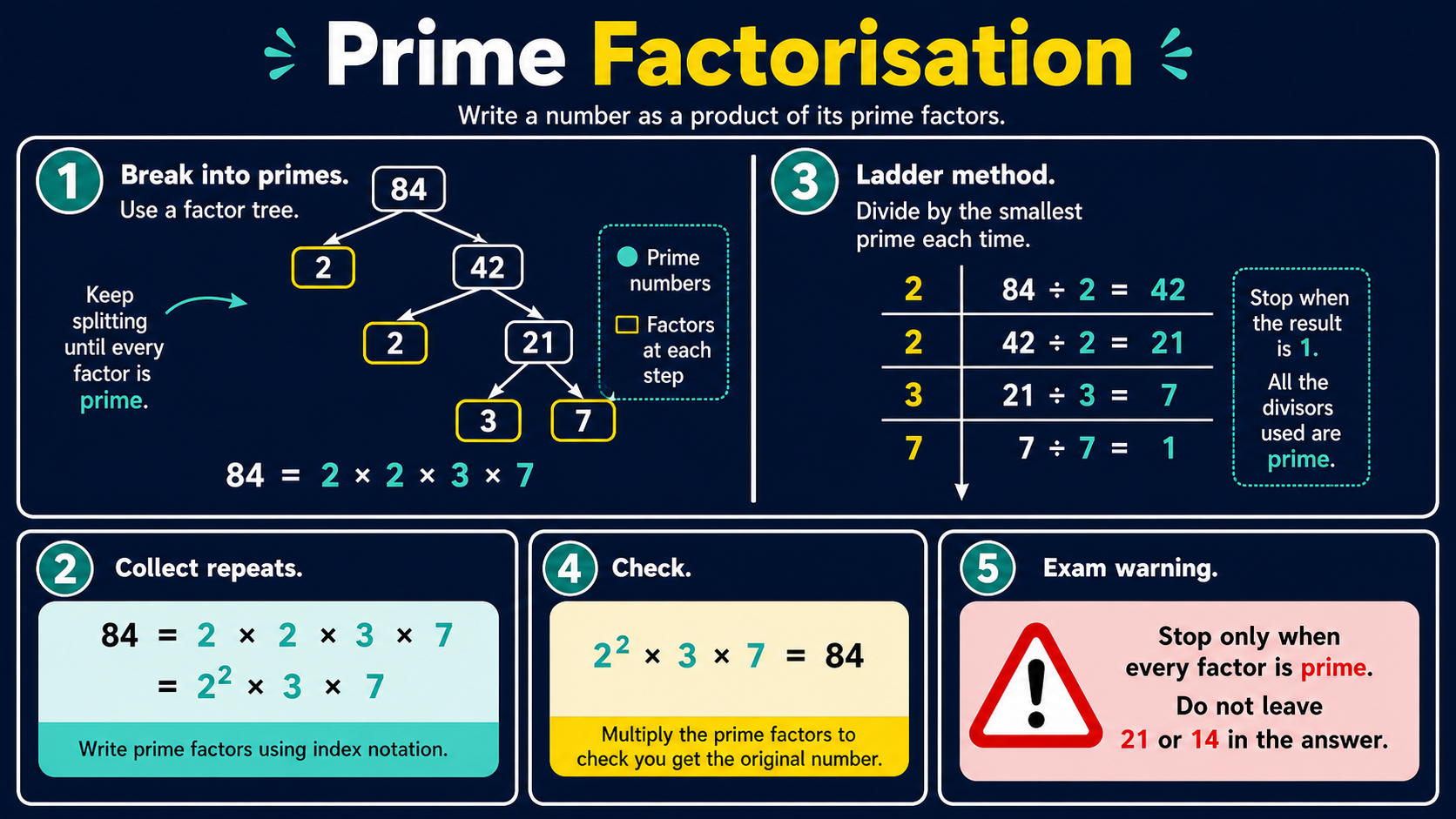
Prime factorisation infographic
Before viewing
Before viewing, follow one factor tree branch until it ends in prime numbers.
After viewing
After viewing, build two different factor trees for the same number and check that the final prime factors match.
What you will learn
Key facts before you start
Why this matters
Prime factorisation gives every whole number a clear building-block structure. Once you can see the prime factors, HCF and LCM questions become less about guessing and more about choosing the right pieces.
This skill also helps later with simplifying fractions, working with powers, surds and algebraic factorisation.
Prior knowledge
You should already be comfortable with:
Clear explanation
A prime number has exactly two factors: 1 and itself. The first few prime numbers are 2, 3, 5, 7, 11 and 13.
Prime factorisation means writing a number as prime numbers multiplied together. The order can change, but the prime factors are the same.
The final line must contain primes only. If your answer still includes 4, 6, 8, 9, 10, 12 or another composite number, keep splitting.
Factor tree method
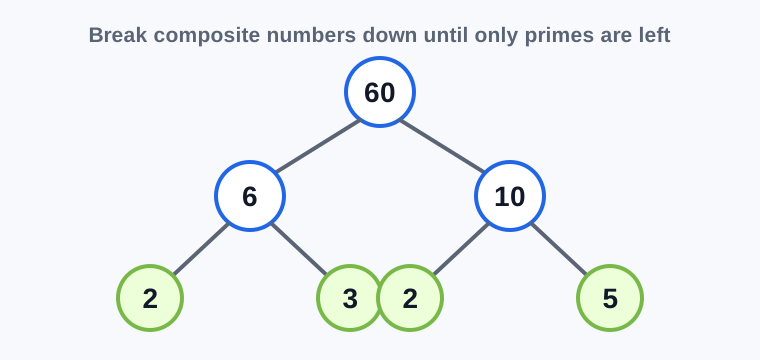
Start with the number. Split it into any factor pair. Keep splitting composite numbers until every branch ends in a prime number.
60 = 2 × 2 × 3 × 5Writing with powers
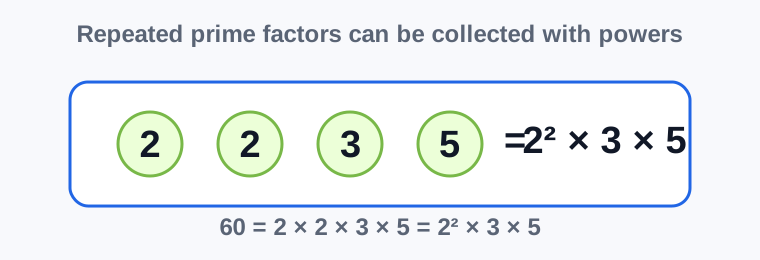
If the same prime appears more than once, you can collect it using a power.
2 × 2 × 3 × 5 = 2² × 3 × 5Division ladder method
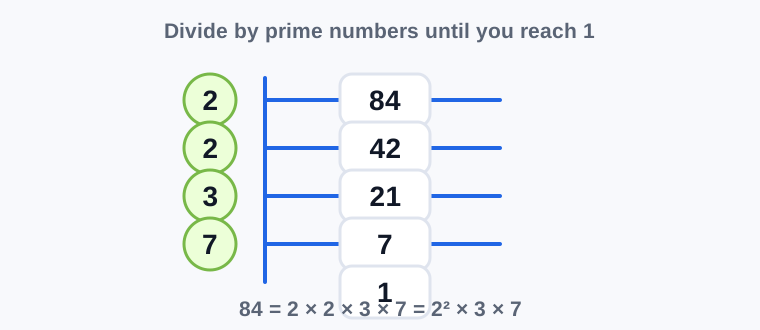
Divide by prime numbers until you reach 1. The primes down the side are the prime factors.
Always check by multiplying the prime factors back together. This catches missed factors before you move on.
Worked examples
Example 1: Write 36 as a product of prime factors.
Split 36 into a factor pair:
36 = 6 × 6Now split each 6:
6 = 2 × 3So all the prime factors are 2, 3, 2 and 3.
Reveal answer
Answer: 36 = 2 × 2 × 3 × 3 = 2² × 3².
Example 2: Write 84 as a product of prime factors.
Use a division ladder:
84 ÷ 2 = 42 42 ÷ 2 = 21 21 ÷ 3 = 7 7 ÷ 7 = 1Reveal answer
Answer: 84 = 2 × 2 × 3 × 7 = 2² × 3 × 7.
Example 3: Use prime factors to support HCF.
Find the HCF of 60 and 84.
60 = 2² × 3 × 5 84 = 2² × 3 × 7The shared prime factors are 2² and 3.
Reveal answer
Answer: HCF = 2² × 3 = 12.
Quick checks
Choose an answer, then check your thinking.
1. Which list contains only prime numbers?
2. What is the prime factorisation of 45?
3. In 2³ × 5, what does 2³ mean?
Practice questions
Question 1
Write 24 as a product of prime factors.
Reveal answer and marking guidance
Answer: 24 = 2 × 2 × 2 × 3 = 2³ × 3.
Marking: Split 24 into factors such as 4 × 6, then split again until only primes remain.
Question 2
Write 72 as a product of prime factors.
Reveal answer and marking guidance
Answer: 72 = 2 × 2 × 2 × 3 × 3 = 2³ × 3².
Marking: A clear tree or ladder earns method credit. Check the final multiplication gives 72.
Question 3
The prime factorisation of a number is 2² × 3 × 5. What is the number?
Reveal answer and marking guidance
Answer: 60.
Marking: 2² × 3 × 5 = 4 × 3 × 5 = 12 × 5 = 60.
Question 4
Use prime factors to find the HCF of 48 and 72.
Reveal answer and marking guidance
Answer: 24.
Marking: 48 = 2⁴ × 3 and 72 = 2³ × 3². The shared prime factors are 2³ and 3, so HCF = 8 × 3 = 24.
Question 5
Write 96 as a product of prime factors, using index notation.
Reveal answer and marking guidance
Answer: 96 = 2⁵ × 3.
Marking: One route is 96 = 32 × 3 and 32 = 2 × 2 × 2 × 2 × 2. Check: 2⁵ × 3 = 32 × 3 = 96.
Question 6
A pupil writes 108 = 2 × 6 × 9. Explain why this is not a prime factorisation, then correct it.
Reveal answer and marking guidance
Answer: 6 and 9 are not prime. The correct prime factorisation is 108 = 2² × 3³.
Marking: Split the composite factors: 6 = 2 × 3 and 9 = 3 × 3, so 108 = 2 × 2 × 3 × 3 × 3.
Question 7
The prime factorisation of a number is 3² × 5 × 7. What is the number?
Reveal answer and marking guidance
Answer: 315.
Marking: 3² × 5 × 7 = 9 × 5 × 7 = 45 × 7 = 315.
Question 8
Use prime factors to find the LCM of 18 and 30.
Reveal answer and marking guidance
Answer: 90.
Marking: 18 = 2 × 3² and 30 = 2 × 3 × 5. The LCM uses every prime factor needed: 2 × 3² × 5 = 90.
Question 9
A number has prime factorisation 2³ × 3 × 11. Find the number, then explain one quick check you can do.
Reveal answer and marking guidance
Answer: 264.
Marking: 2³ × 3 × 11 = 8 × 3 × 11 = 264. A quick check is to multiply the prime factors back together and confirm the product is 264.
Question 10
84 is multiplied by the smallest positive integer that makes the result a square number. Find that integer.
Reveal answer and marking guidance
Answer: 21.
Marking: 84 = 2² × 3 × 7. A square number needs even powers of every prime, so multiply by 3 × 7 = 21. Then 84 × 21 = 1764 = 42².
Answers and marking guidance
The exact practice answers are hidden under each question so you can try first. For prime factorisation, marks often come from a complete method: keep splitting until every final factor is prime, write repeated primes with correct index notation when useful, and check by multiplying back. In HCF, LCM or square-number questions, compare the powers of each prime rather than relying on a guessed factor pair.
Common mistakes
- Stopping too early: 4, 6, 9, 10, 12 and 15 are not prime, so they still need splitting.
- Including 1: 1 is not a prime factor.
- Losing a factor: every split must keep the same value when multiplied back together.
- Writing powers incorrectly: 2³ means 2 × 2 × 2, not 2 × 3.
- Not checking the product: multiply your prime factors to make sure you get the original number.
Extension challenge
A number has prime factorisation 2³ × 3² × 5. Find the number, then write down two different factor pairs for it.
Reveal answer
Answer: 2³ × 3² × 5 = 8 × 9 × 5 = 360. Two possible factor pairs are 10 and 36, or 12 and 30.
Exam-board guidance
Prime factorisation appears across GCSE Maths specifications as a direct Number skill and as support for HCF, LCM, powers and later exact-value work. Show a complete factor tree or repeated-division ladder, collect repeated primes into powers when asked, and check by multiplying back to the original number.
Next suggested lesson
Squares, Cubes and Roots is a useful next step because prime factorisation already uses powers and repeated multiplication.