
Lesson overview
A shared GCSE Number skill.
Squares, cubes and roots are shared GCSE Number skills. This lesson builds from repeated multiplication to inverse operations, then uses the ideas in area, volume, ordering and sign-error questions.
The main exam habit is simple but powerful: when you find a root, check by powering back. If the answer is a length, use a length unit; if the question gives an area or volume, do not copy the area or volume unit into the final side length.
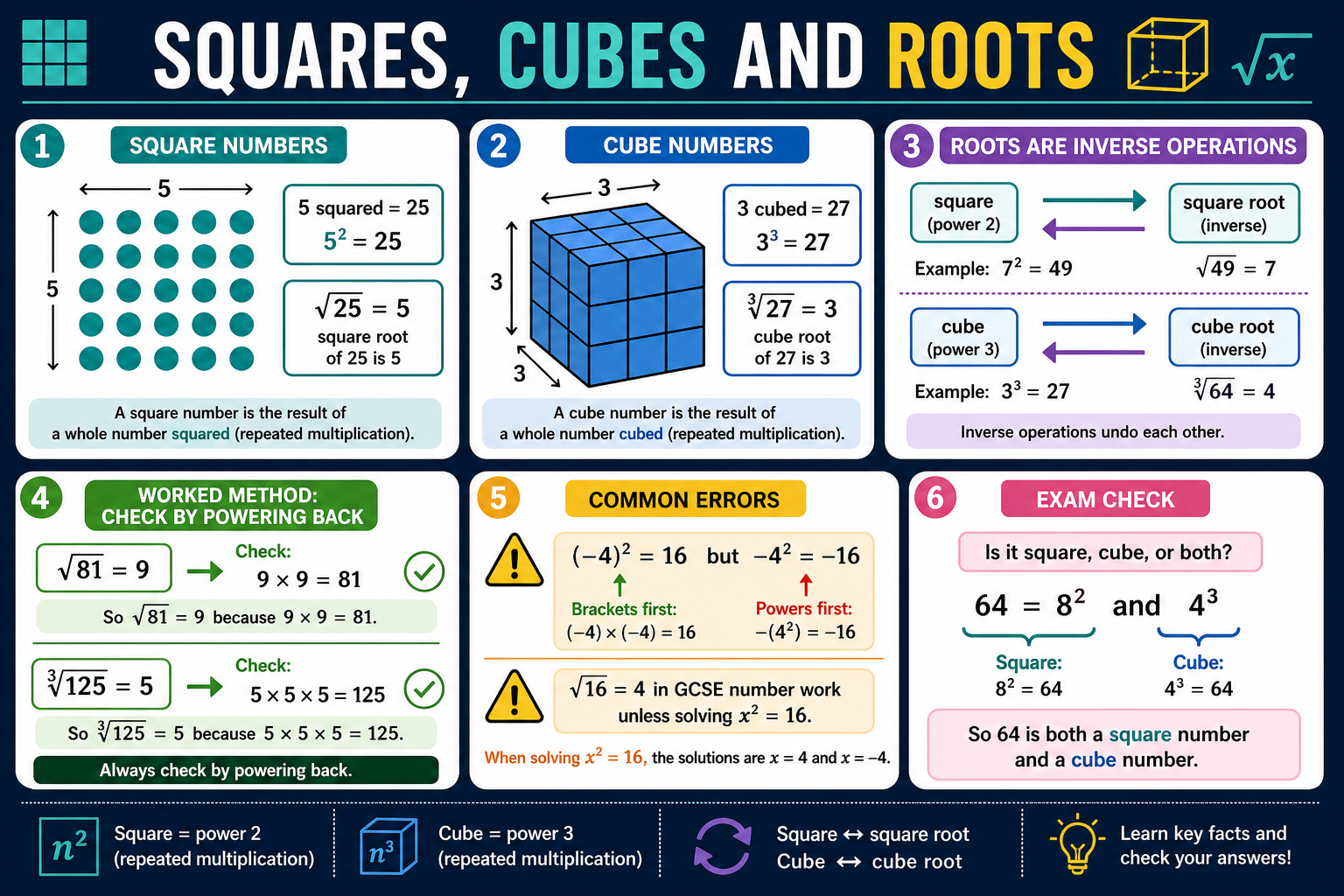
Squares, cubes and roots infographic
Use the infographic as a focus task before the examples: find where it shows that roots undo powers, then explain why 64 is both a square number and a cube number.
After viewing
Write two inverse-operation sentences: one using a square and one using a cube. Example: 7² = 49, so √49 = 7.
What you will learn
Key facts before you start
Why this matters
Squares and roots appear in number questions, area, Pythagoras, graphs, surds and algebra. Cubes and cube roots appear in volume, powers and calculator questions.
Knowing the common values helps you work faster and makes later topics feel much less mysterious.
Prior knowledge
You should already be comfortable with:
Clear explanation
To square a number, multiply it by itself. The notation 5² means 5 × 5.
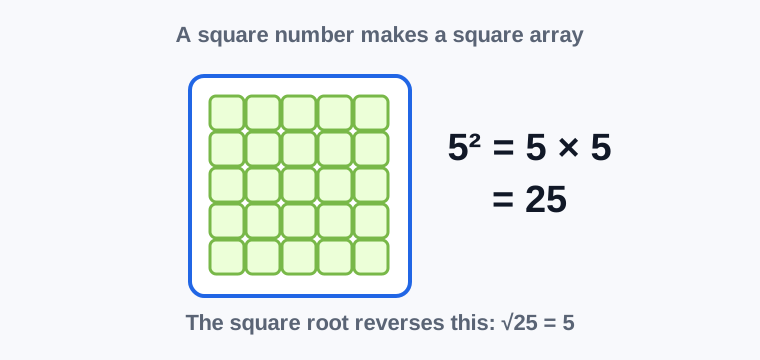
A square root reverses squaring. It asks: what number was squared to make this?
√25 = 5 because 5² = 25For GCSE number work, the square root symbol √ usually asks for the positive square root. When an equation such as x² = 25 is being solved, both x = 5 and x = −5 may need considering because both square to 25.
Cube numbers
To cube a number, multiply it by itself three times. The notation 3³ means 3 × 3 × 3.
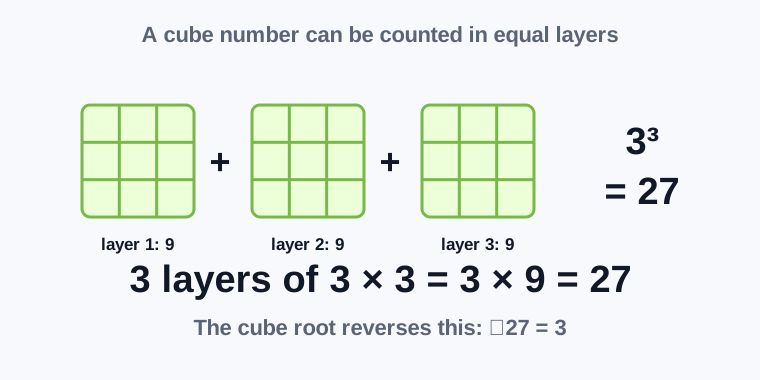
A cube root reverses cubing.
∛27 = 3 because 3³ = 27Roots undo powers
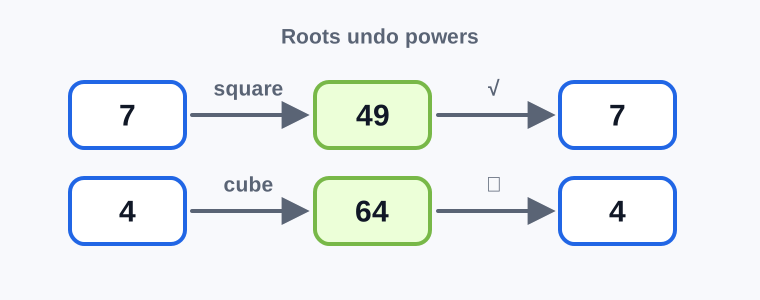
A useful habit is to check roots by multiplying back. If √81 = 9, then 9 × 9 should give 81.
Common values worth knowing
You do not need to memorise every possible power, but the common GCSE values make non-calculator questions much faster. A short recall list also helps you spot when a calculator answer is unreasonable.
Negative signs and brackets
Brackets matter when negative numbers are squared. (−4)² means (−4) × (−4), so the answer is 16. But −4² is usually read as −(4²), so the answer is −16.
(−4)² = 16, but −4² = −16In geometry, square roots often find a side length from an area, and cube roots often find an edge length from a volume.
If a cube has volume 125 cm³, each edge is ∛125 = 5 cm.Method habit
After every root, multiply back. After √196 = 14, check 14 × 14 = 196. After ∛216 = 6, check 6 × 6 × 6 = 216.
Worked examples
Example 1: Find 8².
Squared means multiply the number by itself.
8² = 8 × 8Reveal answer
Answer: 8² = 64. This is not 8 × 2.
Example 2: Find √144.
Ask which number squared gives 144.
12 × 12 = 144Reveal answer
Answer: √144 = 12. Check by powering back: 12² = 144.
Example 3: Find 4³ and ∛64.
Cube 4 by multiplying three 4s:
4³ = 4 × 4 × 4 = 64So the cube root reverses this.
Reveal answer
Answer: 4³ = 64 and ∛64 = 4. The same number, 64, is also 8², so it can be both a square and a cube number.
Example 4: Brackets with a negative number
Find (−6)² and −6².
(−6)² = (−6) × (−6) = 36 −6² = −(6 × 6) = −36Reveal answer
Answer: the brackets change the meaning, so the answers are 36 and −36. In written work, keep the brackets visible.
Example 5: Use roots in a volume question
A cube has volume 729 cm³. Find one edge length.
∛729 = 9 because 9 × 9 × 9 = 729Reveal answer
Answer: each edge is 9 cm. Use cm because the question asks for a length, not a volume.
Example 6: Decide which operation is needed
A square has side length 11 cm. Another square has area 121 cm². What calculation answers each question?
Side 11 cm → area = 11² = 121 cm² Area 121 cm² → side = √121 = 11 cmReveal answer
Answer: square when moving from side to area; square root when moving from area back to side.
Quick checks
Choose an answer, then check your thinking.
1. What is 9²?
2. Which calculation checks that √121 = 11?
3. What is ∛125?
4. A square has area 49 cm². What is the side length?
5. Which statement is correct?
Practice questions
Work down the ladder: fluency first, then inverse reasoning, then area and volume contexts. Show enough working that someone can see whether you squared, cubed, square-rooted or cube-rooted.
Question 1: fluency
Find 12².
Reveal answer and marking guidance
Answer: 144.
Marking: 1 mark for recognising 12² means 12 × 12; 1 mark for 144. Common error: calculating 12 × 2.
Question 2: inverse operation
Find √196.
Reveal answer and marking guidance
Answer: 14.
Marking: 1 mark for using a square root; 1 mark for checking 14 × 14 = 196. Accept a correct calculator answer if the question allows calculators.
Question 3: cube number
Find 6³.
Reveal answer and marking guidance
Answer: 216.
Marking: 1 mark for 6 × 6 × 6; 1 mark for 216. Common error: calculating 6 × 3 = 18.
Question 4: cube root
Find ∛343.
Reveal answer and marking guidance
Answer: 7.
Marking: 1 mark for recognising a cube root; 1 mark for 7 because 7 × 7 × 7 = 343.
Question 5: area context
A square has area 81 cm². What is the length of one side?
Reveal answer and marking guidance
Answer: 9 cm.
Marking: 1 mark for √81; 1 mark for 9; 1 mark for the length unit cm. Do not give cm² for a side length.
Question 6: negative-number notation
Find (−5)² and −5².
Reveal answer and marking guidance
Answer: (−5)² = 25 and −5² = −25.
Marking: 1 mark for (−5) × (−5) = 25; 1 mark for recognising −5² means −(5²) unless brackets are shown. The key evidence is the brackets.
Question 7: volume context
A cube has volume 216 cm³. What is the length of one edge?
Reveal answer and marking guidance
Answer: 6 cm.
Marking: 1 mark for ∛216; 1 mark for 6; 1 mark for using cm, not cm³, because an edge is a length.
Question 8: compare values
Put these values in ascending order: √49, 3², ∛64, 2³.
Reveal answer and marking guidance
Answer: ∛64, √49, 2³, 3².
Marking: 1 mark for converting to 4, 7, 8 and 9; 1 mark for ascending order. Common error: placing 3² before 2³ because 3 is smaller than 2³'s answer.
Question 9: decimal area
A square has area 2.25 m². Find the side length.
Reveal answer and marking guidance
Answer: 1.5 m.
Marking: 1 mark for √2.25; 1 mark for 1.5; 1 mark for m. Check by multiplying 1.5 × 1.5 = 2.25.
Question 10: larger cube root
A cube has volume 729 cm³. Find the length of one edge.
Reveal answer and marking guidance
Answer: 9 cm.
Marking: 1 mark for ∛729; 1 mark for 9; 1 mark for cm. A full-credit answer checks 9 × 9 × 9 = 729.
Question 11: explain your choice
A pupil says √64 = 4 because 4³ = 64. Explain the mistake and give the correct value of √64.
Reveal answer and marking guidance
Answer: The pupil has used the cube root fact. √64 = 8 because 8 × 8 = 64.
Marking: 1 mark for identifying the square-root/cube-root mix-up; 1 mark for √64 = 8; 1 mark for the check 8² = 64.
Answers and marking guidance
The practice answers are hidden under each question so you can try first. For this topic, marks often come from using the correct inverse operation, showing the multiplication that checks a root, recalling common square and cube values accurately, keeping square roots and cube roots separate, including units in area or volume contexts, and treating brackets around negative numbers carefully.
A strong GCSE answer normally shows the operation, the checked value and the correct unit where there is a context. When an area or volume is decimal or large, check by multiplying the proposed side or edge back.
Common mistakes
Multiplying by 2 instead of squaring
Why it is wrong: the power tells you how many times the number appears as a factor, not which number to multiply by.
Corrected example: 7² = 7 × 7 = 49, not 7 × 2 = 14.
Multiplying by 3 instead of cubing
Why it is wrong: cubing means three copies of the number are multiplied together.
Corrected example: 4³ = 4 × 4 × 4 = 64, not 4 × 3 = 12.
Mixing up square roots and cube roots
Why it is wrong: a square root reverses squaring; a cube root reverses cubing.
Corrected example: √64 = 8, but ∛64 = 4.
Dropping or copying the wrong unit
Why it is wrong: finding a side or edge length gives a length unit, even if the question starts with area or volume.
Corrected example: if area = 81 cm², side = √81 = 9 cm.
Ignoring brackets around negative numbers
Why it is wrong: brackets decide whether the negative sign is part of the number being squared.
Corrected example: (−3)² = 9, but −3² is usually read as −(3²) = −9.
Extension challenge
Find three positive whole numbers that are both square numbers and cube numbers. For each one, show the square fact and the cube fact. Then write one sentence explaining the pattern.
Reveal answer
One possible answer: 1, 64 and 729. 1 = 1² = 1³, 64 = 8² = 4³, and 729 = 27² = 9³.
These are sixth powers: for example, 2⁶ = 64 and 3⁶ = 729. A sixth power can be written as both a square and a cube.
Exam-board guidance
This is shared GCSE Number content: specifications commonly include inverse operations, conventional notation with brackets, powers and roots, and positive integer powers with associated square and cube roots. Check your own specification for exact wording, tier sequencing and calculator rules.
Aplailasain is an independent learning resource. Board wording and assessment routes can change, so use this as study guidance alongside your current specification.
Next suggested lesson
Powers and Indices is a useful next step because squares and cubes are the first examples of index notation.