
Lesson overview
A core GCSE Number skill that later appears in Algebra.
Powers and indices help you write repeated multiplication neatly. The same laws are used in standard form, prime factorisation, algebra and exact-value work.
The main GCSE habit is to check the base first. If the bases match, an index law may help. If the bases do not match, rewrite them first or leave the expression alone.
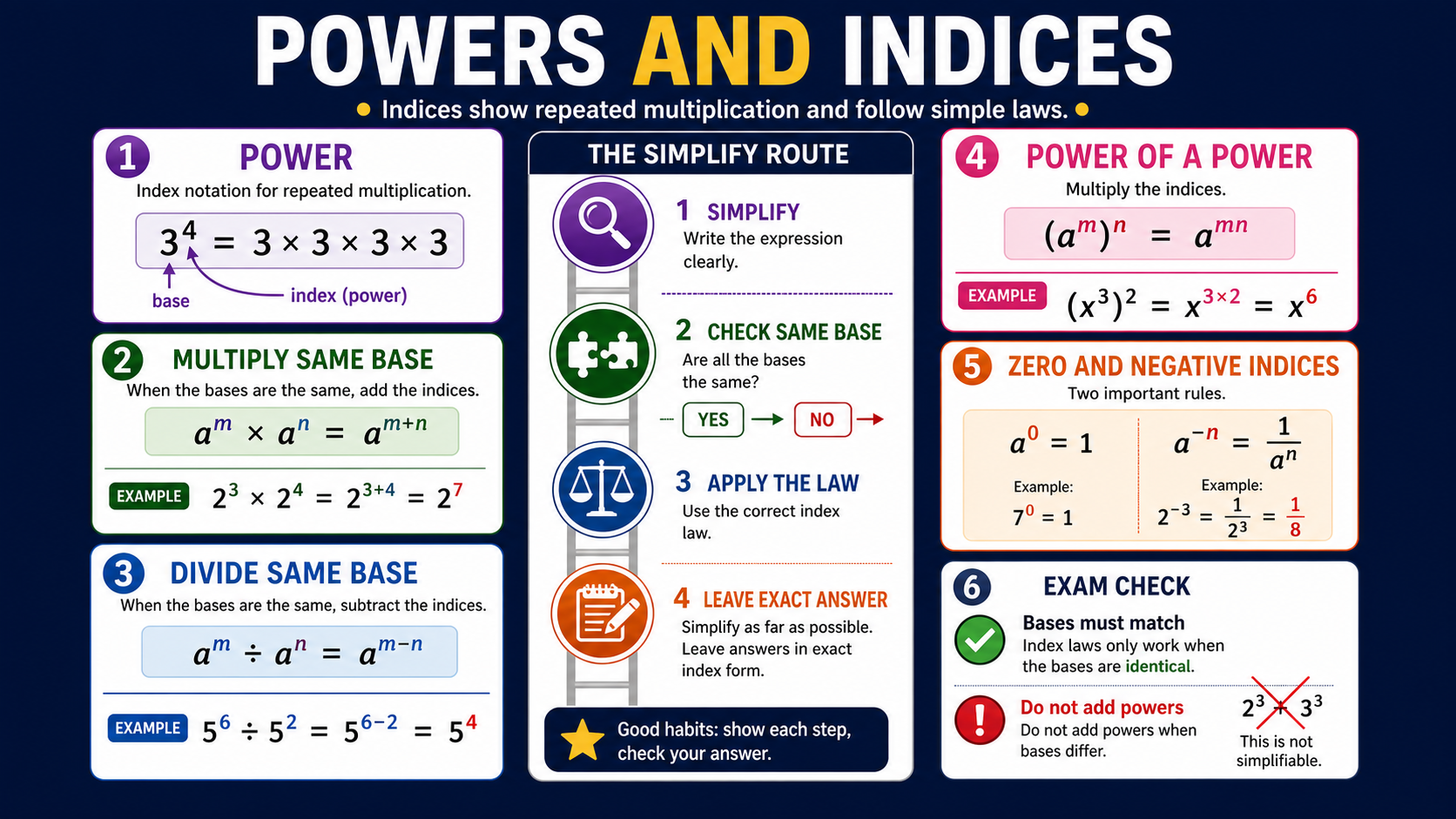
Powers and indices infographic
Before viewing
Point to the base, the index, the same-base check, and the negative-index rule. Say aloud which law is being used in each panel.
After viewing
Write one example where bases match and one where they do not. Explain which expression can be simplified using an index law.
What you will learn
Key facts before you start
Why this matters
Index notation saves space and helps you see structure. Instead of writing a long string of repeated multiplication, you can write one clear power.
These laws also make later topics easier, especially standard form, algebraic expressions, compound growth and exact number work.
Prior knowledge
You should already be comfortable with:
Clear explanation
An index tells you how many times to use a number as a factor. In 2⁵, the base is 2 and the index is 5.
2⁵ = 2 × 2 × 2 × 2 × 2 = 32The most important rule is: only use the simple index laws when the base is the same. If the bases are different, do not add or subtract the indices unless you can rewrite the expression with a common base.
Multiplying powers with the same base
When you multiply powers with the same base, add the indices.
aᵐ × aⁿ = aᵐ⁺ⁿDividing powers with the same base
When you divide powers with the same base, subtract the indices.
aᵐ ÷ aⁿ = aᵐ⁻ⁿPowers of powers
When a power is raised to another power, multiply the indices.
(aᵐ)ⁿ = aᵐⁿ (2³)² = 2⁶ = 64Zero and negative indices
A non-zero number to the power 0 equals 1. A negative index means a reciprocal.
7⁰ = 1 4⁻¹ = 14The phrase non-zero matters: 0⁰ is not treated as a normal GCSE calculation.
Fractional indices
Extension questions may write roots as fractional powers. The denominator of the fraction tells you the root.
161/2 = √16 = 4 271/3 = ∛27 = 3Method habit
Before using a law, say the check: “the bases match” or “I need to rewrite the base first”. This prevents the most common index-law error.
Worked examples
Example 1: Simplify 2³ × 2⁴.
The base is the same, so add the indices.
2³ × 2⁴ = 2⁷Reveal answer
Answer: 2⁷, which is 128 if a numerical value is requested.
Example 2: Simplify 10⁶ ÷ 10².
The base is the same, so subtract the indices.
10⁶ ÷ 10² = 10⁴Reveal answer
Answer: 10⁴. This is useful later in standard form.
Example 3: Simplify (3²)³.
A power raised to a power means multiply the indices.
(3²)³ = 3⁶Reveal answer
Answer: 3⁶, which is 729 if you need the value.
Example 4: Use a fractional index
Evaluate 641/3.
641/3 = ∛64 4 × 4 × 4 = 64Reveal answer
Answer: 641/3 = 4.
Example 5: Rewriting a base first
Simplify 2³ × 8² as a single power of 2.
8 = 2³, so 8² = (2³)² = 2⁶ 2³ × 2⁶ = 2⁹Reveal answer
Answer: 2⁹. The index law is used only after both terms have base 2.
Example 6: Reject an unsafe law
Can 3² × 4² be simplified by adding the indices?
3² × 4² = 9 × 16 = 144 It is not 12⁴.Reveal answer
Answer: No. The bases are different, so the simple same-base law does not apply.
Quick checks
Choose an answer, then check your thinking.
1. What is 4² × 4³?
2. What is 6⁷ ÷ 6²?
3. What value does the zero index give for 9⁰?
4. Which expression is equal to 5⁻²?
5. Why can you not simplify 2³ × 3³ by adding the indices?
Practice questions
Work in stages: first identify the base, then choose the law, then simplify. Where a base does not match, rewrite it before using an index law.
Question 1: multiply same bases
A calculator check shows two powers with the same base: 7² × 7⁵. Simplify the expression using an index law.
Reveal answer and marking guidance
Answer: 7⁷.
Marking: 1 mark for checking the base is 7 in both terms; 1 mark for adding indices, 2 + 5 = 7.
Question 2: divide same bases
A pupil writes 8⁹ ÷ 8⁴ as one power of 8. What should the simplified expression be?
Reveal answer and marking guidance
Answer: 8⁵.
Marking: 1 mark for using division law; 1 mark for 9 − 4 = 5. Common error: adding to get 8¹³.
Question 3: power of a power
The expression (5³)² means a power has been raised to another power. Simplify it as a single power of 5.
Reveal answer and marking guidance
Answer: 5⁶.
Marking: 1 mark for choosing the power-of-a-power law; 1 mark for multiplying indices, 3 × 2 = 6.
Question 4: negative index
Write 2⁻³ as an exact fraction, showing that a negative index means a reciprocal rather than a negative answer.
Reveal answer and marking guidance
Answer: 18.
Marking: 1 mark for 2⁻³ = 12³; 1 mark for 18. Do not write −8.
Question 5: explain a bad law
A classmate says 3² × 4² = 12⁴ because the bases can be multiplied and the indices added. Explain why this is not a valid index-law step.
Reveal answer and marking guidance
Answer: The bases are different, so you cannot add the indices in that way.
Marking: 1 mark for saying the bases are different; 1 mark for a check such as 3² × 4² = 9 × 16 = 144, not 12⁴.
Question 6: roots as fractional powers
Evaluate 811/2 and 1251/3.
Reveal answer and marking guidance
Answer: 811/2 = 9 and 1251/3 = 5.
Marking: 1 mark for recognising 12 as a square root; 1 mark for recognising 13 as a cube root; 1 mark for both values.
Question 7: rewrite the base
Simplify 3⁴ × 9² as a power of 3.
Reveal answer and marking guidance
Answer: 3⁸.
Marking: 1 mark for rewriting 9 as 3²; 1 mark for 9² = 3⁴; 1 mark for 3⁴ × 3⁴ = 3⁸.
Question 8: add a negative index
Evaluate 10³ × 10⁻¹.
Reveal answer and marking guidance
Answer: 10² = 100.
Marking: 1 mark for adding indices with signs, 3 + (−1); 1 mark for 10²; 1 mark for 100 if a value is required.
Question 9: choose a route
Simplify 16 × 2⁻³.
Reveal answer and marking guidance
Answer: 2.
Marking: 1 mark for rewriting 16 as 2⁴ or 2⁻³ as 18; 1 mark for a valid calculation; 1 mark for 2.
Question 10: multi-step simplification
Simplify 27 × 3⁻²3⁴ as a fraction in its simplest form.
Reveal answer and marking guidance
Answer: 127.
Marking: 1 mark for rewriting 27 as 3³; 1 mark for combining numerator indices; 1 mark for subtracting the denominator index; 1 mark for 127. Check the signs: 3 + (−2) − 4 = −3.
Question 11: exam-style explanation
A pupil writes 2⁴ × 8 = 16⁵. Explain the error and simplify 2⁴ × 8 as a power of 2.
Reveal answer and marking guidance
Answer: 8 must be rewritten as 2³, so 2⁴ × 8 = 2⁴ × 2³ = 2⁷.
Marking: 1 mark for identifying that the bases were not matched; 1 mark for 8 = 2³; 1 mark for 2⁷.
Answers and marking guidance
The exact practice answers are hidden under each question so you can try first. For powers and indices, marks usually come from choosing the correct index law and applying it only when the bases match: add indices when multiplying, subtract them when dividing, multiply indices for a power of a power, use reciprocals for negative indices, and translate fractional indices into roots when they are in your tier. When bases do not match at first, look for a rewrite such as 8 = 2³ or 9 = 3² before using an index law.
A strong answer states the law, shows the index calculation, and leaves the answer in the form requested: exact fraction, same-base power, or final numerical value.
Common mistakes
Multiplying indices when multiplying powers
Why it is wrong: multiplication with the same base means add the indices, not multiply them.
Corrected example: 2³ × 2⁴ = 2⁷, not 2¹².
Using laws when bases differ
Why it is wrong: the simple index laws need a matching base.
Corrected example: 3² × 4² is not 12⁴. Calculate or rewrite first if possible.
Thinking a zero index gives zero
Why it is wrong: any non-zero number to the power 0 is 1.
Corrected example: 6⁰ = 1, not 0.
Making negative powers negative answers
Why it is wrong: a negative index means reciprocal.
Corrected example: 5⁻¹ = 15, not −5.
Changing the requested form
Why it is wrong: a question may ask for a power, exact fraction or value.
Corrected example: if asked for a power of 2, write 2⁷ rather than 128.
Extension challenge
Simplify this expression as far as possible, then explain which law you used at each step:
2³ × 2⁻¹ × (2²)³Reveal answer
Answer: 2⁸ = 256.
First use the power-of-a-power law: (2²)³ = 2⁶. Then use the same-base multiplication law: 3 + (−1) + 6 = 8.
Challenge extension: create a similar expression with value 3⁵ and include one negative index.
Exam-board guidance
This is shared GCSE Number content. Specifications commonly include positive integer powers, roots and standard form, with zero, negative and fractional indices appearing where the route requires them. Check your own specification for exact tier sequencing and calculator rules.
AQA GCSE Maths
Index laws support Number, standard form and Algebra. Check matching bases before choosing a law, and use exact reciprocal notation for negative powers.
OCR GCSE Maths
Commonly links indices to surds, standard form and exact values. Show the law used and keep roots or reciprocals exact where needed.
Pearson Edexcel GCSE Maths
Powers and roots appear in Number and Algebra. Question style may mix index laws with standard form, simplification or same-base rewrites.
Eduqas GCSE Maths
Use clear method steps for powers, roots and index laws. Show whether you are adding, subtracting or multiplying indices.
WJEC Wales
Treat separately from Eduqas. Indices may connect to standard form, powers of 10, calculator interpretation and algebraic manipulation.
CCEA GCSE Maths
Learn the core laws first, then match practice to your unit, tier and calculator or non-calculator paper for negative and fractional powers.
Aplailasain is an independent learning resource. Board wording and assessment routes can change, so use this as study guidance alongside your current specification.
Next lesson
The next lesson is Standard Form, where powers of 10 are used to write very large and very small numbers neatly.