
Lesson overview
A practical Number skill for very large and very small values.
Standard form uses powers of 10 to write numbers compactly. It appears in GCSE Maths and is also useful in science, finance, distances, populations and measurements.
Standard form infographic
Before viewing
Before viewing, identify the first number A and check whether it is between 1 and 10.
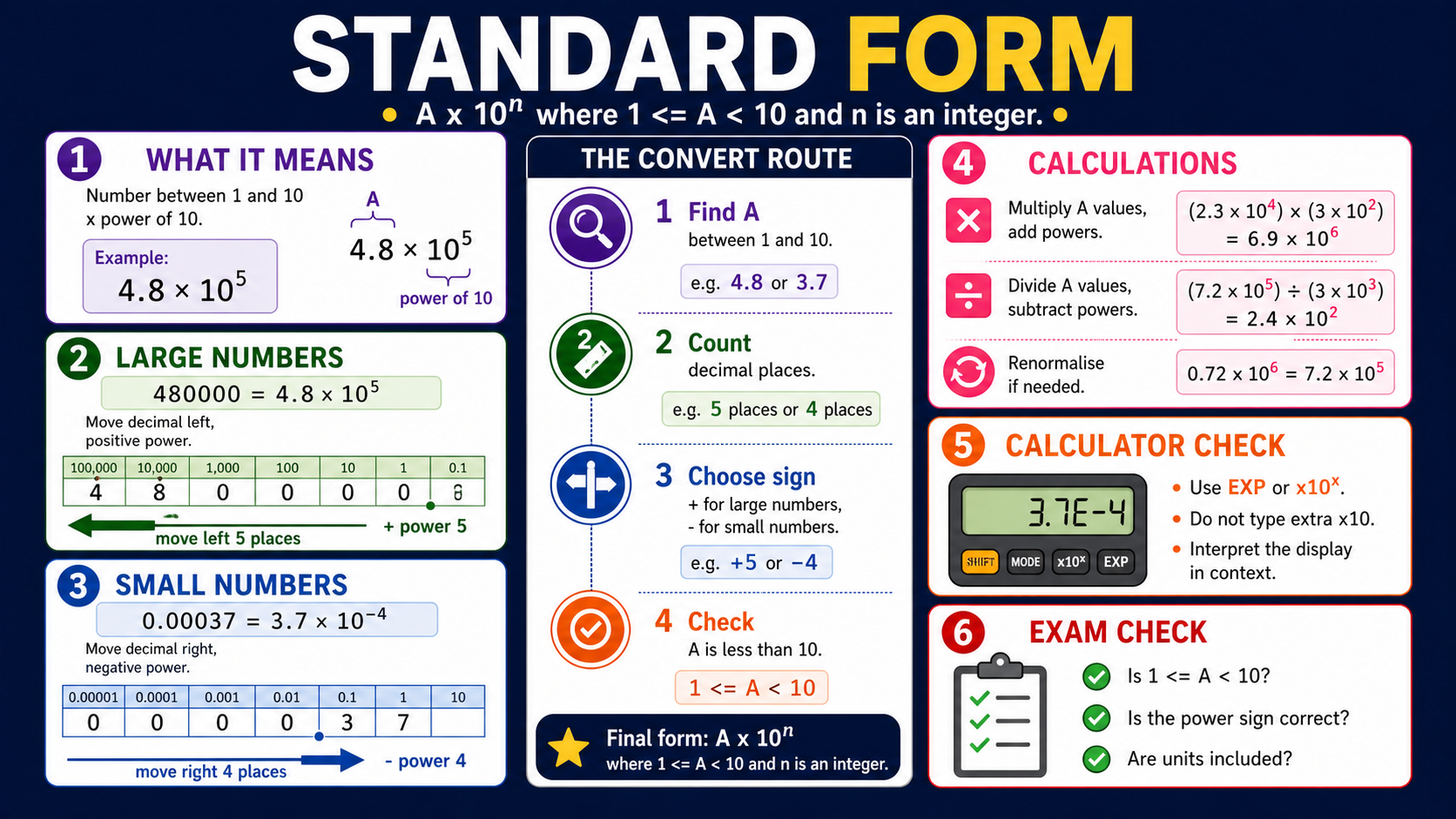
After viewing
After viewing, convert one large and one small number into standard form, then explain the sign of each power.
What you will learn
Key facts before you start
Why this matters
Some numbers are awkward to write in ordinary form. For example, the distance from Earth to the Sun is about 150,000,000 km. A very small measurement might be 0.0000042 m.
Standard form keeps the important digits visible and uses a power of 10 to show the size.
Prior knowledge
You should already be comfortable with:
Clear explanation
A number in standard form is written as:
A × 10ⁿThe first number, A, must be at least 1 but less than 10. The index n is an integer.
1 ≤ A < 10Large numbers
For a large number, move the decimal point left until the first number is between 1 and 10. The power of 10 is positive.
Small numbers
For a small decimal, move the decimal point right until the first number is between 1 and 10. The power of 10 is negative.
Back to ordinary numbers
A positive power of 10 makes the number bigger. A negative power of 10 makes the number smaller.
6.5 × 10⁵ = 650,000 7.1 × 10⁻⁴ = 0.00071Calculator displays
Calculators may show standard form using E. For example, 3.4E6 means:
3.4E6 = 3.4 × 10⁶Calculating with standard form
For multiplication and division, deal with the first numbers and the powers of 10 separately, then rewrite the answer so the first number is between 1 and 10.
If the first number becomes 10 or more, rewrite it before giving the final answer.
Worked examples
Example 1: Write 730,000 in standard form.
Move the decimal point so the first number is between 1 and 10.
730,000 = 7.3 × 10⁵Reveal answer
Answer: 7.3 × 10⁵.
Example 2: Write 0.00056 in standard form.
The number is small, so the power of 10 will be negative.
0.00056 = 5.6 × 10⁻⁴Reveal answer
Answer: 5.6 × 10⁻⁴.
Example 3: Write 2.9 × 10³ as an ordinary number.
10³ means 1000, so multiply 2.9 by 1000.
2.9 × 10³ = 2900Reveal answer
Answer: 2900.
Example 4: Multiply two standard-form numbers.
Find (4 × 10⁵) × (3 × 10²).
Reveal answer
Answer: 1.2 × 10⁸.
Example 5: Divide and rewrite in standard form.
Find (9.6 × 10⁷) ÷ (3 × 10²).
Reveal answer
Answer: 3.2 × 10⁵.
Quick checks
Choose an answer, then check your thinking.
1. Which number is written correctly in standard form?
2. What is 81,000 in standard form?
3. What is 6.4 × 10⁻² as an ordinary number?
Practice questions
Question 1
Write 540,000 in standard form.
Reveal answer and marking guidance
Answer: 5.4 × 10⁵.
Marking: 5.4 is between 1 and 10, and 10⁵ means 100,000.
Question 2
Write 0.00091 in standard form.
Reveal answer and marking guidance
Answer: 9.1 × 10⁻⁴.
Marking: The number is small, so the power is negative. 9.1 × 10⁻⁴ = 0.00091.
Question 3
Write 3.75 × 10⁶ as an ordinary number.
Reveal answer and marking guidance
Answer: 3,750,000.
Marking: 10⁶ means 1,000,000, so 3.75 × 1,000,000 = 3,750,000.
Question 4
Write 4.8E−3 as ordinary decimal notation.
Reveal answer and marking guidance
Answer: 0.0048.
Marking: 4.8E−3 means 4.8 × 10⁻³, so divide by 1000.
Question 5
A bacterium is about 0.000002 m long. Write this length in standard form.
Reveal answer and marking guidance
Answer: 2 × 10⁻⁶ m.
Marking: Keep the unit and use a negative power because the value is smaller than 1.
Question 6
Calculate (2 × 10⁵) × (3 × 10³). Give your answer in standard form.
Reveal answer and marking guidance
Answer: 6 × 10⁸.
Marking: Multiply 2 by 3 to get 6, then add the powers: 10⁵ × 10³ = 10⁸.
Question 7
Calculate (8 × 10⁶) ÷ (4 × 10²). Give your answer in standard form.
Reveal answer and marking guidance
Answer: 2 × 10⁴.
Marking: Divide 8 by 4 to get 2, then subtract the powers: 10⁶ ÷ 10² = 10⁴.
Question 8
Which is larger: 4.9 × 10⁵ or 5.1 × 10⁴?
Reveal answer and marking guidance
Answer: 4.9 × 10⁵ is larger.
Marking: 4.9 × 10⁵ = 490,000 and 5.1 × 10⁴ = 51,000, so compare the powers and place values carefully.
Question 9
Calculate (6.4 × 10⁸) ÷ (8 × 10³). Give your answer in standard form.
Reveal answer and marking guidance
Answer: 8 × 10⁴.
Marking: Divide 6.4 by 8 to get 0.8, and subtract the powers to get 10⁵. Then rewrite 0.8 × 10⁵ as 8 × 10⁴ so the first number is between 1 and 10.
Question 10
A satellite travels about 7.8 × 10³ m each second. How far does it travel in 2 × 10² seconds? Give your answer in standard form, in metres.
Reveal answer and marking guidance
Answer: 1.56 × 10⁶ m.
Marking: Multiply 7.8 by 2 to get 15.6 and add the powers: 10³ × 10² = 10⁵. Then rewrite 15.6 × 10⁵ as 1.56 × 10⁶ m.
Answers and marking guidance
The exact practice answers are hidden under each question so you can try first. For standard form, marks usually come from writing the first number between 1 and 10, choosing the correct power of 10, showing a sensible place-value move, applying index laws in calculations, rewriting answers such as 0.8 × 10⁵ or 12 × 10⁷ into correct standard form, and keeping units or rounding instructions in the final answer.
Common mistakes
- Using a first number that is too big: 42 × 10³ is not standard form because 42 is not less than 10.
- Wrong sign on the power: small decimals use negative powers of 10.
- Losing zeros when converting back: 2.3 × 10⁵ is 230,000, not 23,000.
- Misreading calculator notation: 6.2E4 means 6.2 × 10⁴, not 6.24.
Extension challenge
The mass of an object is 3.2 × 10⁵ kg. Another object has mass 8 × 10³ kg. How many times larger is the first mass?
Reveal answer
Answer: 40 times larger.
3.2 × 10⁵ = 320,000 and 8 × 10³ = 8000. Then 320,000 ÷ 8000 = 40.
Exam-board guidance
Standard form is a shared GCSE Maths skill. The same core idea appears across boards, though CCEA may call it standard index form, and different papers may test calculator notation, ordering, units, bounds, estimation or non-calculator index laws.
AQA GCSE Maths
Standard form may be tested with or without a calculator, so be ready to convert both ways, interpret displays such as 3.4E6 and show sensible rounding.
OCR GCSE Maths
Learn to convert both ways, order standard-form numbers and use index laws for calculator and non-calculator calculations.
Pearson Edexcel GCSE Maths
Standard form is useful for very large and very small numbers, especially in calculator, science-style, unit-based and estimation contexts.
Eduqas GCSE Maths
Focus on the correct first number between 1 and 10, then use the sign of the power of 10 to show whether the value is large or small.
WJEC Wales
Standard form sits in the Number section and may also appear in numeracy-style contexts where units, estimates, bounds and calculator displays matter.
CCEA GCSE Maths
This skill may be described as standard index form, especially on Higher units, so connect it to powers of 10, units and your unit's calculator rules.
Next lesson
The next lesson is Equivalent Fractions and Simplifying, which returns to everyday fraction fluency before deeper operations.