
Lesson overview
A starting point skill for fractions, ratio and proportion.
Equivalent fractions and simplifying are part of the Number strand. They support later fraction calculations, ratio, probability, percentages and algebraic fractions.
What you will learn
Key facts before you start
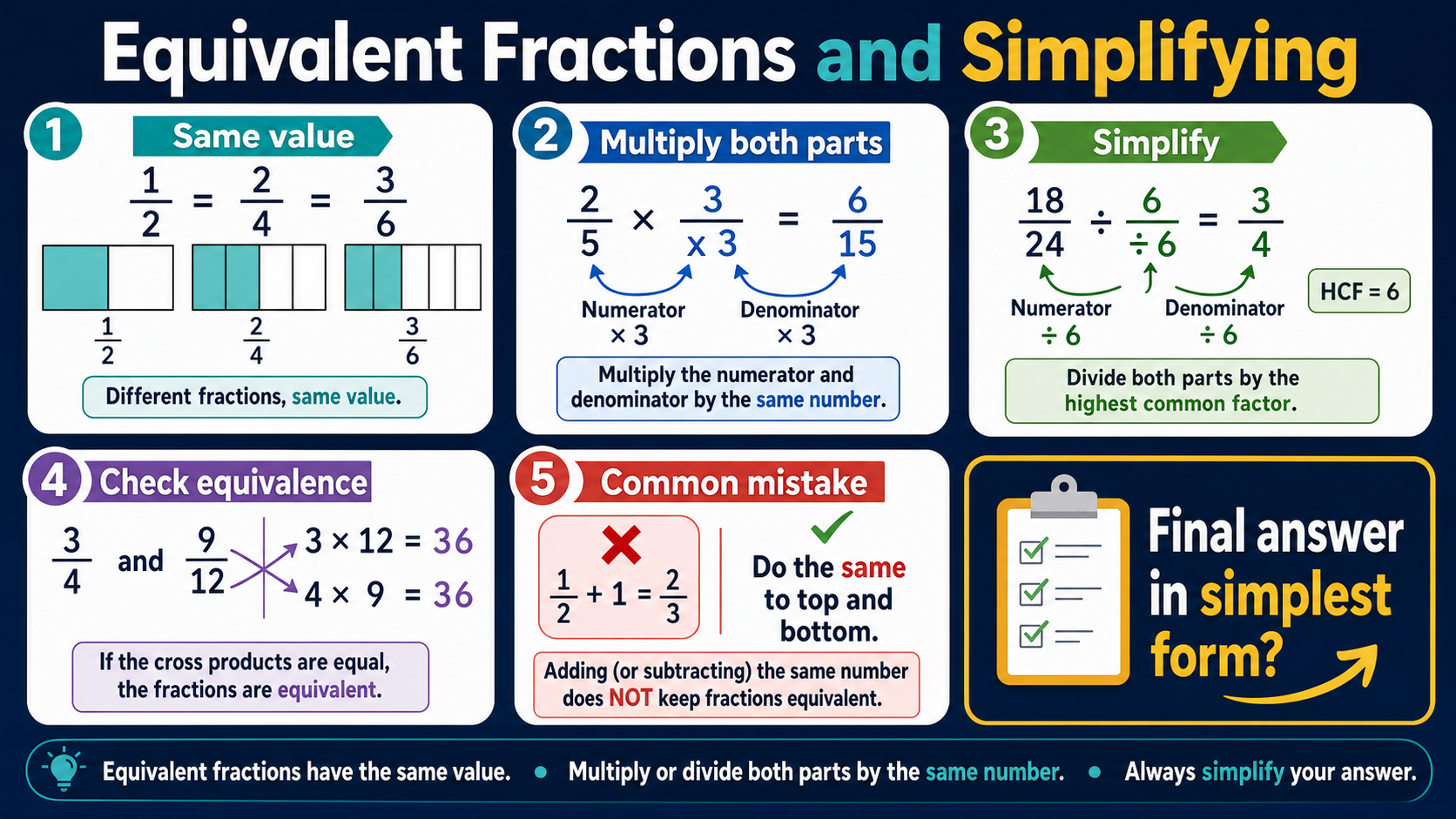
Equivalent fractions and simplifying infographic
Before viewing
Before viewing, choose one fraction in the visual and say what both numerator and denominator have been multiplied or divided by.
After viewing
After viewing, simplify one fraction and then create an equivalent fraction by scaling it back up.
Why this matters
Fractions appear in number work, ratio, probability, algebra and geometry. If equivalent fractions feel secure, many later questions become less stressful.
Simplifying also helps examiners see your final answer clearly.
Prior knowledge
You should already be comfortable with:
Clear explanation
Equivalent fractions have the same value, even though they look different.
12 = 24 = 36You make an equivalent fraction by multiplying the top and bottom by the same number.
Simplifying is the reverse. You divide the top and bottom by the same common factor.
A fraction is in its simplest form when the numerator and denominator have no common factor bigger than 1.
Worked examples
Example 1: Make an equivalent fraction.
Write an equivalent fraction to 23 with denominator 12.
23 = 2 × 43 × 4 = 812Reveal answer
Answer: 812.
Example 2: Simplify 1520.
15 and 20 both divide by 5.
1520 = 34Reveal answer
Answer: 34.
Example 3: Simplify 4256.
The highest common factor of 42 and 56 is 14.
4256 = 42 ÷ 1456 ÷ 14 = 34Reveal answer
Answer: 34.
Quick checks
Choose an answer, then check your thinking.
1. Which fraction is equivalent to 13?
2. Simplify 1218.
3. Which fraction is already in simplest form?
Practice questions
Question 1
Write an equivalent fraction to 47 with denominator 21.
Reveal answer and marking guidance
Answer: 1221.
Marking: Multiply the denominator by 3, so multiply the numerator by 3 as well.
Question 2
Simplify 1624.
Reveal answer and marking guidance
Answer: 23.
Marking: Divide the top and bottom by 8.
Question 3
Simplify 4560.
Reveal answer and marking guidance
Answer: 34.
Marking: Divide the top and bottom by 15.
Question 4
Find the missing number: 59 = ?36.
Reveal answer and marking guidance
Answer: 20.
Marking: 9 × 4 = 36, so 5 × 4 = 20.
Question 5
Explain why 812 and 23 are equivalent.
Reveal answer and marking guidance
Answer: 812 simplifies to 23.
Marking: Divide the numerator and denominator by 4, or explain that 2 × 4 = 8 and 3 × 4 = 12.
Question 6
Simplify 84126 fully.
Reveal answer and marking guidance
Answer: 23.
Marking: The highest common factor is 42. Divide 84 and 126 by 42, or simplify in smaller exact steps until no common factor remains.
Question 7
Find the missing number: 18? = 37.
Reveal answer and marking guidance
Answer: 42.
Marking: 3 × 6 = 18, so 7 × 6 = 42. The same scale factor must be used on the numerator and denominator.
Question 8
Which is the simplest form of 7296: 68, 34 or 912? Explain your choice.
Reveal answer and marking guidance
Answer: 34.
Marking: 72 and 96 divide by 24. The other two options are equivalent but still have common factors.
Question 9
A pupil says 4560 simplifies to 912. Give the fully simplified fraction and explain what they still need to do.
Reveal answer and marking guidance
Answer: 34.
Marking: 912 is equivalent but not fully simplified. Divide both parts by 3, or divide 45 and 60 by their highest common factor of 15.
Question 10
Are 1435 and 1845 equivalent? Show a check.
Reveal answer and marking guidance
Answer: Yes. Both simplify to 25.
Marking: A valid check is 14 ÷ 7 = 2 and 35 ÷ 7 = 5, while 18 ÷ 9 = 2 and 45 ÷ 9 = 5. Cross-multiplication also works because 14 × 45 = 630 and 35 × 18 = 630.
Answers and marking guidance
The exact practice answers are hidden under each question so you can try first. For equivalent fractions, marks usually come from doing the same operation to the numerator and denominator, naming or showing the scale factor, using common factors to simplify, and checking that the final fraction cannot be reduced further. If a question asks you to explain, say why the two fractions have the same value rather than just writing the final fraction.
Common mistakes
- Changing only the top or only the bottom: do the same operation to both parts of the fraction.
- Stopping too early: 69 is simpler than 1218, but 23 is simplest.
- Dividing by a number that is not a factor: both numerator and denominator must divide exactly.
- Thinking bigger numbers mean a bigger fraction: 48 and 12 are the same value.
Extension challenge
Find two different fractions equivalent to 38, then explain how you know they are all the same value.
Reveal answer
Example answer: 616 and 1540.
Both simplify back to 38.
Exam-board guidance
Equivalent fractions and simplifying are assessed across GCSE Maths because they support exact answers, ratio, proportion, probability and fraction-decimal-percentage links.
AQA GCSE Maths
Simplifying fractions helps with exact answers, ratio and proportion; show the common factor or equivalent scaling step when working is needed.
OCR GCSE Maths
Equivalent fractions are named directly, so practise scaling the numerator and denominator by the same multiplier and simplifying fully.
Pearson Edexcel GCSE Maths
Fraction simplification supports number, ratio and proportion questions; leave exact fraction answers in simplest form unless the question asks for another form.
Eduqas GCSE Maths
Keep your fraction working clear, especially when simplifying before a final answer or comparing fractions with decimals and percentages.
WJEC Wales
Equivalent fractions are part of Number and numeracy work, especially when converting between fractions, decimals, percentages and ratio.
CCEA GCSE Maths
Equivalent fractions appear early, then support unitised work on fractions, decimals, percentages and ratio; be ready for calculator and non-calculator contexts.
Next lesson
The next lesson is Fractions: Four Operations, where you will add, subtract, multiply and divide fractions.