
Lesson overview
A core calculation skill used across GCSE Maths.
Fraction operations appear in direct number questions and inside ratio, probability, algebra, exact values and multi-step problem solving.
What you will learn
Key facts before you start
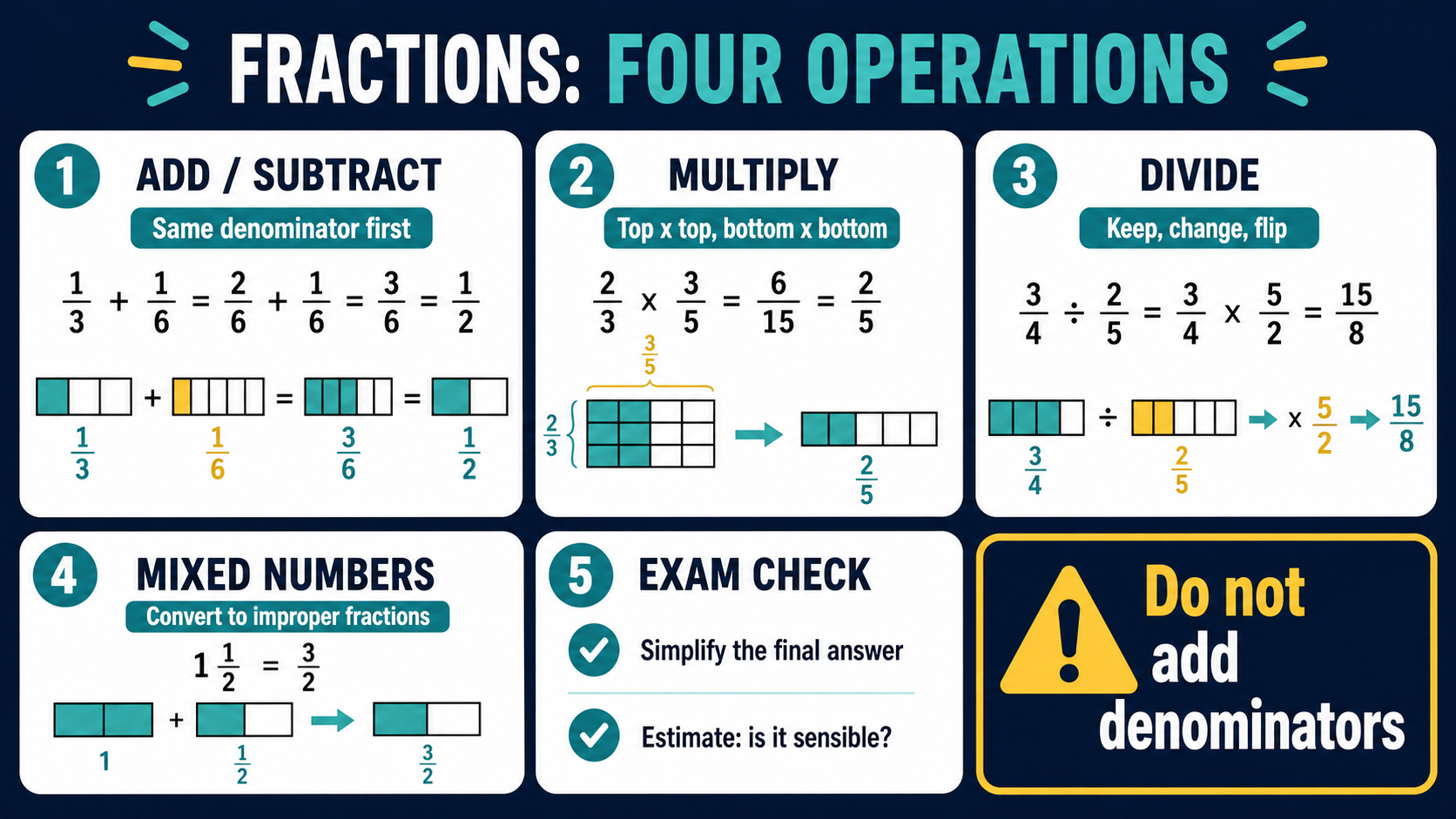
Fractions four operations infographic
Before viewing
Before viewing, find the panel showing a common denominator and the panel showing a reciprocal.
After viewing
After viewing, explain why adding denominators is not a valid fraction method.
Why this matters
Fractions are not just a Number topic. They appear in probability, ratio, algebra, exact trigonometry, surds and formula work.
The key is knowing which method belongs to which operation. Addition and subtraction need common denominators. Multiplication and division do not.
Prior knowledge
You should already be comfortable with:
Clear explanation
Adding and subtracting
To add or subtract fractions, first make the denominators the same.
Multiplying
To multiply fractions, multiply the numerators and multiply the denominators.
23 × 57 = 1021Dividing
To divide by a fraction, multiply by its reciprocal. The reciprocal is the fraction turned upside down.
Mixed numbers
Mixed numbers are often easier to calculate with after changing them to improper fractions.
123 = 53Worked examples
Example 1: Add 25 and 110.
25 = 410 410 + 110 = 510 = 12Reveal answer
Answer: 12.
Example 2: Multiply 34 by 29.
34 × 29 = 636 = 16Reveal answer
Answer: 16.
Example 3: Divide 45 by 23.
45 ÷ 23 = 45 × 32 = 1210 = 65Reveal answer
Answer: 65 or 115.
Quick checks
Choose an answer, then check your thinking.
1. What is 13 + 16?
2. What is 25 × 34?
3. What is 56 ÷ 13?
Practice questions
Question 1
Calculate 38 + 14.
Reveal answer and marking guidance
Answer: 58.
Marking: Change one quarter to two eighths, then add.
Question 2
Calculate 710 − 15.
Reveal answer and marking guidance
Answer: 12.
Marking: Change one fifth to two tenths, then subtract.
Question 3
Calculate 56 × 310.
Reveal answer and marking guidance
Answer: 14.
Marking: Multiply to get 1560, then simplify.
Question 4
Calculate 23 ÷ 45.
Reveal answer and marking guidance
Answer: 56.
Marking: Multiply 23 by 54.
Question 5
Calculate 112 × 25.
Reveal answer and marking guidance
Answer: 35.
Marking: Change 112 to 32, then multiply.
Question 6
Calculate −34 + 56.
Reveal answer and marking guidance
Answer: 112.
Marking: Use twelfths: −912 + 1012 = 112.
Question 7
Calculate 56 − 13 × 34.
Reveal answer and marking guidance
Answer: 712.
Marking: Multiply first: 13 × 34 = 14. Then subtract using twelfths: 1012 − 312 = 712.
Question 8
A recipe uses 34 kg of flour. You make 23 of the recipe. How much flour is needed?
Reveal answer and marking guidance
Answer: 12 kg.
Marking: Find a fraction of an amount by multiplying: 23 × 34 = 12. Include kg in the final answer.
Question 9
Calculate 214 − 35 ÷ 67.
Reveal answer and marking guidance
Answer: 11120.
Marking: Do the division first: 35 ÷ 67 = 35 × 76 = 710. Then 94 − 710 = 4520 − 1420 = 3120 = 11120.
Question 10
A tank is 35 full. A pump removes 27 of the water currently in the tank. What fraction of the whole tank is removed?
Reveal answer and marking guidance
Answer: 635 of the whole tank.
Marking: Find a fraction of a fraction by multiplying: 27 × 35 = 635. The answer is already simplified.
Answers and marking guidance
The exact practice answers are hidden under each question so you can try first. For fraction calculations, marks usually come from choosing the correct method for the operation: common denominators for adding or subtracting, improper fractions for mixed numbers, multiplying straight across for multiplication, using the reciprocal for division, handling signs carefully and simplifying the final answer where possible. In mixed calculations, show the operation order so the examiner can see why you multiplied or divided before adding or subtracting.
Common mistakes
- Adding denominators: 13 + 16 is not 29.
- Using a common denominator for multiplication: multiply fractions directly, then simplify.
- Flipping the wrong fraction: in division, only flip the fraction you are dividing by.
- Forgetting to simplify: check for a common factor in the final answer.
Extension challenge
Calculate 34 − 25 × 58.
Reveal answer
Answer: 12.
Do the multiplication first: 25 × 58 = 14. Then 34 − 14 = 12.
Exam-board guidance
Fraction operations are assessed across GCSE Maths as exact arithmetic, often inside ratio, probability, algebra, measures or calculator/non-calculator questions.
AQA GCSE Maths
Focus on the shared method, notation and checking habit; wording and context can vary by route.
OCR GCSE Maths
Show clear method steps and use precise notation; question wording may vary by route.
Pearson Edexcel GCSE Maths
Keep working visible and check units or notation; contexts may vary by route.
Eduqas GCSE Maths
Use the same core skill in practical contexts, with clear reasoning and final checks.
WJEC Wales
Connect the method to the context and state what the result means.
CCEA GCSE Maths
Make each method step visible and keep notation, units and final checks clear.
Next lesson
Next, practise reading, comparing and rounding decimal numbers.