
Lesson overview
A core Number skill for calculation, rounding and problem solving.
Decimal place value is used when comparing numbers, rounding, estimating, working with money and measures, using standard form and checking answers.
What you will learn
Key facts before you start
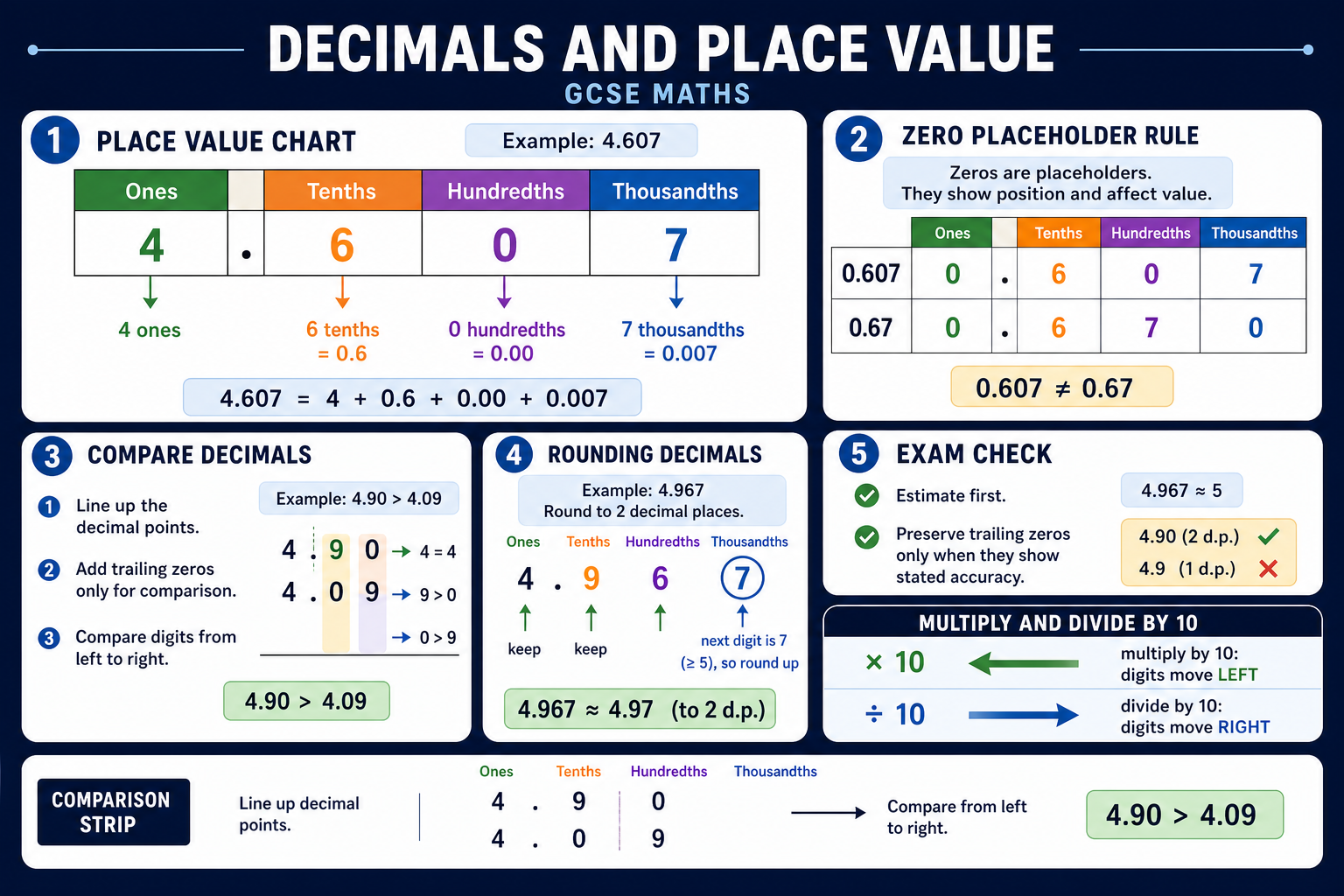
Decimals and place value infographic
Before viewing
Before viewing, identify the tenths, hundredths and thousandths columns, then explain why 0.7 and 0.700 have the same value.
After viewing
After viewing, compare 0.607, 0.67 and 0.706 by writing them with the same number of decimal places.
Why this matters
Decimals appear throughout GCSE Maths: money, measurement, percentages, bounds, standard form, graphs, probability and calculator answers.
A small place-value mistake can make an answer ten times too big or ten times too small, so this is one of the habits that protects your marks.
Prior knowledge
You should already be comfortable with:
Clear explanation
Place value after the decimal point
Digits to the left of the decimal point are whole-number places. Digits to the right are parts of one whole.
The first digit after the decimal point is tenths, the second is hundredths and the third is thousandths.
Comparing decimals
Compare from left to right. If it helps, add zeros at the end so the numbers have the same number of decimal places.
Rounding decimals
To round a decimal, find the place you are keeping, then look at the next digit. If the next digit is 5 or more, round up. If it is 4 or less, keep the digit the same.
3.486 rounded to 2 decimal places is 3.49 3.486 rounded to 1 decimal place is 3.5Decimal places and significant figures
Decimal places count digits after the decimal point. Significant figures count important digits from the first non-zero digit.
0.0479 to 2 decimal places = 0.05 0.0479 to 2 significant figures = 0.048Worked examples
Example 1: What is the value of the 6 in 18.264?
The 6 is the second digit after the decimal point, so it is in the hundredths column.
6 hundredths = 0.06Reveal answer
Answer: 0.06.
Example 2: Put 0.54, 0.507, 0.59 and 0.5 in ascending order.
Add zeros so each number has three decimal places.
0.540, 0.507, 0.590, 0.500 0.500 < 0.507 < 0.540 < 0.590Reveal answer
Answer: 0.5, 0.507, 0.54, 0.59.
Example 3: Round 7.356 to 1 decimal place.
The tenths digit is 3. The next digit is 5, so round the tenths digit up.
7.356 ≈ 7.4Reveal answer
Answer: 7.4.
Quick checks
Choose an answer, then check your thinking.
1. In 5.308, what is the value of the 0?
2. Which number is the largest?
3. What is 4.965 rounded to 2 decimal places?
Practice questions
Question 1
Write the value of the 7 in 23.174.
Reveal answer and marking guidance
Answer: 0.07 or 7 hundredths.
Marking: The 7 is the second digit after the decimal point, so it is in the hundredths column.
Question 2
Write 0.6, 0.58, 0.607 and 0.059 in descending order.
Reveal answer and marking guidance
Answer: 0.607, 0.6, 0.58, 0.059.
Marking: Compare as 0.607, 0.600, 0.580 and 0.059.
Question 3
Round 12.748 to 1 decimal place.
Reveal answer and marking guidance
Answer: 12.7.
Marking: Keep the tenths digit. The next digit is 4, so do not round up.
Question 4
Round 0.03864 to 2 significant figures.
Reveal answer and marking guidance
Answer: 0.039.
Marking: The first two significant figures are 3 and 8. The next digit is 6, so 38 rounds to 39.
Question 5
A runner completes a race in 12.405 seconds. Write this time to 2 decimal places.
Reveal answer and marking guidance
Answer: 12.41 seconds.
Marking: Keep the hundredths digit and use the thousandths digit 5 to round up.
Question 6
Write 4.08, 4.8, 4.008 and 4.18 in ascending order.
Reveal answer and marking guidance
Answer: 4.008, 4.08, 4.18, 4.8.
Marking: Compare as 4.008, 4.080, 4.180 and 4.800 so the columns line up.
Question 7
A calculator shows 3.2 × 0.48 = 15.36. Explain why this cannot be correct and give the correct answer.
Reveal answer and marking guidance
Answer: It cannot be correct because 3.2 × 0.48 is less than 3.2 × 0.5, which is 1.6. The correct answer is 1.536.
Marking: Use estimation to spot the decimal-place error, then place the decimal point correctly.
Question 8
A shop price is £0.075 per gram. Write this price in pence per gram, rounded to 1 decimal place.
Reveal answer and marking guidance
Answer: 7.5 pence per gram.
Marking: £0.075 = 7.5p; no extra rounding changes the value to 1 decimal place.
Question 9
A calculator gives 18 ÷ 7 = 2.571428571. Write the answer to 3 significant figures and explain which digit decides the rounding.
Reveal answer and marking guidance
Answer: 2.57. The next digit after the first three significant figures is 1, so the 7 stays the same.
Marking: Count significant figures from the first non-zero digit: 2, 5 and 7. Use the following digit to decide whether to round up.
Question 10
A measurement is 0.6049 m. Write it to 3 decimal places and explain why the final zero is or is not needed.
Reveal answer and marking guidance
Answer: 0.605 m. The final zero is not needed because the rounded value has three digits after the decimal point: 6, 0 and 5.
Marking: Keep the thousandths place and use the next digit, 9, to round up. Check that the answer shows exactly 3 decimal places.
Answers and marking guidance
The exact practice answers are hidden under each question so you can try first. For decimals, marks usually come from lining up place-value columns carefully, using zero placeholders when comparing numbers, showing the digit that decides rounding, and keeping the requested accuracy and units in the final answer.
Common mistakes
- Thinking more digits always means larger: 0.607 is larger than 0.59, but 0.059 is much smaller than both.
- Ignoring zero placeholders: 0.6 and 0.600 have the same value, but placeholders can make comparison clearer.
- Counting decimal places from the wrong side: decimal places are counted after the decimal point, from left to right.
- Mixing decimal places and significant figures: 0.0479 to 2 decimal places and to 2 significant figures give different answers.
Extension challenge
Find a decimal number between 0.37 and 0.38 that rounds to 0.38 to 2 decimal places and to 0.4 to 1 decimal place.
Reveal answer
One possible answer: 0.375.
0.375 rounds to 0.38 to 2 decimal places because the thousandths digit is 5. It rounds to 0.4 to 1 decimal place because the hundredths digit is 7.
Exam-board guidance
Decimal place value is assessed across GCSE Maths because it underpins rounding, estimation, calculator checks, money, measures and percentages.
AQA GCSE Maths
Focus on the shared method, notation and checking habit; wording and context can vary by route.
OCR GCSE Maths
Show clear method steps and use precise notation; question wording may vary by route.
Pearson Edexcel GCSE Maths
Keep working visible and check units or notation; contexts may vary by route.
Eduqas GCSE Maths
Use the same core skill in practical contexts, with clear reasoning and final checks.
WJEC Wales
Connect the method to the context and state what the result means.
CCEA GCSE Maths
Make each method step visible and keep notation, units and final checks clear.
Next lesson
Next, practise comparing negative numbers and reading inequality symbols.