
Lesson overview
A core Number skill for arithmetic, algebra and graphs.
Negative numbers and inequality symbols help you compare values below zero, describe ranges and prepare for later work with algebraic inequalities and number lines.
What you will learn
Key facts before you start
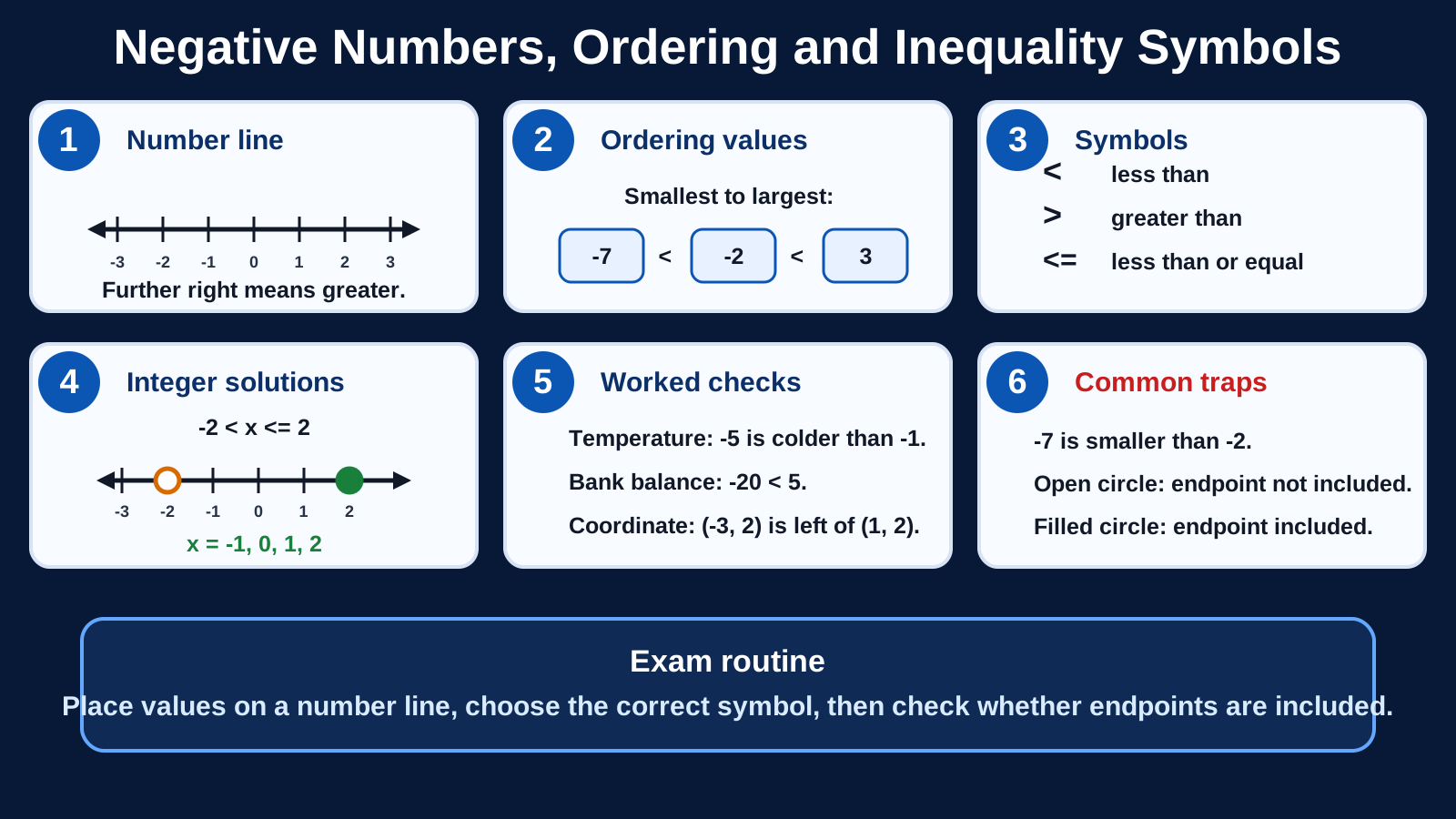
Negative numbers, ordering and inequalities infographic
Before viewing
Before viewing, locate two negative numbers and say which is larger using the number line direction.
After viewing
After viewing, order three negative values and justify the inequality symbols you use.
Why this matters
Negative numbers appear in temperature, bank balances, lifts below ground level, coordinates and graphs. Inequality symbols let you write comparisons quickly.
This skill also protects marks later: solving inequalities, reading graph regions and handling calculator answers all depend on knowing which value is bigger.
Prior knowledge
You should already be comfortable with:
Clear explanation
Negative numbers are less than zero
A negative number uses the minus sign to show it is below zero. For example, −3 is three steps below zero.
Use the number line
On a number line, values increase as you move right. Values decrease as you move left. This rule works for positive numbers, zero and negative numbers.
A number further right is greater. So −2 is greater than −5 because −2 is closer to zero and sits to the right of −5.
−5 < −2 −2 > −5Inequality symbols
Read an inequality from left to right. The wide side of < or > faces the larger value.
Ordering values
Ascending order means smallest to largest. Descending order means largest to smallest. For negatives, the number with the bigger digit is not automatically bigger.
Ascending: −9, −4, −1, 0, 6 Descending: 6, 0, −1, −4, −9Worked examples
Example 1: Which is greater, −7 or −3?
On a number line, −3 is to the right of −7, so −3 is greater.
−3 > −7Reveal answer
Answer: −3 is greater.
Example 2: Put −4, 2, −8, 0 and 5 in ascending order.
Start with the smallest value, which is furthest left on the number line.
−8 < −4 < 0 < 2 < 5Reveal answer
Answer: −8, −4, 0, 2, 5.
Example 3: Write an inequality for “a temperature is at least −2°C”.
At least means the value can be −2 or anything greater than −2.
temperature ≥ −2°CReveal answer
Answer: T ≥ −2°C.
Quick checks
Choose an answer, then check your thinking.
1. Which negative-number comparison is true?
2. Which list is in ascending order?
3. In this inequality, what does x ≤ 7 mean?
Practice questions
Question 1
Write the correct symbol, < or >, between the numbers: −6 __ −1.
Reveal answer and marking guidance
Answer: −6 < −1.
Marking: Award credit for recognising that −6 is further left on the number line than −1.
Question 2
Put −3, 7, −10, 0 and 2 in ascending order.
Reveal answer and marking guidance
Answer: −10, −3, 0, 2, 7.
Marking: Ascending order means smallest to largest. The most negative value comes first.
Question 3
Put −0.8, −1.2, 0.3 and −0.1 in descending order.
Reveal answer and marking guidance
Answer: 0.3, −0.1, −0.8, −1.2.
Marking: Descending order means largest to smallest. Values closer to zero are greater than more negative values.
Question 4
Write an inequality for “n is greater than or equal to −5”.
Reveal answer and marking guidance
Answer: n ≥ −5.
Marking: “Greater than or equal to” requires the ≥ symbol, not just >.
Question 5
The temperature at 6 am is −4°C. At midday it is 3°C. Which temperature is lower, and by how many degrees?
Reveal answer and marking guidance
Answer: −4°C is lower by 7°C.
Marking: Count from −4 to 0, then from 0 to 3. That is 4 + 3 = 7 degrees.
Question 6
List the integer values of x that satisfy −2 < x ≤ 4.
Reveal answer and marking guidance
Answer: −1, 0, 1, 2, 3, 4.
Marking: Exclude −2 because the symbol is <, but include 4 because the symbol is ≤.
Question 7
Put −2.5, −2.05, −2.55 and −1.9 in ascending order.
Reveal answer and marking guidance
Answer: −2.55, −2.5, −2.05, −1.9.
Marking: Award credit for comparing place value carefully. The most negative value is smallest, even if its digits look larger.
Question 8
A lift starts on floor −3, goes up 8 floors, then down 5 floors. Which floor does it finish on?
Reveal answer and marking guidance
Answer: Floor 0.
Marking: Show the directed-number movement: −3 + 8 = 5, then 5 − 5 = 0.
Question 9
A bank balance is −£18. A payment of £25 is added, then a £9 charge is taken away. What is the final balance?
Reveal answer and marking guidance
Answer: −£2.
Marking: Show the movement through zero: −18 + 25 = 7, then 7 − 9 = −2.
Question 10
List the integer values of n that satisfy −7 ≤ 2n + 1 < 9.
Reveal answer and marking guidance
Answer: −4, −3, −2, −1, 0, 1, 2, 3.
Marking: Subtract 1 from all three parts: −8 ≤ 2n < 8. Divide by 2 to get −4 ≤ n < 4, then list the integers including −4 but excluding 4.
Answers and marking guidance
The exact practice answers are hidden under each question so you can try first. For negative numbers and inequalities, marks usually come from using number-line order, keeping the inequality sign facing the correct way, including equality when the question needs it, comparing decimal place value carefully and counting through zero in context questions.
Common mistakes
- Thinking −8 is bigger than −3: −8 has a larger digit, but it is further below zero, so it is smaller.
- Reading the symbol backwards: read from left to right. −2 > −5 means “−2 is greater than −5”.
- Forgetting the “or equal to” line: x ≤ 4 allows x to be 4, but x < 4 does not.
- Ordering negatives like positives: use the number line whenever the order feels uncertain.
Extension challenge
Find all the integer values of x that satisfy −4 ≤ x < 3.
Reveal answer
Answer: −4, −3, −2, −1, 0, 1, 2.
The value −4 is included because of ≤. The value 3 is not included because the inequality is < 3.
Exam-board guidance
Negative numbers, ordering and inequality symbols are shared GCSE Maths skills. The same ideas also support algebra, graph regions, bounds and practical contexts.
AQA GCSE Maths
Focus on the shared method, notation and checking habit; wording and context can vary by route.
OCR GCSE Maths
Show clear method steps and use precise notation; question wording may vary by route.
Pearson Edexcel GCSE Maths
Keep working visible and check units or notation; contexts may vary by route.
Eduqas GCSE Maths
Use the same core skill in practical contexts, with clear reasoning and final checks.
WJEC Wales
Connect the method to the context and state what the result means.
CCEA GCSE Maths
Make each method step visible and keep notation, units and final checks clear.
Next lesson
Next, practise choosing the right calculation order and using inverse operations to check your work.