
Lesson overview
A core calculation skill for Number, Algebra and problem solving.
Order of operations tells you how to read a calculation in the intended way. Inverse operations help you undo steps, check calculations and solve missing-number questions.
What you will learn
Key facts before you start
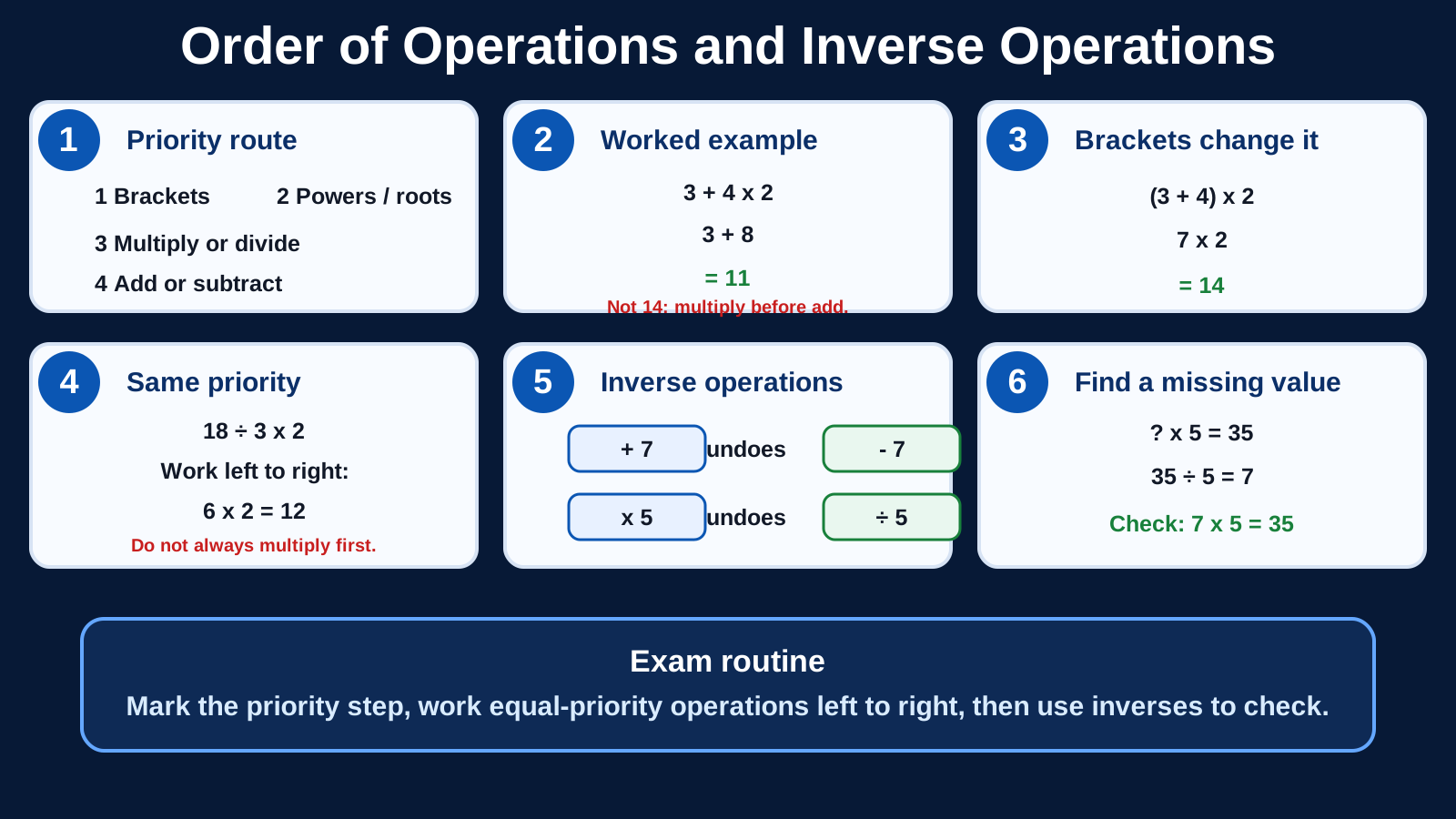
Order of operations and inverse operations infographic
Before viewing
Before viewing, identify where brackets change the order of calculation.
After viewing
After viewing, create two expressions with the same numbers but different answers because the brackets changed.
Why this matters
The same written calculation can give different answers if you do the steps in the wrong order. GCSE questions often mix operations, especially in non-calculator work.
Inverse operations are also a calm way to check yourself. They are the bridge from arithmetic into solving equations and rearranging formulae.
Prior knowledge
You should already be comfortable with:
Clear explanation
Use this order when a calculation has more than one operation:
A useful shortcut is BIDMAS or BODMAS, but the important detail is that multiplication does not always come before division. They have equal priority. Addition and subtraction also have equal priority.
Work equal-priority operations from left to right
24 ÷ 6 × 2 = 4 × 2 = 8Do not jump to the multiplication just because it appears later. The division and multiplication have the same priority, so work from left to right.
20 − 6 + 3 = 14 + 3 = 17Subtraction and addition also have the same priority, so work from left to right.
Brackets change the order
Brackets tell you to calculate that part first.
4 + 3 × 5 = 4 + 15 = 19 (4 + 3) × 5 = 7 × 5 = 35Inverse operations undo each other
An inverse operation reverses another operation. If you add 9, subtract 9 to undo it. If you multiply by 4, divide by 4 to undo it.
Inverse operations are especially useful for checking. If 17 + 28 = 45, then 45 − 28 should return 17.
Worked examples
Example 1: Calculate 6 + 4 × 3.
Multiplication comes before addition.
6 + 4 × 3 = 6 + 12 = 18Reveal answer
Answer: 18.
Example 2: Calculate (6 + 4) × 3.
Brackets come first, so this is different from Example 1.
(6 + 4) × 3 = 10 × 3 = 30Reveal answer
Answer: 30.
Example 3: Calculate 36 ÷ 6 × 2.
Division and multiplication have equal priority, so work from left to right.
36 ÷ 6 × 2 = 6 × 2 = 12Reveal answer
Answer: 12.
Example 4: Find the missing number in n × 5 = 45.
Multiplying by 5 is undone by dividing by 5.
n = 45 ÷ 5 = 9Reveal answer
Answer: n = 9.
Quick checks
Choose an answer, then check your thinking.
1. What is 8 + 2 × 5?
2. What is 30 − 12 ÷ 3?
3. Which operation undoes “multiply by 7”?
Practice questions
Question 1
A ticket costs £9 plus 6 groups of £4 booking fees. Calculate 9 + 6 × 4, showing why the multiplication is done first.
Reveal answer and marking guidance
Answer: 33.
Marking: Award credit for doing 6 × 4 = 24 before adding 9.
Question 2
Four pupils each pay the same shared cost of (9 + 6). Calculate (9 + 6) × 4, using the brackets first.
Reveal answer and marking guidance
Answer: 60.
Marking: Award credit for evaluating the brackets first: 9 + 6 = 15, then 15 × 4 = 60.
Question 3
A 48 cm strip is divided into 6 equal pieces, then 3 pieces are joined. Calculate 48 ÷ 6 × 3 by working left to right.
Reveal answer and marking guidance
Answer: 24.
Marking: Award credit for working left to right: 48 ÷ 6 = 8, then 8 × 3 = 24.
Question 4
After 17 is subtracted from a number, the result is 28. Use an inverse operation to find m in m − 17 = 28.
Reveal answer and marking guidance
Answer: m = 45.
Marking: Award credit for using the inverse operation: 28 + 17 = 45.
Question 5
A total p is shared equally between 8 people and each person gets 6. Use an inverse operation to find p.
Reveal answer and marking guidance
Answer: p = 48.
Marking: Award credit for undoing ÷ 8 with × 8: 6 × 8 = 48.
Question 6
Calculate 5² + 18 ÷ 3 − 4.
Reveal answer and marking guidance
Answer: 27.
Marking: Award credit for powers first and division before addition/subtraction: 25 + 6 − 4 = 27.
Question 7
Calculate 64 ÷ (5 + 3)² × 6.
Reveal answer and marking guidance
Answer: 6.
Marking: Brackets first give 8, then 8² = 64. Work left to right for division and multiplication: 64 ÷ 64 × 6 = 1 × 6 = 6.
Question 8
Find the missing number: 4(n + 3) = 52.
Reveal answer and marking guidance
Answer: n = 10.
Marking: Undo the multiplication first: 52 ÷ 4 = 13. Then undo + 3: 13 − 3 = 10.
Question 9
Calculate 3 × (14 − 6)² ÷ 12 + 5.
Reveal answer and marking guidance
Answer: 21.
Marking: Brackets first give 8, then 8² = 64. Work left to right for multiplication and division: 3 × 64 ÷ 12 = 192 ÷ 12 = 16, then add 5.
Question 10
Calculate √81 + 2(7 − 3)² ÷ 4.
Reveal answer and marking guidance
Answer: 17.
Marking: Work inside the brackets first: 7 − 3 = 4. Then √81 = 9 and 4² = 16, so 9 + 2 × 16 ÷ 4 = 9 + 8 = 17.
Answers and marking guidance
The exact practice answers are hidden under each question so you can try first. For order of operations, marks usually come from showing brackets, powers or roots, multiplication or division, then addition or subtraction in a clear order. For inverse operations, write the operation you are undoing, keep equations balanced on both sides and use brackets when a calculator input could be ambiguous.
Common mistakes
- Working strictly left to right for everything: in 7 + 3 × 2, do 3 × 2 first.
- Thinking multiplication always comes before division: in 24 ÷ 3 × 2, work from left to right.
- Thinking addition always comes before subtraction: in 10 − 4 + 1, work from left to right.
- Ignoring brackets: 2 × (5 + 4) is not the same as 2 × 5 + 4.
- Using the wrong inverse: to undo ÷ 6, multiply by 6, not subtract 6.
Extension challenge
A pupil enters this into a calculator:
72 ÷ 3² + 5 × (11 − 7)Work out the value, then write one inverse check for one step of your calculation.
Reveal answer
Answer: 28.
Brackets and powers first: 11 − 7 = 4 and 3² = 9. Then 72 ÷ 9 + 5 × 4 = 8 + 20 = 28.
One possible inverse check is 8 × 9 = 72, which checks the division step.
Exam-board guidance
Order of operations and inverse operations are core GCSE Maths skills. They are often tested quietly inside longer Number and Algebra questions, so careful working matters.
AQA GCSE Maths
Order of operations protects method marks in number questions, and inverse operations help you check calculations, solve equations, rearrange formulae and spot calculator-entry errors.
OCR GCSE Maths
Expect these skills in direct calculation questions and longer multi-step problems where equal-priority operations and bracketed calculator inputs must be shown in order.
Pearson Edexcel GCSE Maths
Show the order you use, especially when a calculation mixes brackets, indices, division, multiplication, roots or calculator display lines.
Eduqas GCSE Maths
Accurate written working is important when a question combines several operations, especially on non-calculator and reasoning questions.
WJEC Wales
These skills support calculator and non-calculator work, including real-life numeracy problems where an answer needs a reverse check.
CCEA GCSE Maths
Secure arithmetic order and inverse checks are useful across units, especially where several steps, equations or calculator checks are needed.
Next lesson
Next, use careful rounding, estimation and bounds to check whether answers are sensible.