
Lesson overview
A core Number skill for accuracy, checking and measurement.
Rounding, estimation and bounds help you control accuracy. They appear in direct Number questions and inside practical problems involving money, measures, area, speed and calculator answers.
What you will learn
Key facts before you start
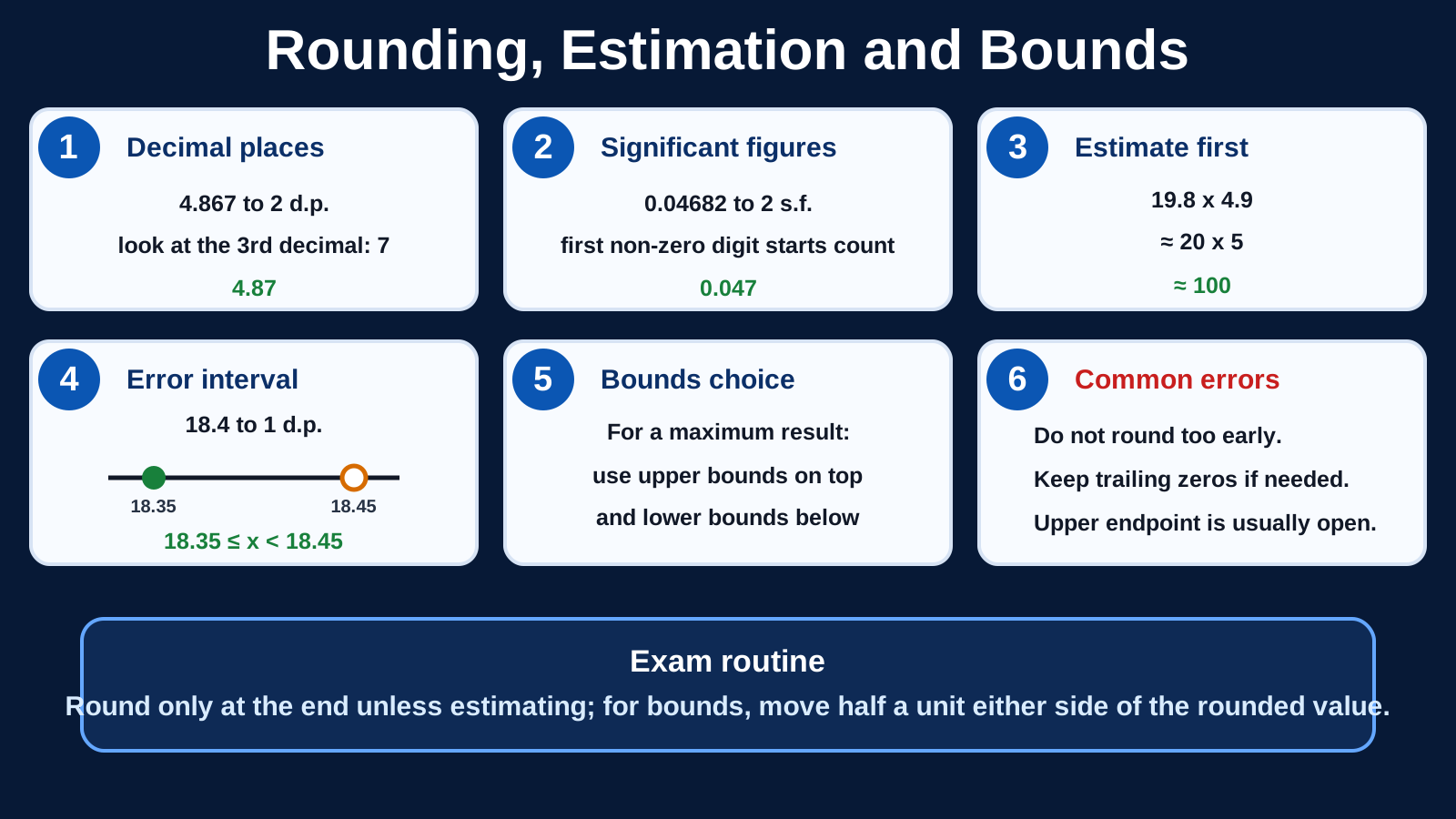
Rounding, estimation and bounds infographic
Before viewing
Before viewing, identify which digit is kept and which digit decides the rounding.
After viewing
After viewing, estimate a calculation first, then compare the exact answer with your estimate.
Why this matters
GCSE answers often need a suitable degree of accuracy. Rounding helps communicate an answer clearly, while estimation helps you spot calculator slips and place-value errors.
Bounds go one step further: if a measurement has been rounded, the exact value could be slightly smaller or larger. Bounds show the whole possible range.
Prior knowledge
You should already be comfortable with:
Clear explanation
Rounding to decimal places
Decimal places count digits after the decimal point. Find the place you are keeping, then look at the next digit.
6.374 rounded to 2 decimal places is 6.37 6.375 rounded to 2 decimal places is 6.38Rounding to significant figures
Significant figures start at the first non-zero digit. This is different from decimal places.
4837 to 2 significant figures ≈ 4800 0.04837 to 2 significant figures ≈ 0.048Estimation
Estimation means replacing numbers with nearby, easier numbers before calculating. It is mainly used as a sensible check.
Bounds and error intervals
If a number has been rounded, the exact value lies in an interval. Half of the rounding unit goes below and half goes above.
The lower bound is included because 7.5 rounds up to 8. The upper bound is not included because 8.5 rounds to 9, not 8.
Worked examples
Example 1: Round 12.746 to 1 decimal place.
The tenths digit is 7. The next digit is 4, so the tenths digit stays the same.
12.746 ≈ 12.7Reveal answer
Answer: 12.7.
Example 2: Round 0.007846 to 2 significant figures.
Start counting at the first non-zero digit: 7. The first two significant figures are 7 and 8. The next digit is 4.
0.007846 ≈ 0.0078Reveal answer
Answer: 0.0078.
Example 3: Estimate 31.2 × 19.7.
Round each number to one significant figure to make the calculation quick.
31.2 × 19.7 ≈ 30 × 20 = 600Reveal answer
Answer: about 600.
Example 4: A mass is 4.6 kg to the nearest 0.1 kg. Write its error interval.
The rounding unit is 0.1 kg, so half of it is 0.05 kg.
Lower bound = 4.6 − 0.05 = 4.55 Upper bound = 4.6 + 0.05 = 4.65Reveal answer
Answer: 4.55 ≤ mass < 4.65.
Quick checks
Choose an answer, then check your thinking.
1. What is 5.684 rounded to 2 decimal places?
2. What is 7380 rounded to 2 significant figures?
3. A length is 12 cm to the nearest cm. Which error interval is correct?
Practice questions
Question 1
Round 18.965 to 2 decimal places.
Reveal answer and marking guidance
Answer: 18.97.
Marking: Keep the hundredths digit. The next digit is 5, so round up.
Question 2
Round 0.004728 to 2 significant figures.
Reveal answer and marking guidance
Answer: 0.0047.
Marking: Start at the first non-zero digit. The first two significant figures are 4 and 7; the next digit is 2.
Question 3
Estimate 48.7 × 6.12 by rounding each number to 1 significant figure.
Reveal answer and marking guidance
Answer: 50 × 6 = 300.
Marking: Round 48.7 to 50 and 6.12 to 6, then multiply.
Question 4
A distance is 3.2 km to the nearest 0.1 km. Write the error interval.
Reveal answer and marking guidance
Answer: 3.15 ≤ distance < 3.25.
Marking: Half of 0.1 km is 0.05 km. Subtract and add 0.05 from 3.2.
Question 5
A rectangle has length 8 cm and width 5 cm, both measured to the nearest cm. Find the lower bound for its area.
Reveal answer and marking guidance
Answer: 33.75 cm².
Marking: Lower bounds are 7.5 cm and 4.5 cm. Lower bound for area = 7.5 × 4.5 = 33.75 cm².
Question 6
A distance of 120 m is measured to the nearest 10 m. A time of 8 s is measured to the nearest second. Find the upper bound for the speed.
Reveal answer and marking guidance
Answer: 16.67 m/s to 2 decimal places.
Marking: Use the largest distance and smallest time: 125 ÷ 7.5 = 16.666..., so the upper bound is 16.67 m/s to 2 decimal places.
Question 7
A mass is 2.45 kg to the nearest 0.01 kg. Write its error interval.
Reveal answer and marking guidance
Answer: 2.445 ≤ mass < 2.455.
Marking: Half of 0.01 kg is 0.005 kg, so subtract and add 0.005 from 2.45. The upper endpoint is not included.
Question 8
A density is found from mass ÷ volume. A mass is 54 g to the nearest gram and a volume is 8.0 cm³ to the nearest 0.1 cm³. Find the lower bound for the density.
Reveal answer and marking guidance
Answer: 6.65 g/cm³ to 2 decimal places.
Marking: Use the smallest mass and largest volume: 53.5 ÷ 8.05 = 6.645962..., so the lower bound is 6.65 g/cm³ to 2 decimal places.
Question 9
A journey distance is 86 km to the nearest kilometre and the time is 1.4 hours to the nearest 0.1 hour. Find the upper bound for the average speed.
Reveal answer and marking guidance
Answer: 64.07 km/h to 2 decimal places.
Marking: Use the largest distance and smallest time: 86.5 ÷ 1.35 = 64.074..., so the upper bound is 64.07 km/h to 2 decimal places.
Question 10
A rectangle has length 14.0 cm to the nearest 0.1 cm and width 6 cm to the nearest cm. Find the upper bound for its perimeter.
Reveal answer and marking guidance
Answer: 41.1 cm.
Marking: Use the largest length and largest width: length < 14.05 cm and width < 6.5 cm, so the upper bound for perimeter is 2 × (14.05 + 6.5) = 41.1 cm.
Answers and marking guidance
The exact practice answers are hidden under each question so you can try first. For rounding, estimation and bounds, marks usually come from identifying the requested accuracy, using the next digit to round, making estimates deliberately rough, using half of the rounding unit for correct limits and choosing inputs that make a compound measure largest or smallest.
Common mistakes
- Mixing decimal places and significant figures: 0.0478 to 2 decimal places is 0.05, but to 2 significant figures it is 0.048.
- Removing important place-value zeros: 7380 to 2 significant figures is 7400, not 74.
- Estimating too late: estimate before doing the full calculation if you are using it to check sense.
- Including the upper bound: write 7.5 ≤ x < 8.5, not 7.5 ≤ x ≤ 8.5, when x rounds to 8 to the nearest whole number.
- Forgetting units: bounds keep the same units as the original measurement.
Extension challenge
A rectangle has length 12.4 cm and width 6.8 cm, both measured to the nearest 0.1 cm. Find the upper bound for its area.
Reveal answer
Answer: 85.2825 cm².
The upper bounds are 12.45 cm and 6.85 cm, so the upper bound for the area is 12.45 × 6.85 = 85.2825 cm².
Exam-board guidance
Rounding, estimation and bounds are shared GCSE Maths skills. They may be tested directly or inside longer measurement, calculator, compound-measure and problem-solving questions.
AQA GCSE Maths
Focus on the shared method, notation and checking habit; wording and context can vary by route.
OCR GCSE Maths
Show clear method steps and use precise notation; question wording may vary by route.
Pearson Edexcel GCSE Maths
Keep working visible and check units or notation; contexts may vary by route.
Eduqas GCSE Maths
Use the same core skill in practical contexts, with clear reasoning and final checks.
WJEC Wales
Connect the method to the context and state what the result means.
CCEA GCSE Maths
Make each method step visible and keep notation, units and final checks clear.
Next lesson
Next, connect percentages with fractions and decimals, then use them to compare amounts fairly.