
Lesson overview
A core Number skill for money, data and proportional reasoning.
Percentages appear throughout GCSE Maths. You need them for straightforward calculations and for deciding which offer, result or change is bigger in context.
What you will learn
Key facts before you start
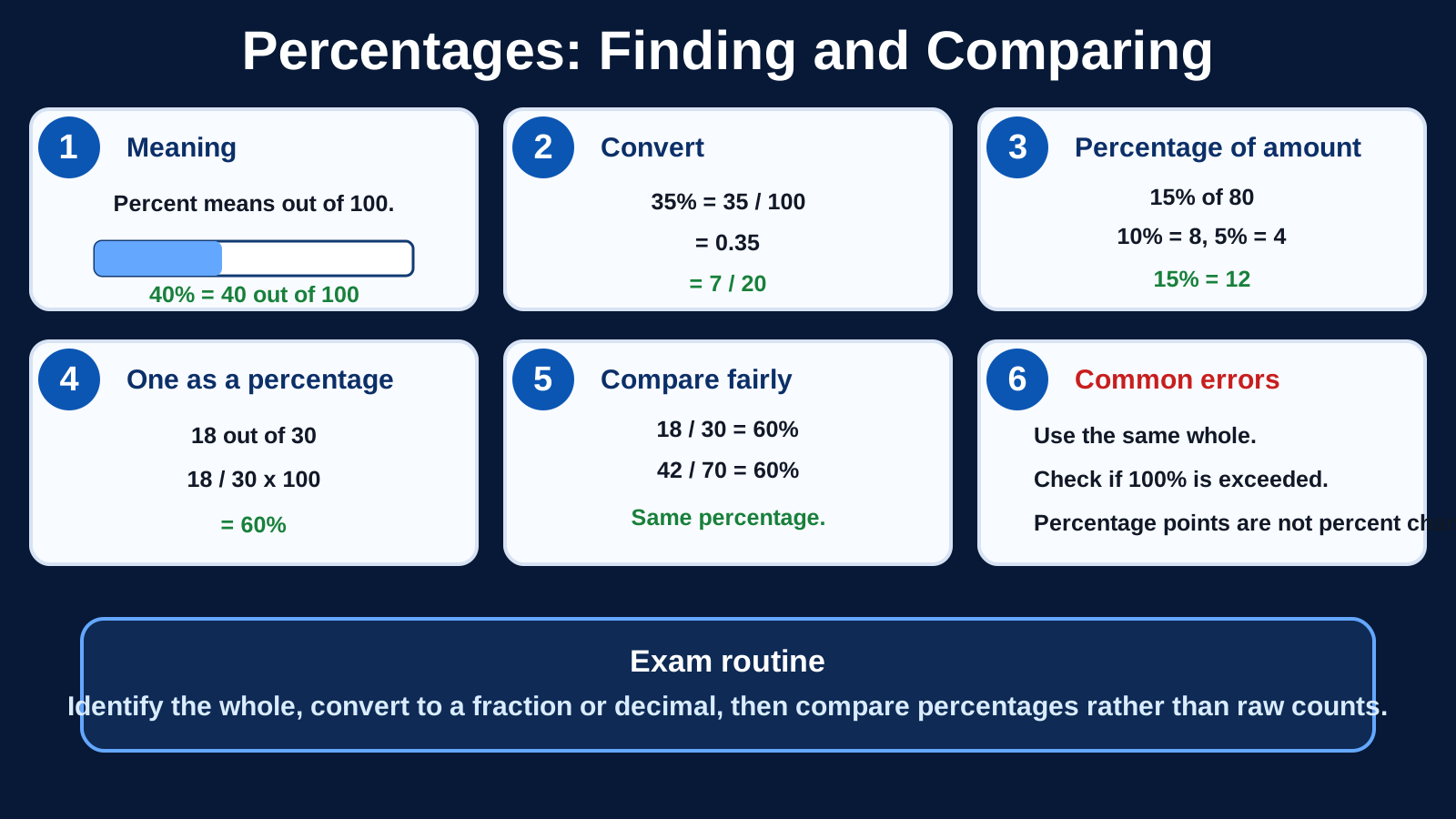
Percentages finding and comparing infographic
Before viewing
Before viewing, identify the whole amount and the percentage amount in the visual.
After viewing
After viewing, compare two scores by converting each to a percentage.
Why this matters
Percentages are used for discounts, test scores, tax, interest, survey results, sports statistics and scientific data.
A percentage lets you compare different-sized groups fairly. For example, 18 out of 30 and 42 out of 70 are both 60%, even though the raw numbers are different.
Prior knowledge
You should already be comfortable with:
Clear explanation
Percentage means out of 100
The symbol % means per cent, or out of 100.
37% = 37 out of 100 = 37100 = 0.37Converting between forms
To change a percentage to a decimal, divide by 100. To change a decimal to a percentage, multiply by 100.
Finding a percentage of an amount
You can use mental building blocks, or change the percentage to a decimal multiplier.
Writing one quantity as a percentage of another
Use this structure when the question asks what percentage one amount is of another:
percentage = part ÷ whole × 100% 18 out of 30 = 18 ÷ 30 × 100% = 60%Comparing percentages
When totals are different, compare percentages rather than just comparing the raw numbers.
Be careful with percentage points. A rise from 40% to 55% is a rise of 15 percentage points, not a 15% increase. The percentage increase is 15 ÷ 40 × 100% = 37.5%.
Worked examples
Example 1: Convert 720 to a percentage.
Make the denominator 100, or divide and multiply by 100.
720 = 35100 = 35%Reveal answer
Answer: 35%.
Example 2: Find 24% of 150.
Change 24% to the decimal 0.24, then multiply.
24% of 150 = 0.24 × 150 = 36Reveal answer
Answer: 36.
Example 3: A shop sells 45 out of 60 tickets. What percentage is this?
The part is 45 and the whole is 60.
45 ÷ 60 × 100% = 75%Reveal answer
Answer: 75% of the tickets were sold.
Example 4: Which result is better, 16 out of 20 or 39 out of 50?
16 ÷ 20 × 100% = 80% 39 ÷ 50 × 100% = 78%Reveal answer
Answer: 16 out of 20 is better because 80% is greater than 78%.
Quick checks
Choose an answer, then check your thinking.
1. What is 0.6 as a percentage?
2. What is 35% of 80?
3. Which is the better score?
Practice questions
Question 1
Write 0.27 as a percentage.
Reveal answer and marking guidance
Answer: 27%.
Marking: Multiply the decimal by 100.
Question 2
Write 18% as a fraction in its simplest form.
Reveal answer and marking guidance
Answer: 950.
Marking: 18% = 18100, then simplify by dividing top and bottom by 2.
Question 3
Find 12% of £250.
Reveal answer and marking guidance
Answer: £30.
Marking: 12% = 0.12, and 0.12 × 250 = 30.
Question 4
A pupil scores 42 marks out of 56. Write this as a percentage.
Reveal answer and marking guidance
Answer: 75%.
Marking: 42 ÷ 56 × 100% = 75%.
Question 5
Shop A sells 24 out of 30 items. Shop B sells 34 out of 40 items. Which shop sells the greater percentage of its items?
Reveal answer and marking guidance
Answer: Shop B.
Marking: Shop A: 24 ÷ 30 × 100% = 80%. Shop B: 34 ÷ 40 × 100% = 85%.
Question 6
A price rises from £80 to £92. Write the new price as a percentage of the original price.
Reveal answer and marking guidance
Answer: 115%.
Marking: Use new price ÷ original price × 100%, so 92 ÷ 80 × 100% = 115%. This is above 100% because the price increased.
Question 7
A club has 48 girls and 32 boys. What percentage of the club are girls?
Reveal answer and marking guidance
Answer: 60%.
Marking: The whole club has 48 + 32 = 80 members. Girls are 48 ÷ 80 × 100% = 60%.
Question 8
A survey result rises from 35% to 49%. State the increase in percentage points, then find the percentage increase from the original result.
Reveal answer and marking guidance
Answer: 14 percentage points; 40% increase.
Marking: Percentage-point increase = 49 − 35 = 14. Percentage increase = 14 ÷ 35 × 100% = 40%.
Question 9
In a year group, 54 out of 72 pupils study Spanish and 65 out of 80 pupils study French. Which subject has the greater percentage of pupils, and by how many percentage points?
Reveal answer and marking guidance
Answer: French, by 6.25 percentage points.
Marking: Spanish: 54 ÷ 72 × 100% = 75%. French: 65 ÷ 80 × 100% = 81.25%. Difference = 81.25 − 75 = 6.25 percentage points.
Question 10
A theatre sells 156 out of 240 seats for Friday and 132 out of 200 seats for Saturday. Which performance has the greater percentage of seats sold?
Reveal answer and marking guidance
Answer: Saturday.
Marking: Friday: 156 ÷ 240 × 100% = 65%. Saturday: 132 ÷ 200 × 100% = 66%. Saturday has the greater percentage of seats sold.
Answers and marking guidance
The exact practice answers are hidden under each question so you can try first. For percentage questions, marks usually come from converting between fractions, decimals and percentages accurately, using part ÷ whole × 100% with the correct whole, interpreting percentages above 100% sensibly, separating percentage points from percentage change, and comparing like with like before making a decision.
Common mistakes
- Forgetting that % means out of 100: 7% is 0.07, not 0.7.
- Using the wrong whole: in 18 out of 30, the whole is 30, so use 18 ÷ 30 × 100%.
- Comparing raw numbers only: 34 sales may not be better than 24 sales unless the totals are considered.
- Dropping units: if the question is about money, include £ or p where needed.
- Rounding too early: keep enough digits until the final answer in comparison questions.
- Confusing percentage points with percentage increase: 30% to 45% is up 15 percentage points, but it is a 50% increase from 30%.
Extension challenge
A sports team wins 18 of its first 24 matches and 15 of its next 18 matches. Which part of the season has the higher win percentage?
Reveal answer
Answer: The next 18 matches had the higher win percentage.
First 24 matches: 18 ÷ 24 × 100% = 75%. Next 18 matches: 15 ÷ 18 × 100% = 83.3% to 1 decimal place.
Exam-board guidance
Percentages are a shared GCSE Maths skill. Expect them in direct Number questions and in real-life contexts such as money, data and comparison.
AQA GCSE Maths
Focus on the shared method, notation and checking habit; wording and context can vary by route.
OCR GCSE Maths
Show clear method steps and use precise notation; question wording may vary by route.
Pearson Edexcel GCSE Maths
Keep working visible and check units or notation; contexts may vary by route.
Eduqas GCSE Maths
Use the same core skill in practical contexts, with clear reasoning and final checks.
WJEC Wales
Connect the method to the context and state what the result means.
CCEA GCSE Maths
Make each method step visible and keep notation, units and final checks clear.
Next lesson
Next, build on this with percentage increase, percentage decrease, reverse percentages and interest.