
Lesson overview
A core Number skill for money, growth, discounts and original values.
Percentage change appears across GCSE Maths. This lesson develops the multiplier method so you can solve ordinary percentage-change questions and reverse questions where the final amount is given.
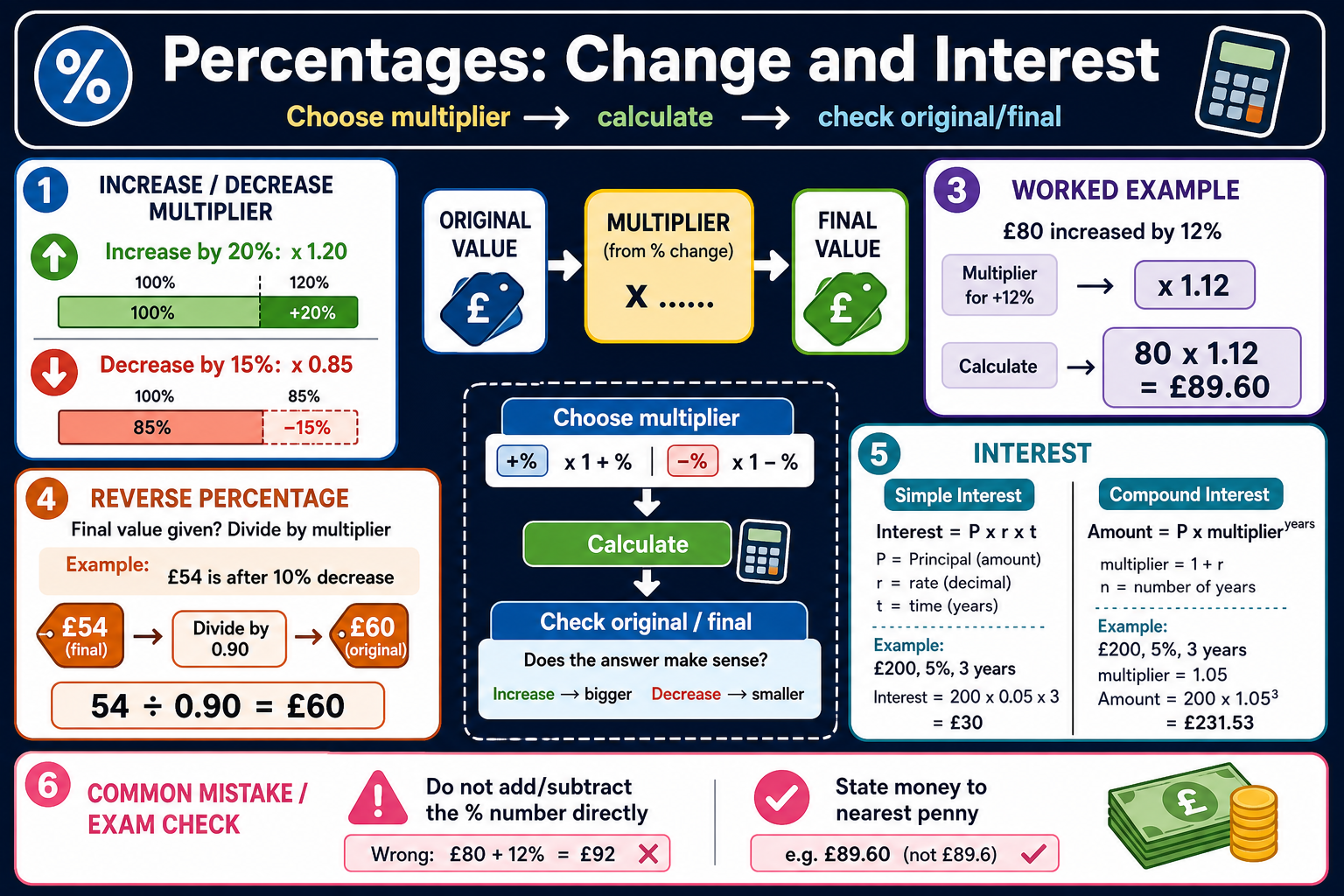
Percentages change and interest infographic
Before viewing
Before viewing, find one increase multiplier and one decrease multiplier in the visual.
After viewing
After viewing, explain why a 20% increase followed by a 20% decrease does not return to the starting value.
What you will learn
Key facts before you start
Why this matters
Percentage change is used for discounts, sale prices, savings, loans, tax, pay rises, population change and worded finance questions.
The multiplier method keeps the whole calculation in one step. It also makes reverse percentages clearer, because you can undo the change by dividing by the multiplier.
Prior knowledge
You should already be comfortable with:
Clear explanation
Percentage increase
For an increase, add the percentage to 100%, then change it to a decimal multiplier.
Percentage decrease
For a decrease, subtract the percentage from 100%, then change it to a decimal multiplier.
Repeated percentage change
If the same percentage change happens more than once, apply the multiplier more than once. For repeated changes, powers are useful.
After 3 years at 5% growth: original amount × 1.05³A 10% increase followed by a 10% decrease does not return to the original value, because the second 10% is taken from a different amount.
Reverse percentages
In a reverse percentage question, the final amount is given and you need the original amount. Work out the multiplier, then divide by it.
original amount = final amount ÷ multiplier After a 25% increase, the multiplier is 1.25.Simple and compound interest
Simple interest is calculated from the original amount each year. Compound interest is calculated from the new amount each year, so interest can earn more interest.
Worked examples
Example 1: Increase £80 by 15%.
An increase of 15% means 115% of the original amount.
£80 × 1.15 = £92Reveal answer
Answer: £92.
Example 2: Decrease 240 by 35%.
A decrease of 35% leaves 65% of the original amount.
240 × 0.65 = 156Reveal answer
Answer: 156.
Example 3: A laptop costs £540 after a 10% discount. What was the original price?
A 10% discount leaves 90%, so the multiplier is 0.9. Because £540 is the final price, divide by 0.9.
original price = £540 ÷ 0.9 = £600Reveal answer
Answer: £600.
Example 4: £500 is invested at 3% compound interest for 2 years.
The multiplier for 3% growth is 1.03. Apply it twice.
£500 × 1.03² = £530.45Reveal answer
Answer: £530.45.
Example 5: £500 is invested at 3% simple interest for 2 years.
Each year the interest is 3% of the original £500.
3% of £500 = 0.03 × 500 = £15 2 years of interest = 2 × £15 = £30 total = £500 + £30 = £530Reveal answer
Answer: £530.
Quick checks
Choose an answer, then check your thinking.
1. What multiplier increases an amount by 18%?
2. A price is reduced by 30%. What multiplier gives the sale price?
3. After a 20% increase, an amount is 96. What was the original amount?
4. Which expression gives £200 at 4% compound interest for 3 years?
Practice questions
Question 1
Increase 350 by 12%.
Reveal answer and marking guidance
Answer: 392.
Marking: Increase multiplier = 1.12. Then 350 × 1.12 = 392.
Question 2
A coat costs £72 after a 40% discount. What was the original price?
Reveal answer and marking guidance
Answer: £120.
Marking: A 40% discount leaves 60%, so the multiplier is 0.6. Original price = 72 ÷ 0.6 = 120.
Question 3
£800 is invested at 5% simple interest for 4 years. Find the total amount.
Reveal answer and marking guidance
Answer: £960.
Marking: 5% of £800 = £40 each year. For 4 years, interest = 4 × £40 = £160. Total = £800 + £160.
Question 4
£800 is invested at 5% compound interest for 4 years. Find the total amount to the nearest penny.
Reveal answer and marking guidance
Answer: £972.41.
Marking: Use £800 × 1.05⁴ = £972.405..., then round to £972.41.
Question 5
A town population decreases by 8% each year. It starts at 25,000. Estimate the population after 2 years.
Reveal answer and marking guidance
Answer: 21,160.
Marking: Decrease multiplier = 0.92. Then 25,000 × 0.92² = 21,160.
Question 6
After a 15% increase, a salary is £29,900. What was the original salary?
Reveal answer and marking guidance
Answer: £26,000.
Marking: Increase multiplier = 1.15. Original salary = 29,900 ÷ 1.15 = 26,000.
Question 7
A bike is reduced by 18% to £369. What was the original price?
Reveal answer and marking guidance
Answer: £450.
Marking: An 18% reduction leaves 82%, so the multiplier is 0.82. Original price = 369 ÷ 0.82 = 450.
Question 8
Account A pays 3% compound interest for 2 years on £2,000. Account B pays 6.1% simple interest for 2 years on £2,000. Which account gives the larger final amount?
Reveal answer and marking guidance
Answer: Account B, with £2,244 compared with £2,121.80 for Account A.
Marking: Account A: 2000 × 1.03² = £2,121.80. Account B: simple interest = 2 × 6.1% × 2000 = £244, so the total is £2,244.
Question 9
A phone costs £640. Its price is increased by 10%, then the new price is reduced by 10%. Find the final price and state whether it returns to £640.
Reveal answer and marking guidance
Answer: £633.60; no, it is £6.40 less than £640.
Marking: Use both multipliers: 640 × 1.10 × 0.90 = 633.60. The second 10% is taken from the increased price, so the changes do not cancel.
Question 10
An investment is worth £1,458 after 2 years of 8% compound interest. How much was invested at the start?
Reveal answer and marking guidance
Answer: £1,250.
Marking: Two years of 8% compound interest uses the multiplier 1.08². Work backwards from the final value: 1458 ÷ 1.08² = 1250.
Answers and marking guidance
The exact practice answers are hidden under each question so you can try first. For percentage change, marks usually come from choosing the right multiplier: above 1 for an increase, below 1 for a decrease, repeated powers for compound change, division by the multiplier when working backwards to the original amount, recognising that opposite-looking changes may act on different amounts, and keeping money values unrounded until the final line.
Common mistakes
- Using the percentage as the multiplier: a 12% increase uses 1.12, not 0.12.
- Subtracting the wrong way for decreases: a 35% decrease leaves 65%, so use 0.65.
- Multiplying instead of dividing in reverse questions: if the final amount is given, divide by the multiplier to find the original.
- Treating compound interest as simple interest: compound interest applies the multiplier to the new amount each year.
- Rounding too early: keep calculator values until the final money answer, then round to the nearest penny.
Extension challenge
A phone is reduced by 20% in a sale. The sale price is then increased by 20% after the sale ends. Is the final price the same as the original price?
Reveal answer
Answer: No. The final price is 96% of the original price.
Use any original price, such as £100. After a 20% decrease: £100 × 0.8 = £80. Then a 20% increase: £80 × 1.2 = £96.
Using multipliers: 0.8 × 1.2 = 0.96.
Exam-board guidance
Percentage change, reverse percentages and interest are shared GCSE Maths skills. They often appear in money, growth, decay and multi-step problem-solving contexts.
AQA GCSE Maths
Focus on the shared method, notation and checking habit; wording and context can vary by route.
OCR GCSE Maths
Show clear method steps and use precise notation; question wording may vary by route.
Pearson Edexcel GCSE Maths
Keep working visible and check units or notation; contexts may vary by route.
Eduqas GCSE Maths
Use the same core skill in practical contexts, with clear reasoning and final checks.
WJEC Wales
Connect the method to the context and state what the result means.
CCEA GCSE Maths
Make each method step visible and keep notation, units and final checks clear.
Next lesson
Next, move into ratio by simplifying and scaling equivalent ratios.