
Lesson overview
A core skill for proportion, scale, sharing and rates.
Ratio is used across GCSE Maths whenever quantities are compared or scaled together. This lesson focuses on the first secure steps: notation, simplifying and equivalent ratios.
What you will learn
Key facts before you start
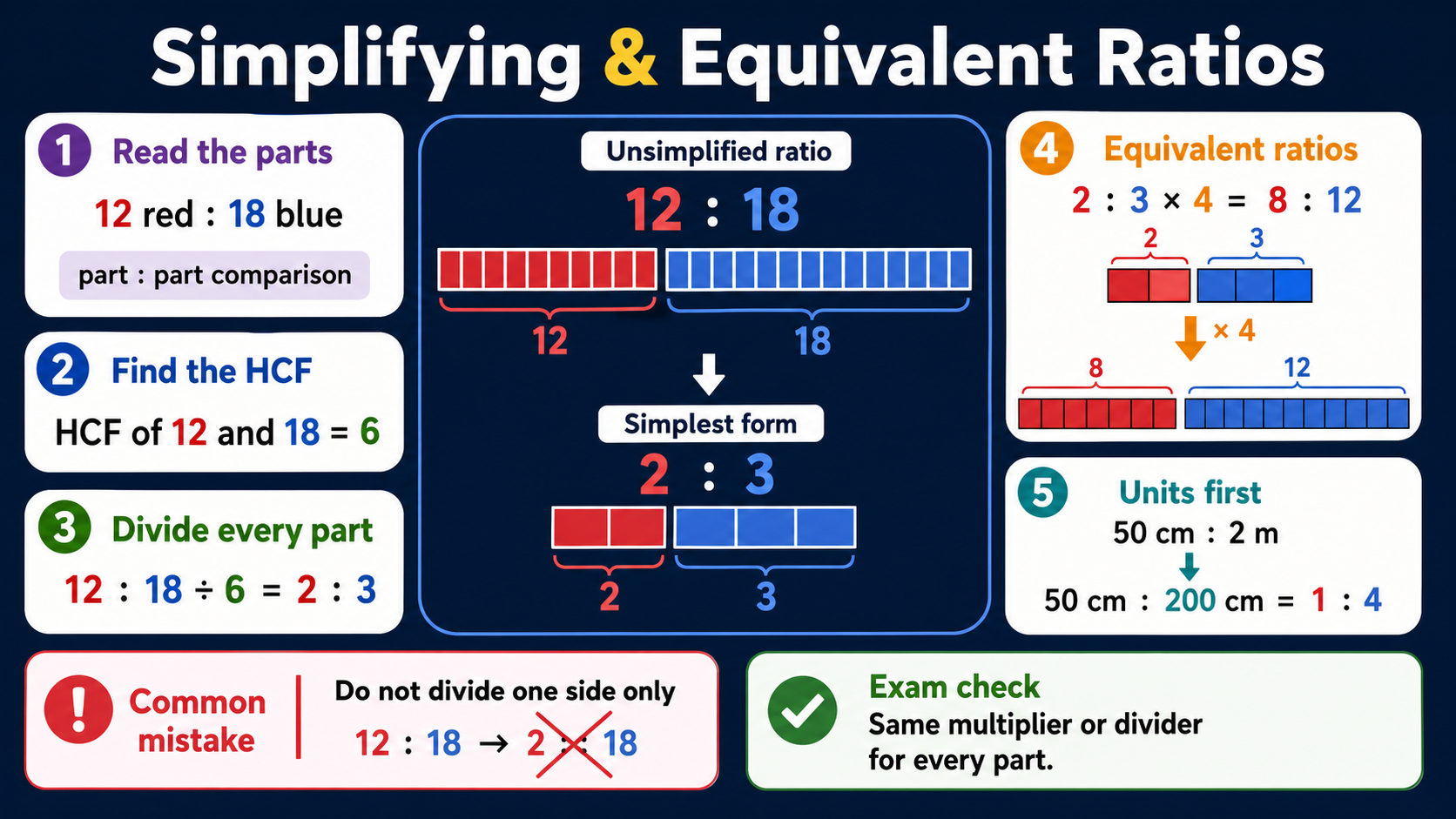
Simplifying and equivalent ratios infographic
Before viewing
Before viewing, identify the common factor shared by all ratio parts.
After viewing
After viewing, simplify a ratio and create an equivalent ratio by scaling it.
Why this matters
Ratios appear in recipes, map scales, paint mixtures, currency, speed, density, probability and similar shapes.
If you can simplify and scale ratios accurately, later GCSE questions about sharing, direct proportion and rates become much more manageable.
Prior knowledge
You should already be comfortable with:
Clear explanation
Ratio notation
A ratio compares quantities. The colon symbol : is read as to.
red : blue = 3 : 2This means there are 3 red parts for every 2 blue parts. The order matters: 3 : 2 is not the same as 2 : 3.
Simplifying ratios
To simplify a ratio, divide every part by the same common factor. Keep dividing until the parts have no common factor bigger than 1.
You must divide every part. For a three-part ratio, all three parts are treated together.
8 : 12 : 20 = 2 : 3 : 5Equivalent ratios
Equivalent ratios compare quantities in the same way. Multiply or divide every part by the same number.
Part-to-part and part-to-whole language
In the ratio boys : girls = 2 : 3, the 2 compares boys with girls and the 3 compares girls with boys. That is part-to-part language.
The whole group has 2 + 3 = 5 equal parts. So boys are 25 of the whole group, not 23 of the whole group.
Do not treat ratios as fractions too early
A ratio such as 2 : 3 is not automatically the fraction 23 of the whole. First ask: what are the parts, and what is the whole?
Once the meaning is clear, fractions can be useful. Before that, they can lead to the wrong denominator.
Worked examples
Example 1: Simplify 15 : 25.
15 and 25 both divide by 5.
15 : 25 = 15 ÷ 5 : 25 ÷ 5 = 3 : 5Reveal answer
Answer: 3 : 5.
Example 2: Simplify 18 : 24 : 30.
The highest common factor of 18, 24 and 30 is 6.
18 : 24 : 30 = 3 : 4 : 5Reveal answer
Answer: 3 : 4 : 5.
Example 3: Complete the equivalent ratio.
Find the missing number: 5 : 8 = 20 : ?
5 × 4 = 20, so 8 × 4 = 32Reveal answer
Answer: 5 : 8 = 20 : 32.
Example 4: Interpret a ratio carefully.
In a bag, red counters : blue counters = 3 : 7. What fraction of the counters are red?
total parts = 3 + 7 = 10 red counters are 310 of the whole bagReveal answer
Answer: 310, not 37.
Quick checks
Choose an answer, then check your thinking.
1. Simplify 14 : 21.
2. Which ratio is equivalent to 4 : 9?
3. The ratio cats : dogs is 2 : 5. What fraction of the animals are dogs?
Practice questions
Question 1
Simplify 10 : 35.
Reveal answer and marking guidance
Answer: 2 : 7.
Marking: Divide both parts by 5.
Question 2
Simplify 16 : 20 : 28.
Reveal answer and marking guidance
Answer: 4 : 5 : 7.
Marking: Divide all three parts by 4.
Question 3
Find the missing number: 6 : 11 = 18 : ?
Reveal answer and marking guidance
Answer: 33.
Marking: 6 × 3 = 18, so 11 × 3 = 33.
Question 4
Are 9 : 12 and 15 : 20 equivalent ratios? Explain your answer.
Reveal answer and marking guidance
Answer: Yes, they are equivalent.
Marking: 9 : 12 simplifies to 3 : 4, and 15 : 20 also simplifies to 3 : 4.
Question 5
In a class, left-handed pupils : right-handed pupils = 1 : 9. What fraction of the class is left-handed?
Reveal answer and marking guidance
Answer: 110.
Marking: Total parts = 1 + 9 = 10, so the left-handed pupils are 1 out of 10 parts.
Question 6
A squash drink uses 500 ml of concentrate and 1.75 litres of water. Write the ratio concentrate : water in its simplest form.
Reveal answer and marking guidance
Answer: 2 : 7.
Marking: Convert 1.75 litres to 1750 ml first. Then 500 : 1750 simplifies by dividing both parts by 250 to give 2 : 7.
Question 7
Paint is mixed in the ratio red : yellow : white = 3 : 5 : 2. A batch uses 750 ml of yellow paint. How much red paint is needed?
Reveal answer and marking guidance
Answer: 450 ml.
Marking: Yellow has 5 parts, and 750 ÷ 5 = 150 ml per part. Red has 3 parts, so red paint = 3 × 150 = 450 ml.
Question 8
Two ratios are written as 4 : 7 and 28 : 49. Are they equivalent? Explain using a scale factor.
Reveal answer and marking guidance
Answer: Yes, they are equivalent.
Marking: 4 × 7 = 28 and 7 × 7 = 49, so every part has been multiplied by the same scale factor of 7.
Question 9
A biscuit recipe uses 0.6 kg flour, 450 g sugar and 150 g butter. Write the ratio flour : sugar : butter in its simplest form.
Reveal answer and marking guidance
Answer: 4 : 3 : 1.
Marking: Convert 0.6 kg to 600 g first. Then 600 : 450 : 150 simplifies by dividing all three parts by 150.
Question 10
A scale drawing uses the ratio drawing length : real length = 3 cm : 1.2 m. Write this ratio in its simplest form.
Reveal answer and marking guidance
Answer: 1 : 40.
Marking: Convert 1.2 m to 120 cm first. Then 3 : 120 simplifies by dividing both parts by 3.
Answers and marking guidance
The exact practice answers are hidden under each question so you can try first. For simplifying and equivalent ratios, marks usually come from scaling every part by the same factor, matching units before simplifying, dividing by the highest common factor where possible, keeping the order of the ratio parts exactly as the question gives them, and using the total number of parts only when the question asks for a fraction or share of the whole.
Common mistakes
- Changing only one part: equivalent ratios must multiply or divide every part by the same number.
- Stopping too early: 12 : 18 can become 6 : 9, but it is not fully simplified until 2 : 3.
- Reversing the order: if the question says red : blue, keep red first and blue second.
- Using the wrong whole: in 2 : 3, the total is 5 parts, so the first part is 25 of the whole.
- Treating ratios as fractions too early: decide whether the question is part-to-part or part-to-whole before writing a fraction.
Extension challenge
The ratio of adult tickets to child tickets sold is 5 : 8. A total of 78 tickets are sold. How many child tickets are sold?
Reveal answer
Answer: 48 child tickets.
Total ratio parts = 5 + 8 = 13. Each part is 78 ÷ 13 = 6 tickets. Child tickets = 8 × 6 = 48.
Exam-board guidance
Ratio notation, simplifying ratios and equivalent ratios are shared GCSE Maths skills. They are often tested directly, then used inside longer proportion and problem-solving questions.
AQA GCSE Maths
Focus on the shared method, notation and checking habit; wording and context can vary by route.
OCR GCSE Maths
Show clear method steps and use precise notation; question wording may vary by route.
Pearson Edexcel GCSE Maths
Keep working visible and check units or notation; contexts may vary by route.
Eduqas GCSE Maths
Use the same core skill in practical contexts, with clear reasoning and final checks.
WJEC Wales
Connect the method to the context and state what the result means.
CCEA GCSE Maths
Make each method step visible and keep notation, units and final checks clear.
Next lesson
Next, use ratios to divide a total into unequal shares.