
Lesson overview
A core ratio skill for money, groups, recipes and measures.
GCSE ratio questions often ask you to divide a total into unequal parts. This lesson focuses on the parts method: add the ratio parts, find one part, then scale each share.
What you will learn
Key facts before you start
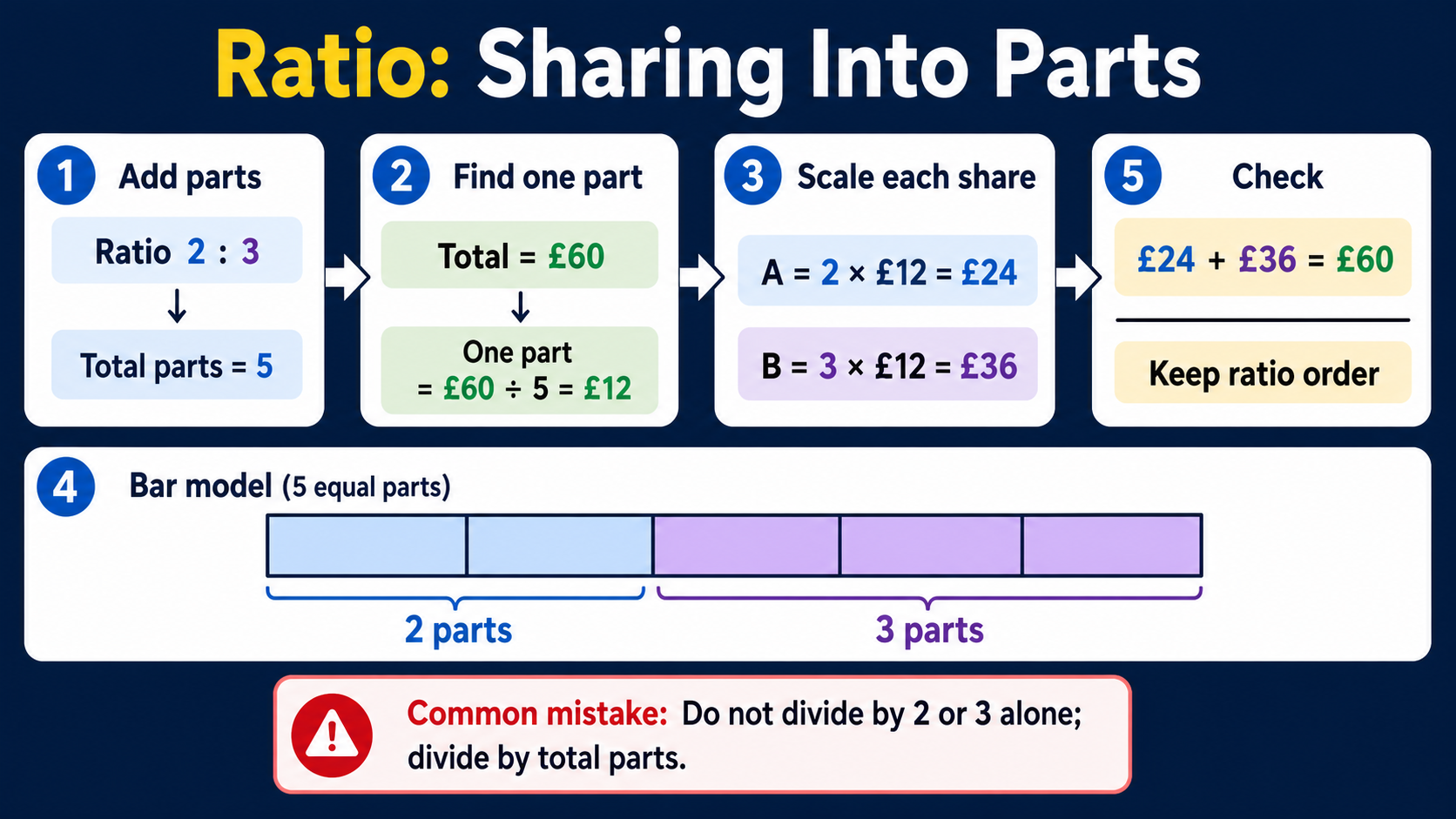
Ratio sharing into parts infographic
Before viewing
Before viewing, count the total ratio parts before calculating any share.
After viewing
After viewing, share one amount in a ratio and check the shares add back to the total.
Why this matters
Sharing into a ratio is useful when prize money is split, ingredients are mixed, groups are divided or distances are compared.
In exams, the method is often worth marks even when the numbers are simple. Clear working helps you avoid mixing up the bigger and smaller shares.
Prior knowledge
You should already be comfortable with:
Clear explanation
The parts method
A ratio tells you how many equal parts belong to each share. To share a total in a ratio:
Sharing into two parts
Share £40 in the ratio 3 : 5. The total number of parts is:
3 + 5 = 8 partsEach part is worth:
£40 ÷ 8 = £5Now multiply by each ratio part:
Sharing into three parts
The same method works for three-part ratios. Share 60 sweets in the ratio 2 : 3 : 5.
Interpreting unequal shares
If the question says Ali : Bea = 2 : 7, Bea gets the larger share because 7 parts is more than 2 parts.
Keep the names in the same order as the ratio. Do not swap the answers at the end.
A simple visual check
This bar shows £40 shared in the ratio 3 : 5. There are 8 equal boxes, so each box is £5.
Worked examples
Example 1: Share £36 in the ratio 1 : 5.
Add the parts, then find one part.
1 + 5 = 6 parts £36 ÷ 6 = £6 per part shares: 1 × £6 = £6 and 5 × £6 = £30Reveal answer
Answer: £6 and £30.
Example 2: Nina and Omar share 72 points in the ratio 4 : 5.
The order is Nina : Omar, so Nina gets 4 parts and Omar gets 5 parts.
4 + 5 = 9 parts 72 ÷ 9 = 8 points per part Nina = 4 × 8 = 32, Omar = 5 × 8 = 40Reveal answer
Answer: Nina gets 32 points and Omar gets 40 points.
Example 3: Share 84 kg in the ratio 2 : 3 : 7.
This is a three-part ratio, so add all three parts.
2 + 3 + 7 = 12 parts 84 ÷ 12 = 7 kg per part 2 × 7 = 14 kg, 3 × 7 = 21 kg, 7 × 7 = 49 kg check: 14 + 21 + 49 = 84Reveal answer
Answer: 14 kg, 21 kg and 49 kg.
Example 4: Find the larger share.
Jamie and Kai share £96 in the ratio Jamie : Kai = 5 : 7. How much more does Kai get?
5 + 7 = 12 parts £96 ÷ 12 = £8 per part Jamie = 5 × £8 = £40, Kai = 7 × £8 = £56 £56 - £40 = £16Reveal answer
Answer: Kai gets £16 more than Jamie.
Quick checks
Choose an answer, then check your thinking.
1. Share £30 in the ratio 2 : 3. What is one part worth?
2. A total of 45 is shared in the ratio 1 : 4. What is the larger share?
3. Share 48 in the ratio 2 : 4 : 6. Which set of shares is correct?
Practice questions
Question 1
Share £24 in the ratio 1 : 3.
Reveal answer and marking guidance
Answer: £6 and £18.
Marking: 1 + 3 = 4 parts; £24 ÷ 4 = £6; shares are 1 × £6 and 3 × £6.
Question 2
Share 56 counters in the ratio 3 : 5.
Reveal answer and marking guidance
Answer: 21 counters and 35 counters.
Marking: 3 + 5 = 8 parts; 56 ÷ 8 = 7; shares are 3 × 7 = 21 and 5 × 7 = 35.
Question 3
Aisha and Ben share £63 in the ratio Aisha : Ben = 2 : 7. How much does Ben get?
Reveal answer and marking guidance
Answer: Ben gets £49.
Marking: 2 + 7 = 9 parts; £63 ÷ 9 = £7; Ben has 7 parts, so 7 × £7 = £49.
Question 4
Share 90 minutes in the ratio 2 : 3 : 4.
Reveal answer and marking guidance
Answer: 20 minutes, 30 minutes and 40 minutes.
Marking: 2 + 3 + 4 = 9 parts; 90 ÷ 9 = 10; multiply 10 by each ratio part.
Question 5
Three people share £120 in the ratio 1 : 2 : 5. How much more does the largest share get than the smallest share?
Reveal answer and marking guidance
Answer: £60 more.
Marking: 1 + 2 + 5 = 8 parts; £120 ÷ 8 = £15; largest share = 5 × £15 = £75; smallest share = £15; difference = £60.
Question 6
A recipe uses flour : sugar : butter = 5 : 2 : 3. The total mass is 800 g. Find the mass of each ingredient.
Reveal answer and marking guidance
Answer: 400 g flour, 160 g sugar and 240 g butter.
Marking: Total parts = 5 + 2 + 3 = 10; one part = 800 g ÷ 10 = 80 g; multiply each part by 80 g.
Question 7
The ratio of adults to children on a coach is 2 : 5. There are 21 more children than adults. How many people are on the coach?
Reveal answer and marking guidance
Answer: 49 people.
Marking: The difference is 5 − 2 = 3 parts. 3 parts = 21, so 1 part = 7. Adults = 14 and children = 35, giving 49 people in total.
Question 8
Three clubs share £360 in the ratio drama : sport : music = 4 : 7 : 9. Sport and music spend £30 together. How much money is left between them?
Reveal answer and marking guidance
Answer: £258 is left between sport and music.
Marking: Total parts = 4 + 7 + 9 = 20, so 1 part = £360 ÷ 20 = £18. Sport and music originally get (7 + 9) × £18 = £288. After spending £30, £288 − £30 = £258 remains.
Question 9
Ali, Bea and Cai share some money in the ratio Ali : Bea : Cai = 2 : 3 : 7. Cai gets £45 more than Ali. How much money is shared altogether?
Reveal answer and marking guidance
Answer: £108.
Marking: Cai has 7 − 2 = 5 more parts than Ali. If 5 parts = £45, then 1 part = £9. The total is 2 + 3 + 7 = 12 parts, so 12 × £9 = £108.
Question 10
Paint is mixed in the ratio red : blue : yellow = 3 : 4 : 5. There are 18 litres more yellow paint than blue paint. How many litres of paint are mixed altogether?
Reveal answer and marking guidance
Answer: 216 litres.
Marking: Yellow is 5 − 4 = 1 part more than blue, so 1 part = 18 litres. Total parts = 3 + 4 + 5 = 12, so total paint = 12 × 18 = 216 litres.
Answers and marking guidance
The exact practice answers are hidden under each question so you can try first. For sharing into a ratio, marks usually come from adding the total parts, finding the value of one part, multiplying each share correctly, and checking that the shares add back to the original total with the right units. When the question gives a difference between two shares, link that difference to the matching difference in ratio parts before finding one part.
Common mistakes
- Dividing by one ratio number: for 2 : 3, divide the total by 5 parts, not by 2 or 3.
- Forgetting a part in a three-part ratio: for 2 : 3 : 5, the total is 10 parts.
- Swapping the shares: keep names or categories in the same order as the ratio.
- Stopping before the check: the final shares should add back to the original total.
- Losing units: use £, g, kg, minutes or counters when the question gives units.
Extension challenge
A charity event raises £210. The money is shared between three causes in the ratio 4 : 5 : 6. The largest cause then donates £8 to the smallest cause. What is the new ratio of the three amounts?
Reveal answer
Answer: 32 : 35 : 38.
Total parts = 4 + 5 + 6 = 15. One part = £210 ÷ 15 = £14, so the original shares are £56, £70 and £84. After £8 moves from the largest to the smallest, the shares are £64, £70 and £76. The ratio 64 : 70 : 76 simplifies by dividing by 2 to give 32 : 35 : 38.
Exam-board guidance
Sharing a quantity in a given ratio is common across GCSE Maths specifications. It may be tested directly or inside worded problems involving money, measurements, recipes, groups and proportional reasoning.
AQA GCSE Maths
Focus on the shared method, notation and checking habit; wording and context can vary by route.
OCR GCSE Maths
Show clear method steps and use precise notation; question wording may vary by route.
Pearson Edexcel GCSE Maths
Keep working visible and check units or notation; contexts may vary by route.
Eduqas GCSE Maths
Use the same core skill in practical contexts, with clear reasoning and final checks.
WJEC Wales
Connect the method to the context and state what the result means.
CCEA GCSE Maths
Make each method step visible and keep notation, units and final checks clear.
Next lesson
Next, connect ratio parts to fractions of a whole.