
Lesson overview
A key link between ratio, fractions and proportion.
GCSE questions often move between ratio language and fraction language. This lesson focuses on the safest method: add the ratio parts to find the whole, then write each part as a fraction of that whole.
What you will learn
Key facts before you start
Ratio and fractions infographic
Before viewing
Before viewing, identify the parts and the total number of parts.
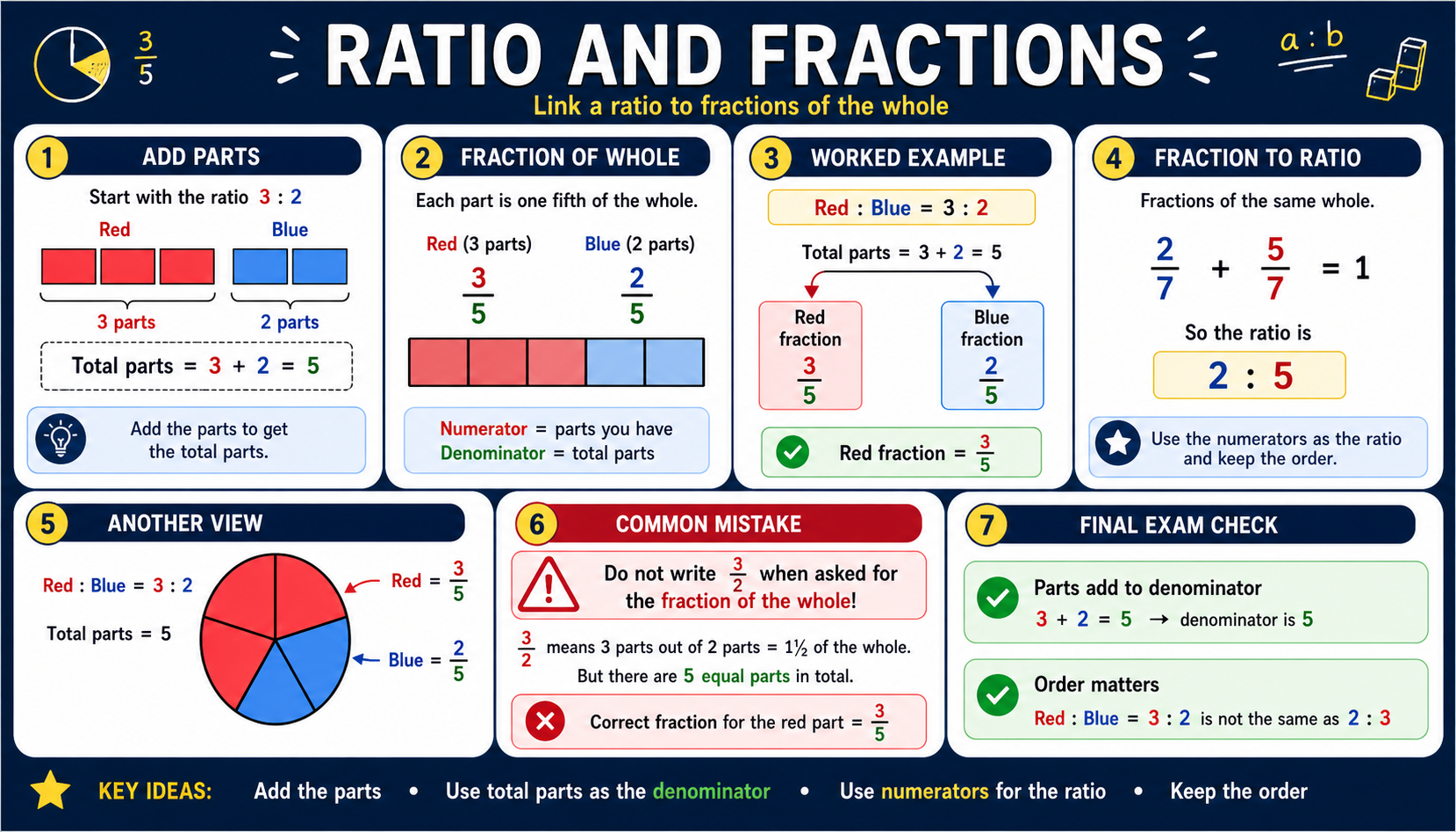
After viewing
After viewing, convert one ratio into a fraction of the whole.
Why this matters
Ratio and fraction language appears in probability, mixtures, recipes, surveys, similar shapes and percentage work.
A ratio such as 2 : 3 does not mean the first amount is automatically 23 of the whole. The whole has 2 + 3 = 5 parts, so the first amount is 25 of the whole.
Prior knowledge
You should already be comfortable with:
Clear explanation
Part-to-part ratios and fractions of the whole
A ratio compares parts with each other. A fraction of the whole compares one part with the total.
The denominator is 5, not 3, because the whole group is made from both colours together.
Converting a ratio into fractions
To convert a ratio into fractions of the whole:
Converting fractions into a ratio
If fractions describe parts of the same whole, their numerators can become ratio parts once the denominators match.
If one fraction is given and there are only two categories, subtract from 1 whole to find the other fraction.
If 27 of counters are green, then 57 are not green. green : not green = 2 : 5Checking denominators by adding total parts
The total number of ratio parts is the denominator for fractions of the whole. This quick check catches many mistakes.
If a total amount is given, the same parts check still works: with 60 counters in the ratio 3 : 4 : 5, one part is 60 ÷ 12 = 5, so the first group is 3 × 5 = 15 counters.
A simple visual check
This bar shows the ratio red : blue = 2 : 3. There are 5 equal parts in total, so the red fraction is 25 and the blue fraction is 35.
Worked examples
Example 1: Ratio to fractions
The ratio of cats to dogs is 3 : 7. What fraction of the animals are cats?
total parts = 3 + 7 = 10 cats are 3 out of 10 partsReveal answer
Answer: 310 of the animals are cats.
Example 2: Three-part ratio to fractions
A recipe has flour : sugar : butter = 5 : 2 : 3. What fraction of the mixture is butter?
total parts = 5 + 2 + 3 = 10 butter is the third part, so butter = 310Reveal answer
Answer: 310 of the mixture is butter.
Example 3: Fraction to ratio
49 of a group are adults. The rest are children. Write the ratio adults : children.
children = 99 − 49 = 59 adults : children = 4 : 5Reveal answer
Answer: 4 : 5.
Example 4: Convert and simplify
In a survey, 615 chose tea and 915 chose juice. Write the ratio tea : juice in simplest form.
tea : juice = 6 : 9 6 : 9 = 2 : 3Reveal answer
Answer: 2 : 3.
Quick checks
Choose an answer, then check your thinking.
1. The ratio red : blue is 2 : 5. What fraction of the whole is red?
2. The ratio A : B : C is 1 : 3 : 4. What fraction is B?
3. 311 of counters are yellow. The rest are green. What is yellow : green?
Practice questions
Question 1
The ratio apples : oranges is 4 : 5. What fraction of the fruit are apples?
Reveal answer and marking guidance
Answer: 49.
Marking: 4 + 5 = 9 total parts; apples are 4 of those 9 parts.
Question 2
A bag has red : blue : green counters in the ratio 2 : 3 : 7. What fraction of the counters are green?
Reveal answer and marking guidance
Answer: 712.
Marking: Total parts = 2 + 3 + 7 = 12; green is the third part, so green is 7 out of 12 parts.
Question 3
58 of a class travel by bus. The rest walk. Write the ratio bus : walk.
Reveal answer and marking guidance
Answer: 5 : 3.
Marking: The whole is 88. Walking is 38, so bus : walk = 5 : 3.
Question 4
In a team, juniors : seniors = 7 : 11. What fraction of the team are seniors?
Reveal answer and marking guidance
Answer: 1118.
Marking: Total parts = 7 + 11 = 18; seniors are 11 of those 18 parts.
Question 5
A drink is concentrate : water = 1 : 6. What fraction of the drink is water?
Reveal answer and marking guidance
Answer: 67.
Marking: Total parts = 1 + 6 = 7; water is 6 out of 7 parts.
Question 6
1220 of a group chose option A and 820 chose option B. Write the ratio A : B in simplest form.
Reveal answer and marking guidance
Answer: 3 : 2.
Marking: A : B = 12 : 8, then divide both parts by 4 to simplify to 3 : 2.
Question 7
The ratio blue : red : yellow beads is 5 : 6 : 9. What fraction of the beads are not red?
Reveal answer and marking guidance
Answer: 710.
Marking: Total parts = 5 + 6 + 9 = 20. Not red is 5 + 9 = 14 parts, so the fraction is 1420 = 710.
Question 8
311 of a packet are strawberry sweets. The rest are lemon sweets. There are 40 lemon sweets. How many strawberry sweets are there?
Reveal answer and marking guidance
Answer: 15 strawberry sweets.
Marking: Lemon sweets are 811 of the packet, so strawberry : lemon = 3 : 8. If 8 parts = 40, then 1 part = 5 and 3 parts = 15.
Question 9
In a club, 25 of the members are juniors and 14 are seniors. The rest are adults. Write the ratio juniors : seniors : adults in its simplest form.
Reveal answer and marking guidance
Answer: 8 : 5 : 7.
Marking: Use twentieths: juniors are 820 and seniors are 520. Adults are 720, so the ratio is 8 : 5 : 7.
Question 10
In a library, fiction : non-fiction = 7 : 5. 38 of the non-fiction books are science books. There are 90 science books. How many books are in the library altogether?
Reveal answer and marking guidance
Answer: 576 books.
Marking: If 38 of the non-fiction books is 90, then all non-fiction books = 90 ÷ 3 × 8 = 240. In the ratio fiction : non-fiction = 7 : 5, 5 parts = 240, so 1 part = 48 and 12 parts = 576.
Answers and marking guidance
The exact practice answers are hidden under each question so you can try first. For ratio and fraction links, marks usually come from treating the total number of ratio parts as the denominator, matching each named part to the correct numerator, and converting fractions to a shared whole before writing a ratio.
Common mistakes
- Using the other part as the denominator: in 2 : 5, the first part is 27 of the whole, not 25.
- Forgetting to add all parts: in 1 : 3 : 4, the denominator is 8, not 4.
- Reversing the ratio: if the question asks for adults : children, keep adults first.
- Missing the rest of the whole: if 310 are red, the rest are 710.
- Not simplifying a final ratio: 12 : 8 is correct working, but the simplest ratio is 3 : 2.
Extension challenge
In a club, the ratio of Year 10 pupils to Year 11 pupils is 3 : 5. Then 6 Year 10 pupils join, and the new ratio becomes 2 : 3. How many pupils were in the club at the start?
Reveal answer
Answer: 144 pupils.
Original numbers can be written as 3x and 5x. After 6 Year 10 pupils join, the ratio is (3x + 6) : 5x = 2 : 3. So 3 × (3x + 6) = 2 × 5x, giving 9x + 18 = 10x and x = 18. Original total = 3x + 5x = 8x = 144.
Correction check: 54 Year 10 and 90 Year 11 gives 144 at the start. After 6 join, 60 : 90 simplifies to 2 : 3.
Exam-board guidance
Moving between ratios and fractions is common across GCSE Maths. The reliable method is always to identify the whole before choosing a denominator.
AQA GCSE Maths
Focus on the shared method, notation and checking habit; wording and context can vary by route.
OCR GCSE Maths
Show clear method steps and use precise notation; question wording may vary by route.
Pearson Edexcel GCSE Maths
Keep working visible and check units or notation; contexts may vary by route.
Eduqas GCSE Maths
Use the same core skill in practical contexts, with clear reasoning and final checks.
WJEC Wales
Connect the method to the context and state what the result means.
CCEA GCSE Maths
Make each method step visible and keep notation, units and final checks clear.
Next lesson
Next, use proportional reasoning to compare deals and solve worded problems in Proportion Problems and Best Buys.