
Lesson overview
A practical proportion skill for prices, recipes, rates and value for money.
GCSE proportion questions often ask you to compare different-sized quantities fairly. This lesson focuses on the unitary method: find one unit first, then scale to the quantity you need.
What you will learn
Key facts before you start
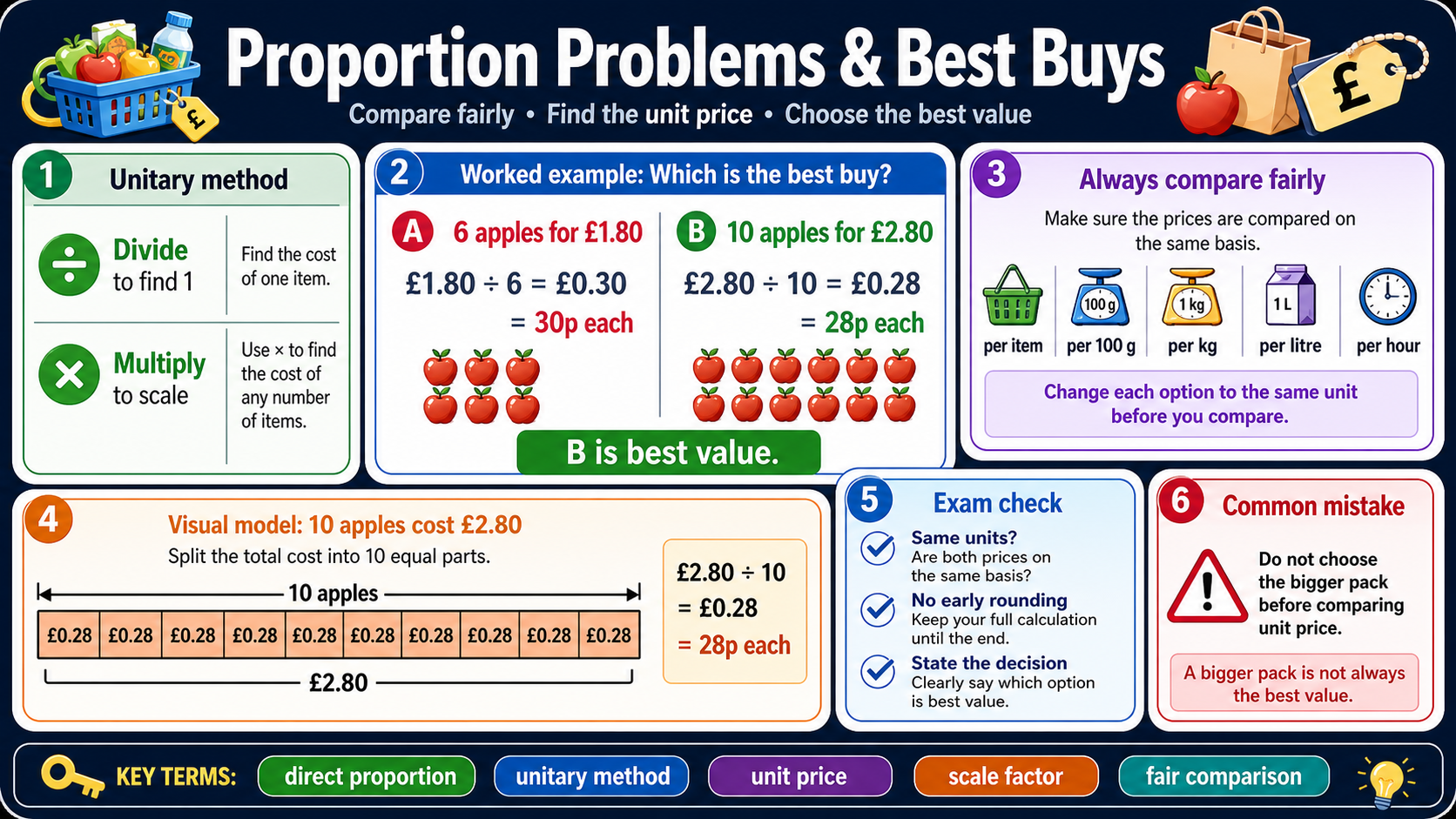
Proportion problems and best buys infographic
Before viewing
Before viewing, identify the unit being compared in the best-buy example.
After viewing
After viewing, compare two offers by calculating the same unit price.
Why this matters
Proportion is the maths behind supermarket offers, recipes, fuel costs, speed, pay rates, exchange rates and shared work.
A bigger pack is not always better value. A faster-looking rate is not always fair unless both rates are compared over the same time, distance or amount.
Prior knowledge
You should already be comfortable with:
Clear explanation
Direct proportion
Two quantities are in direct proportion when they increase or decrease by the same scale factor. If 2 notebooks cost £3.00, then 4 notebooks cost £6.00 because the number of notebooks has doubled.
The unitary method
The unitary method means finding the value of one unit first. Once you know one unit, you can multiply by the amount you need.
6 apples cost £2.40 1 apple costs £2.40 ÷ 6 = £0.40 10 apples cost 10 × £0.40 = £4.00Scaling up and down
You can also scale directly if the factor is clear. A recipe for 4 people uses 300 g pasta. For 6 people, multiply by 6 ÷ 4 = 1.5.
300 g × 1.5 = 450 gThe same scale factor must be used for every ingredient.
Unit prices and best buys
To compare different pack sizes, change each option to the same unit. For food, common units are price per item, price per 100 g, price per kg or price per litre.
Comparing rates fairly
Rates compare different types of unit, such as miles per hour, pounds per hour or litres per minute. Make the units match before deciding.
Machine A: 150 labels in 5 minutes → 150 ÷ 5 = 30 labels per minute Machine B: 210 labels in 7 minutes → 210 ÷ 7 = 30 labels per minuteThe rates are equal, even though Machine B makes more labels overall.
A simple visual check
This comparison changes both prices to pence per 100 g, so the smaller value is the better buy.
Worked examples
Example 1: Direct proportion in a price question
5 pens cost £3.50. How much do 8 pens cost?
1 pen costs £3.50 ÷ 5 = £0.70 8 pens cost 8 × £0.70 = £5.60Reveal answer
Answer: £5.60.
Example 2: Scaling a recipe
A recipe for 3 people uses 240 g rice. How much rice is needed for 5 people?
1 person needs 240 g ÷ 3 = 80 g 5 people need 5 × 80 g = 400 gReveal answer
Answer: 400 g rice.
Example 3: Best buy
Which is better value: 12 bottles for £7.20 or 8 bottles for £5.20?
12 bottles: £7.20 ÷ 12 = £0.60 per bottle 8 bottles: £5.20 ÷ 8 = £0.65 per bottleReveal answer
Answer: 12 bottles for £7.20 is better value because each bottle costs 60p.
Example 4: Comparing rates
Driver A travels 180 miles in 3 hours. Driver B travels 260 miles in 5 hours. Who has the higher average speed?
Driver A: 180 ÷ 3 = 60 miles per hour Driver B: 260 ÷ 5 = 52 miles per hourReveal answer
Answer: Driver A has the higher average speed.
Quick checks
Choose an answer, then check your thinking.
1. 4 tickets cost £18. How much does 1 ticket cost?
2. Which is cheaper per item?
3. A printer makes 240 pages in 6 minutes. What is the rate per minute?
Practice questions
Question 1
3 notebooks cost £4.50. Find the cost of 7 notebooks.
Reveal answer and marking guidance
Answer: £10.50.
Marking: 1 notebook costs £4.50 ÷ 3 = £1.50; 7 notebooks cost 7 × £1.50 = £10.50.
Question 2
A recipe for 4 people uses 500 ml stock. How much stock is needed for 10 people?
Reveal answer and marking guidance
Answer: 1250 ml, or 1.25 litres.
Marking: 1 person needs 500 ml ÷ 4 = 125 ml; 10 people need 10 × 125 ml = 1250 ml.
Question 3
Which is better value: 500 g cereal for £1.80 or 750 g cereal for £2.55?
Reveal answer and marking guidance
Answer: 750 g for £2.55 is better value.
Marking: 500 g: £1.80 ÷ 5 = £0.36 per 100 g. 750 g: £2.55 ÷ 7.5 = £0.34 per 100 g.
Question 4
Shop A sells 9 batteries for £6.75. Shop B sells 12 batteries for £9.60. Which shop is cheaper per battery?
Reveal answer and marking guidance
Answer: Shop A.
Marking: Shop A: £6.75 ÷ 9 = £0.75 per battery. Shop B: £9.60 ÷ 12 = £0.80 per battery.
Question 5
A tap fills 18 litres in 3 minutes. Another tap fills 28 litres in 4 minutes. Which tap has the faster flow rate?
Reveal answer and marking guidance
Answer: The second tap.
Marking: First tap: 18 ÷ 3 = 6 litres per minute. Second tap: 28 ÷ 4 = 7 litres per minute.
Question 6
Paint covers 24 m² using 3 litres. How many litres are needed for 40 m² at the same coverage rate?
Reveal answer and marking guidance
Answer: 5 litres.
Marking: 1 litre covers 24 ÷ 3 = 8 m²; 40 m² needs 40 ÷ 8 = 5 litres.
Question 7
Orange juice is sold as 1.5 litres for £2.40 or 900 ml for £1.53. Which is better value?
Reveal answer and marking guidance
Answer: 1.5 litres for £2.40 is better value.
Marking: 1.5 litres = 1500 ml, so £2.40 ÷ 15 = £0.16 per 100 ml. 900 ml: £1.53 ÷ 9 = £0.17 per 100 ml. The 1.5 litre bottle is cheaper per 100 ml.
Question 8
A printer uses 18 sheets in 4.5 minutes. At the same rate, how many sheets will it use in 12 minutes?
Reveal answer and marking guidance
Answer: 48 sheets.
Marking: 18 ÷ 4.5 = 4 sheets per minute. In 12 minutes it uses 12 × 4 = 48 sheets.
Question 9
Potatoes are sold in a 3.6 kg bag for £4.68 or a 2.5 kg bag for £3.35. Which bag is better value, and by how much per kg?
Reveal answer and marking guidance
Answer: The 3.6 kg bag is better value by 4p per kg.
Marking: 3.6 kg bag: £4.68 ÷ 3.6 = £1.30 per kg. 2.5 kg bag: £3.35 ÷ 2.5 = £1.34 per kg. Difference = £0.04 per kg.
Question 10
A 500 ml bottle of sauce costs £1.15. A 2 litre bottle costs £4.00 but has 10% off. After the discount, which bottle is better value, and by how much per litre?
Reveal answer and marking guidance
Answer: The 2 litre bottle is better value by 50p per litre.
Marking: 500 ml = 0.5 litres, so £1.15 ÷ 0.5 = £2.30 per litre. The discounted 2 litre bottle costs £4.00 × 0.90 = £3.60, so £3.60 ÷ 2 = £1.80 per litre. Difference = £0.50 per litre.
Answers and marking guidance
The exact practice answers are hidden under each question so you can try first. For proportion and best-buy problems, marks usually come from finding a fair unit rate, scaling both quantities consistently, converting units before comparing, keeping extra decimal places until the final decision, and writing a final sentence that answers the real-life question.
Common mistakes
- Comparing total prices only: a lower total price might be worse value if the pack is much smaller.
- Mixing units: do not compare p per 100 g with £ per kg unless you convert one of them.
- Scaling only one quantity: in a recipe, every ingredient must be multiplied or divided by the same factor.
- Rounding too early: keep enough decimal places until the final comparison.
- Forgetting the decision sentence: best-buy questions usually need a clear final choice with a reason.
Extension challenge
A 1.2 kg bag of rice costs £3.06. A 750 g bag of the same rice costs £2.10. Which bag is better value, and by how many pence per kg?
Reveal answer
Answer: The 1.2 kg bag is better value by 25p per kg.
1.2 kg bag: £3.06 ÷ 1.2 = £2.55 per kg. 750 g = 0.75 kg, so £2.10 ÷ 0.75 = £2.80 per kg. Difference = £2.80 − £2.55 = £0.25 per kg.
Exam-board guidance
Proportion and best-buy methods are common across GCSE Maths specifications. Expect questions involving money, rates, measures, recipes, speed, flow, unit costs and value-for-money decisions.
AQA GCSE Maths
Focus on the shared method, notation and checking habit; wording and context can vary by route.
OCR GCSE Maths
Show clear method steps and use precise notation; question wording may vary by route.
Pearson Edexcel GCSE Maths
Keep working visible and check units or notation; contexts may vary by route.
Eduqas GCSE Maths
Use the same core skill in practical contexts, with clear reasoning and final checks.
WJEC Wales
Connect the method to the context and state what the result means.
CCEA GCSE Maths
Make each method step visible and keep notation, units and final checks clear.
Next lesson
Next, build on this with a focused lesson on Direct Proportion.