
Lesson overview
A core proportion skill for formulae, graphs and real-life scaling.
Direct proportion describes situations where two quantities scale together at a constant rate. This lesson focuses on recognising the relationship, finding the constant and using it accurately.
What you will learn
Key facts before you start
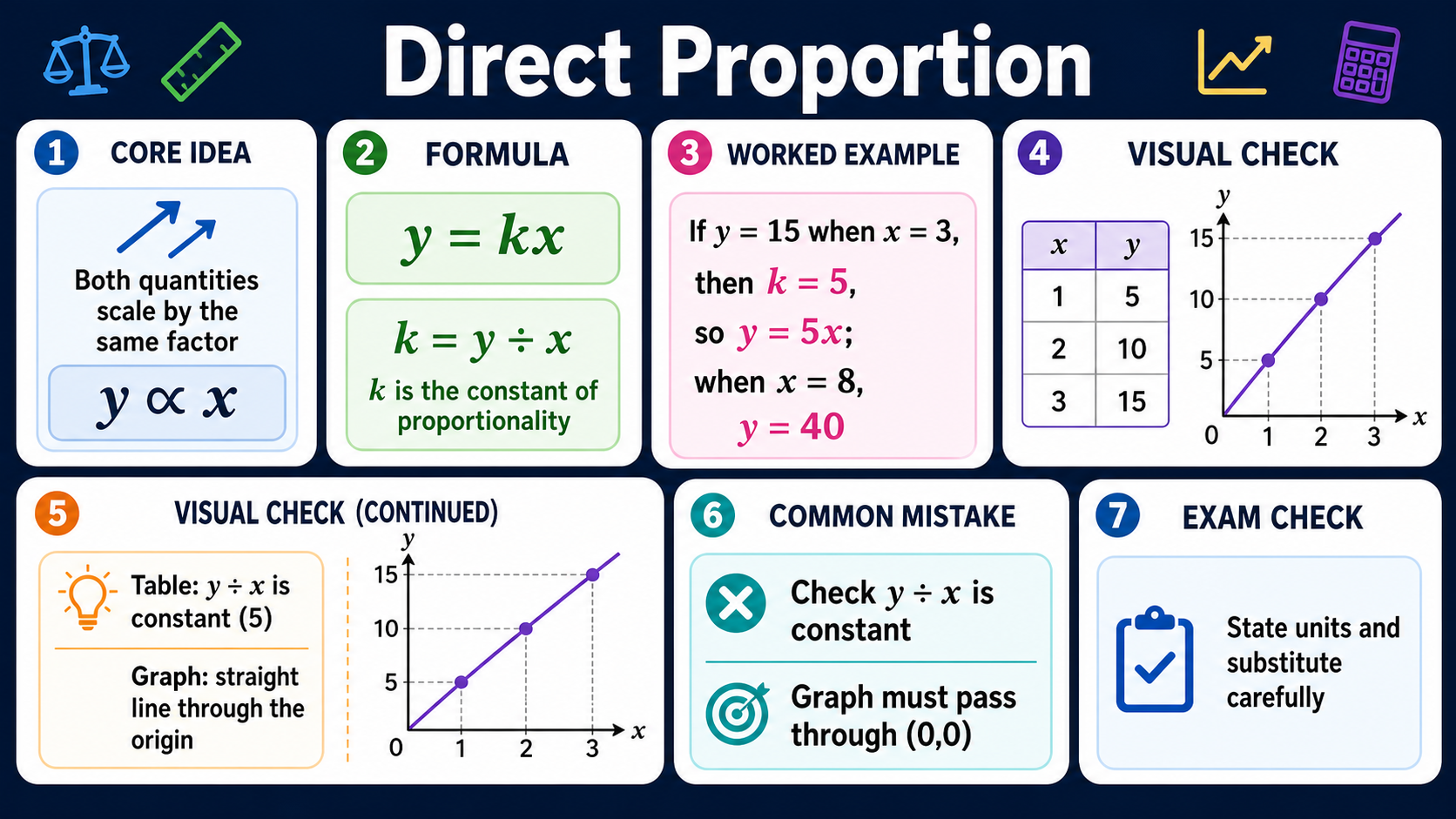
Direct proportion infographic
Before viewing
Before viewing, identify the constant multiplier linking the two quantities.
After viewing
After viewing, write a direct proportion equation and test it with one value.
Why this matters
Direct proportion appears in recipe scaling, prices, wages, exchange rates, conversion graphs, speed, density and other compound measures.
It is also a bridge between arithmetic and algebra: the same idea can be solved by finding one unit first, by using a scale factor, or by writing a formula.
Prior knowledge
You should already be comfortable with:
Clear explanation
What direct proportion means
Two quantities are in direct proportion when one quantity is always a constant multiple of the other. If one doubles, the other doubles. If one is divided by 5, the other is divided by 5.
The cost changes by the same factor as the number of notebooks, so the cost is directly proportional to the number of notebooks.
Proportional notation
The notation y ∝ x means y is directly proportional to x. This can be written as an equation:
y ∝ x y = kxThe letter k is the constant of proportionality. It tells you how many times as large y is compared with x.
At extension practice, read the exact wording carefully. y ∝ x² becomes y = kx², while y ∝ √x becomes y = k√x. The constant is found after using the squared or rooted value.
Finding the constant of proportionality
To find k, substitute a matching pair of values into y = kx.
Tables and graphs
In a direct proportion table, the value of y ÷ x stays constant. On a graph, direct proportion is shown by a straight line through the origin.
A simple visual check
This graph represents y = 2x. The line is straight and passes through (0, 0), so it shows direct proportion.
Worked examples
Example 1: Find the equation
y is directly proportional to x. When x = 6, y = 42. Find an equation for y in terms of x.
y = kx 42 = k × 6 k = 42 ÷ 6 = 7Reveal answer
Answer: y = 7x.
Example 2: Use the equation to find a value
p is directly proportional to q. When q = 5, p = 17.5. Find p when q = 8.
p = kq 17.5 = k × 5 k = 17.5 ÷ 5 = 3.5 p = 3.5q when q = 8, p = 3.5 × 8 = 28Reveal answer
Answer: p = 28.
Example 3: Check a table
Does this table show direct proportion?
Reveal answer
Answer: Yes. The value of y ÷ x is always 4, so y = 4x.
Example 4: Direct proportion in context
A worker earns £57 for 6 hours. Pay is directly proportional to time. How much do they earn for 9 hours?
hourly pay = £57 ÷ 6 = £9.50 pay for 9 hours = 9 × £9.50 = £85.50Reveal answer
Answer: £85.50.
Example 5: Direct proportion with a square
y is directly proportional to x². When x = 4, y = 48. Find y when x = 7.
y = kx² 48 = k × 4² = 16k k = 3 when x = 7, y = 3 × 7² = 147Reveal answer
Answer: y = 147.
Quick checks
Choose an answer, then check your thinking.
1. If y ∝ x and y = 24 when x = 6, what is k?
2. Which table shows direct proportion?
3. A direct proportion graph must be a straight line that passes through which point?
Practice questions
Question 1
y is directly proportional to x. When x = 5, y = 30. Find an equation for y in terms of x.
Reveal answer and marking guidance
Answer: y = 6x.
Marking: Use y = kx; 30 = k × 5, so k = 6.
Question 2
a is directly proportional to b. When b = 8, a = 14. Find a when b = 20.
Reveal answer and marking guidance
Answer: a = 35.
Marking: a = kb; 14 = k × 8, so k = 1.75. Then a = 1.75 × 20 = 35.
Question 3
Does this table show direct proportion? Explain your answer.
Reveal answer and marking guidance
Answer: Yes.
Marking: 18 ÷ 4 = 4.5, 31.5 ÷ 7 = 4.5 and 45 ÷ 10 = 4.5. The constant is the same each time, so y = 4.5x.
Question 4
The cost of fabric is directly proportional to its length. 2.5 m of fabric costs £16. How much does 7 m cost?
Reveal answer and marking guidance
Answer: £44.80.
Marking: 1 m costs £16 ÷ 2.5 = £6.40. Then 7 m costs 7 × £6.40 = £44.80.
Question 5
m is directly proportional to n². When n = 3, m = 45. Find m when n = 5.
Reveal answer and marking guidance
Answer: m = 125.
Marking: m = kn². Since 45 = k × 3² = 9k, k = 5. When n = 5, m = 5 × 5² = 125.
Question 6
A graph shows a direct proportion relationship between x and y. The line passes through (6, 15). Find y when x = 14.
Reveal answer and marking guidance
Answer: y = 35.
Marking: y = kx. Using (6, 15), 15 = 6k, so k = 2.5. When x = 14, y = 2.5 × 14 = 35.
Question 7
y is directly proportional to √x. When x = 36, y = 15. Find y when x = 100.
Reveal answer and marking guidance
Answer: y = 25.
Marking: y = k√x. Since 15 = k√36 = 6k, k = 2.5. When x = 100, y = 2.5 × 10 = 25.
Question 8
A recipe uses 180 g of flour for 12 biscuits. The amount of flour is directly proportional to the number of biscuits. How many biscuits can be made with 450 g of flour?
Reveal answer and marking guidance
Answer: 30 biscuits.
Marking: Flour per biscuit is 180 ÷ 12 = 15 g. Then 450 ÷ 15 = 30 biscuits, or use the scale factor 450 ÷ 180 = 2.5 and 12 × 2.5 = 30.
Question 9
y is directly proportional to x². When x = 6, y = 90. Find y when x = 10.
Reveal answer and marking guidance
Answer: y = 250.
Marking: Use y = kx². Since 90 = k × 6² = 36k, k = 2.5. When x = 10, y = 2.5 × 10² = 250.
Question 10
A table gives values of x and y. Does it show direct proportion? Explain your answer.
Reveal answer and marking guidance
Answer: No, it does not show direct proportion.
Marking: Check y ÷ x for each pair. 12 ÷ 3 = 4, 21 ÷ 5 = 4.2 and 32 ÷ 8 = 4, so the constant is not the same for all values.
Answers and marking guidance
The exact practice answers are hidden under each question so you can try first. For direct proportion, marks usually come from showing the constant multiplier, writing the relationship in the correct form such as y = kx, checking that y ÷ x stays constant, and using squared or rooted forms only when the question asks for them. Copy the proportion statement before finding k so a squared or square-root relationship is not accidentally treated as y = kx. In context questions, make the constant mean something practical, such as pounds per metre or grams per biscuit, and finish with the correct unit.
Common mistakes
- Assuming any straight line is direct proportion: the graph must pass through the origin.
- Finding k the wrong way round: for y = kx, use k = y ÷ x.
- Changing only one value in a table: direct proportion needs every pair to have the same value of y ÷ x.
- Ignoring powers: if y ∝ x², the equation is y = kx², not y = kx.
- Dropping units in context: a constant might mean pounds per metre, grams per person or miles per hour.
Extension challenge
r is directly proportional to the square root of s. When s = 25, r = 12. Find r when s = 81.
Reveal answer
Answer: r = 21.6.
r = k√s. Since 12 = k√25 = 5k, k = 2.4. When s = 81, r = 2.4√81 = 2.4 × 9 = 21.6.
Exam-board guidance
Direct proportion is common across GCSE Maths. Expect questions involving proportional formulae, tables, conversion graphs through the origin, unit rates, measures, gradients and real-life scaling. At extension practice, the same method can use x² or √x, so copy the exact proportional statement before finding the constant.
AQA GCSE Maths
Focus on the shared method, notation and checking habit; wording and context can vary by route.
OCR GCSE Maths
Show clear method steps and use precise notation; question wording may vary by route.
Pearson Edexcel GCSE Maths
Keep working visible and check units or notation; contexts may vary by route.
Eduqas GCSE Maths
Use the same core skill in practical contexts, with clear reasoning and final checks.
WJEC Wales
Connect the method to the context and state what the result means.
CCEA GCSE Maths
Make each method step visible and keep notation, units and final checks clear.
Next lesson
Next, compare this with Inverse Proportion, where one quantity increases as the other decreases.