
Lesson overview
A core algebra method for every routes.
Linear equations ask you to find the value of an unknown. They appear as direct algebra questions and inside worded GCSE problems.
What you will learn
Key facts before you start
Linear equations infographic
Before viewing
Before viewing, identify the operation to undo first and say why both sides must stay balanced.
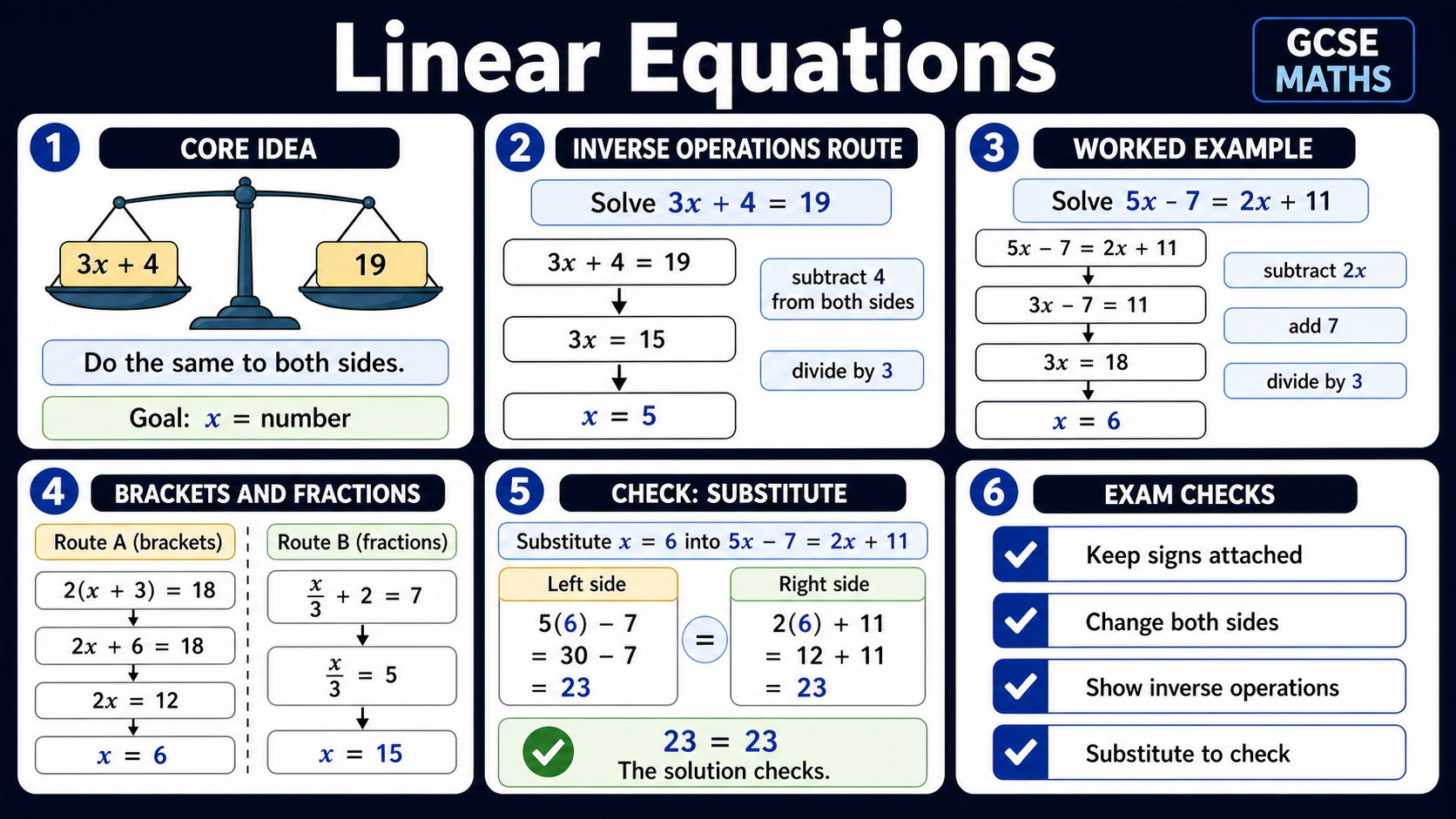
After viewing
After viewing, solve one equation and check it by substitution.
Why this matters
Equations turn unknown quantities into something you can work out. They are used in number problems, geometry, formulae, graphs and ratio questions.
Clear equation solving is also one of the easiest ways to protect method marks, because each balanced step shows what you did.
Prior knowledge
You should already be comfortable with:
Clear explanation
What solving means
An equation says two expressions are equal. To solve it, find the value of the unknown that makes the statement true.
Keep the equation balanced
Whatever you do to one side, do to the other side. This keeps the equality true while you isolate the unknown.
Undo in the reverse order
If the unknown has been multiplied and then added to, undo the addition first, then undo the multiplication.
Expand brackets first when needed
Brackets are easier to solve after you expand and simplify the equation.
Unknowns on both sides
Move the smaller unknown term first if it keeps the coefficient positive. Then solve the simpler equation.
Form an equation from words
In problem questions, define the unknown first. Then translate each part of the sentence into algebra before solving.
Check at the end
Substitute your answer into the original equation. If both sides match, your solution works.
Worked examples
Example 1: One-step equation
Solve x − 9 = 14.
Add 9 to both sides. x = 23Reveal answer
Answer: x = 23.
Example 2: Two-step equation
Solve 4a + 7 = 31.
4a = 24 a = 6Reveal answer
Answer: a = 6.
Example 3: Brackets
Solve 3(2m − 1) = 27.
6m − 3 = 27 6m = 30 m = 5Reveal answer
Answer: m = 5.
Example 4: Unknown on both sides
Solve 9p + 2 = 5p + 18.
4p + 2 = 18 4p = 16 p = 4Reveal answer
Answer: p = 4.
Quick checks
Choose an answer, then check your thinking.
1. Solve x + 6 = 15.
2. Solve 2x + 5 = 17.
3. Solve 6x − 4 = 2x + 20.
Practice questions
Question 1
Solve x + 8 = 21.
Reveal answer and marking guidance
Answer: x = 13.
Marking: Subtract 8 from both sides and write the final value of x.
Question 2
Solve 5y = 45.
Reveal answer and marking guidance
Answer: y = 9.
Marking: Divide both sides by 5.
Question 3
Solve 4a − 3 = 25.
Reveal answer and marking guidance
Answer: a = 7.
Marking: Add 3 first to get 4a = 28, then divide by 4.
Question 4
Solve 2(n + 5) = 28.
Reveal answer and marking guidance
Answer: n = 9.
Marking: Expand to 2n + 10 = 28, or divide by 2 first; both methods should reach n = 9.
Question 5
Solve 8p − 7 = 3p + 18.
Reveal answer and marking guidance
Answer: p = 5.
Marking: Subtract 3p to collect unknown terms, then add 7 and divide by 5.
Question 6
Solve x ÷ 3 + 4 = 10
Reveal answer and marking guidance
Answer: x = 18.
Marking: Subtract 4 to get x ÷ 3 = 6, then multiply by 3.
Question 7
Solve 3(2x − 1) = x + 22.
Reveal answer and marking guidance
Answer: x = 5.
Marking: Expand to 6x − 3 = x + 22, collect to get 5x = 25, then divide by 5.
Question 8
Three identical notebooks and a £2 pen cost £14.60 altogether. Form and solve an equation to find the cost of one notebook.
Reveal answer and marking guidance
Answer: one notebook costs £4.20.
Marking: Let n be the notebook cost. Solve 3n + 2 = 14.60, so 3n = 12.60 and n = 4.20. Include the money unit.
Question 9
Solve (x + 4) ÷ 3 = (x − 2) ÷ 2
Reveal answer and marking guidance
Answer: x = 14.
Marking: Multiply by 6 to clear the denominators: 2(x + 4) = 3(x − 2). Then 2x + 8 = 3x − 6, so x = 14.
Question 10
Solve (2x − 6) ÷ 4 = (x + 1) ÷ 3
Reveal answer and marking guidance
Answer: x = 11.
Marking: Multiply by 12 to clear the denominators: 3(2x − 6) = 4(x + 1). Then 6x − 18 = 4x + 4, so 2x = 22 and x = 11. Check in the original equation: (22 − 6) ÷ 4 = 4 and (11 + 1) ÷ 3 = 4.
Answers and marking guidance
The exact practice answers are hidden under each question so you can try first. For linear equations, marks usually come from defining the unknown when needed, showing balanced inverse operations, expanding brackets accurately, clearing fractions or decimals carefully, collecting unknown terms on one side, keeping signs attached to their terms, and checking the answer in the original equation or context.
Common mistakes
- Changing only one side: every operation must keep the equation balanced.
- Undoing steps in the wrong order: in 3x + 4 = 19, subtract 4 before dividing by 3.
- Losing negative signs: −2x and +2x behave differently when moved or divided.
- Forgetting to expand brackets: 2(x + 3) is 2x + 6, not 2x + 3.
- Not defining the unknown: in worded questions, say what the letter represents before forming the equation.
- Not checking: substituting the answer back catches many arithmetic slips.
Extension challenge
Solve 3(2x − 5) = 4x + 17.
Reveal answer
Answer: x = 16.
Expand to 6x − 15 = 4x + 17, then 2x = 32, so x = 16.
Exam-board guidance
Linear equations are assessed by every GCSE Maths board. They can be direct algebra questions or part of a worded problem where you must form the equation first.
AQA GCSE Maths
Focus on the shared method, notation and checking habit; wording and context can vary by route.
OCR GCSE Maths
Show clear method steps and use precise notation; question wording may vary by route.
Pearson Edexcel GCSE Maths
Keep working visible and check units or notation; contexts may vary by route.
Eduqas GCSE Maths
Use the same core skill in practical contexts, with clear reasoning and final checks.
WJEC Wales
Connect the method to the context and state what the result means.
CCEA GCSE Maths
Make each method step visible and keep notation, units and final checks clear.
Next lesson
Next, move into Inequalities.