
Lesson overview
A core algebra skill for comparing possible values.
Inequalities describe ranges rather than single answers. GCSE questions may ask you to solve them, draw them on a number line, or list the integer values that work.
What you will learn
Key facts before you start
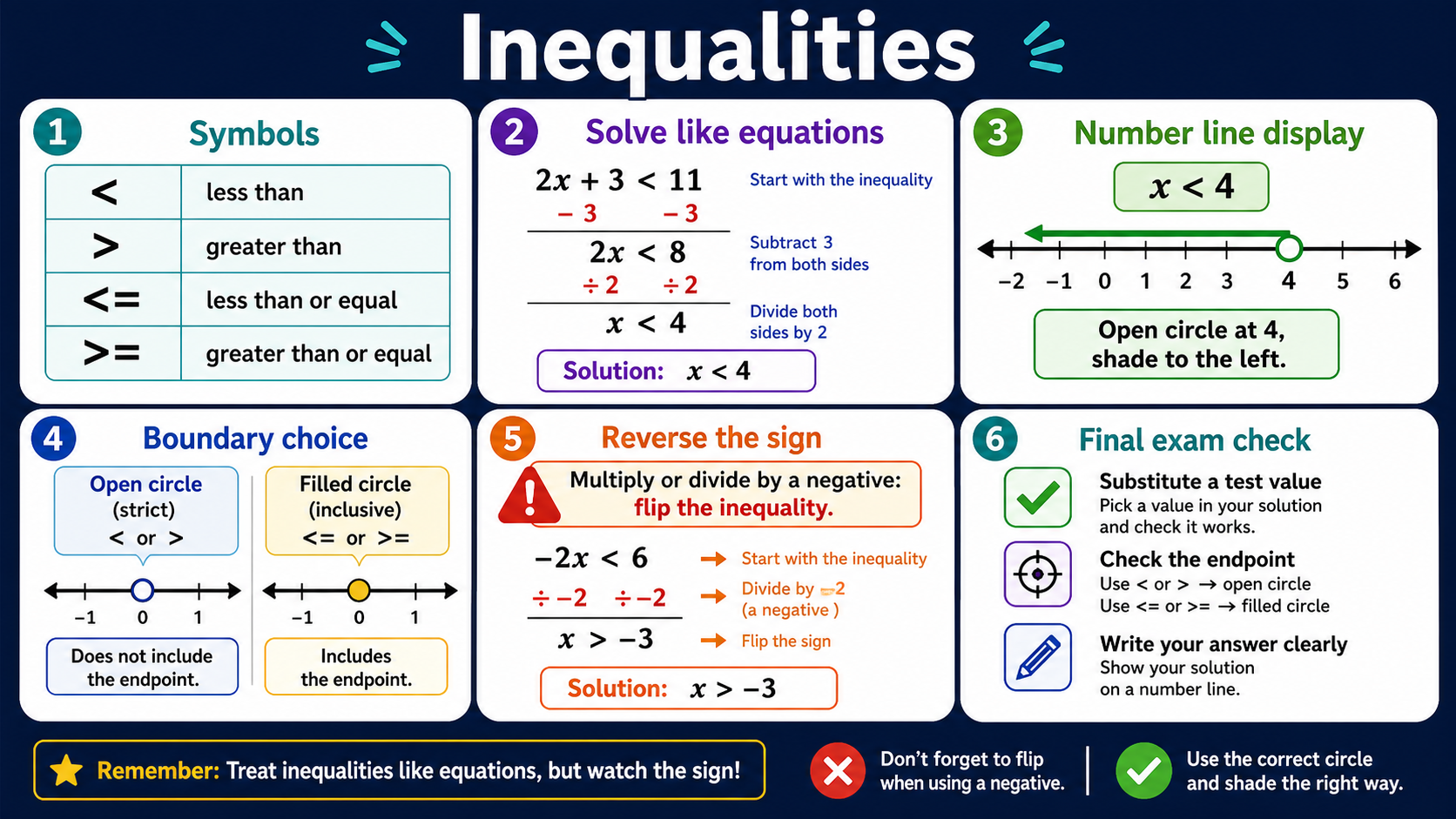
Inequalities infographic
Before viewing
Before viewing, identify whether the endpoint should be open or closed.
After viewing
After viewing, solve one inequality and show the answer on a number line.
Why this matters
Inequalities appear when an answer can be more than one value: a cost must be under a budget, a measurement must be within a range, or a variable can take several integer values.
The method is close to solving equations, but the final answer is a range. That range must be written and drawn accurately.
Prior knowledge
You should already be comfortable with:
Clear explanation
Read the symbol from the variable
Read an inequality from left to right. The small end points to the smaller value.
Open and closed circles
Use an open circle for < or > because the endpoint is not included. Use a closed circle for ≤ or ≥ because the endpoint is included.
Solve like an equation
Use inverse operations on both sides. Most steps work just like equation solving.
Reverse the sign when dividing by a negative
Multiplying or dividing both sides by a negative reverses the order of the numbers, so the inequality sign must reverse too.
Integer solutions
If a question asks for integer solutions, list whole-number values only. Check the endpoint carefully.
Use the context to choose sensible values
In worded questions, the algebraic range is not always the final answer. A context may require whole numbers, positive values or a maximum allowed amount.
Worked examples
Example 1: Draw a simple inequality
Represent x ≥ 6 on a number line.
Closed circle at 6 because 6 is included. Shade to the right because x is greater than or equal to 6.Reveal answer
Answer: closed circle at 6, arrow to the right.
Example 2: Solve a two-step inequality
Solve 4x − 3 ≤ 17.
4x ≤ 20 x ≤ 5Reveal answer
Answer: x ≤ 5.
Example 3: Reverse the sign
Solve −3y ≥ 12.
Divide both sides by −3. y ≤ −4Reveal answer
Answer: y ≤ −4.
Example 4: List integer solutions
List the integer solutions of −1 < n ≤ 4.
n must be bigger than −1, but 4 is allowed.Reveal answer
Answer: 0, 1, 2, 3, 4.
Quick checks
Choose an answer, then check your thinking.
1. How should you read x ≤ 7 on a number line?
2. Solve 2x + 1 > 9.
3. Solve −5x < 20.
Practice questions
Question 1
Write in words: x > 12.
Reveal answer and marking guidance
Answer: x is greater than 12.
Marking: Do not include 12, because there is no equals line under the symbol.
Question 2
Describe the number line for x ≤ −3.
Reveal answer and marking guidance
Answer: closed circle at −3, shaded to the left.
Marking: Use a closed circle because −3 is included, and shade left for smaller values.
Question 3
Solve x + 9 ≥ 15.
Reveal answer and marking guidance
Answer: x ≥ 6.
Marking: Subtract 9 from both sides and keep the inequality direction unchanged.
Question 4
Solve 3a − 4 < 11.
Reveal answer and marking guidance
Answer: a < 5.
Marking: Add 4 to get 3a < 15, then divide by 3.
Question 5
Solve −2p ≥ 14.
Reveal answer and marking guidance
Answer: p ≤ −7.
Marking: Divide by −2 and reverse the inequality sign.
Question 6
List the integer solutions of −2 < n ≤ 3.
Reveal answer and marking guidance
Answer: −1, 0, 1, 2, 3.
Marking: Exclude −2 because the left symbol is strict, but include 3 because the right symbol has equals.
Question 7
Solve 5 − 2x < 13.
Reveal answer and marking guidance
Answer: x > −4.
Marking: Subtract 5 to get −2x < 8, then divide by −2 and reverse the sign.
Question 8
A theatre trip has a coach budget of £240. Each ticket costs £18 and there is a fixed booking fee of £24. Write and solve an inequality for the maximum number of tickets.
Reveal answer and marking guidance
Answer: 18t + 24 ≤ 240, so t ≤ 12. The maximum is 12 tickets.
Marking: Subtract 24 to get 18t ≤ 216, divide by 18, and interpret the answer as a whole-number maximum.
Question 9
Solve −1 ≤ 2x + 3 < 9, then list the integer solutions.
Reveal answer and marking guidance
Answer: −2 ≤ x < 3, with integer solutions −2, −1, 0, 1, 2.
Marking: Subtract 3 from all three parts to get −4 ≤ 2x < 6, then divide all parts by 2. Include −2 because the left endpoint is closed, and exclude 3 because the right endpoint is strict.
Question 10
A lift can carry at most 630 kg. One adult has mass 78 kg and each box has mass 36 kg. Write and solve an inequality for the maximum number of boxes.
Reveal answer and marking guidance
Answer: 78 + 36b ≤ 630, so b ≤ 15.333... The maximum is 15 boxes.
Marking: Use ≤ because the lift can carry exactly 630 kg. Subtract 78 to get 36b ≤ 552, divide by 36, then round down because only whole boxes are possible.
Answers and marking guidance
The exact practice answers are hidden under each question so you can try first. For inequalities, marks usually come from reading the symbol correctly, showing balanced inverse operations, reversing the sign when multiplying or dividing by a negative number, using open or closed endpoints correctly, handling double inequalities across all parts of the statement, and interpreting the final range in the context when only whole-number values make sense.
Common mistakes
- Including a strict endpoint: x < 5 does not include 5.
- Using the wrong circle: open for < or >, closed for ≤ or ≥.
- Forgetting to reverse the sign: reverse it when multiplying or dividing by a negative number.
- Listing non-integers: if the question asks for integer solutions, list whole-number values only.
- Ignoring the context: a ticket, person or box count must usually be a whole number inside the inequality range.
- Reading the symbol backwards: say the inequality aloud from left to right before answering.
Extension challenge
Solve −3(2x − 1) ≤ 15.
Reveal answer
Answer: x ≥ −2.
Expand to −6x + 3 ≤ 15, then −6x ≤ 12. Dividing by −6 reverses the sign, so x ≥ −2.
Exam-board guidance
Inequalities are assessed by every GCSE Maths board. They can appear as direct algebra, number-line questions, integer-solution questions or constraints inside worded problems.
AQA GCSE Maths
Focus on the shared method, notation and checking habit; wording and context can vary by route.
OCR GCSE Maths
Show clear method steps and use precise notation; question wording may vary by route.
Pearson Edexcel GCSE Maths
Keep working visible and check units or notation; contexts may vary by route.
Eduqas GCSE Maths
Use the same core skill in practical contexts, with clear reasoning and final checks.
WJEC Wales
Connect the method to the context and state what the result means.
CCEA GCSE Maths
Make each method step visible and keep notation, units and final checks clear.
Next lesson
Next, practise using formulae and rearranging them so the letter you need is on its own.