
Lesson overview
A core algebra skill that links number, geometry and measures.
Formulae give a rule that connects quantities. GCSE questions may ask you to substitute values, calculate with a formula, or rearrange it so a different variable becomes the subject.
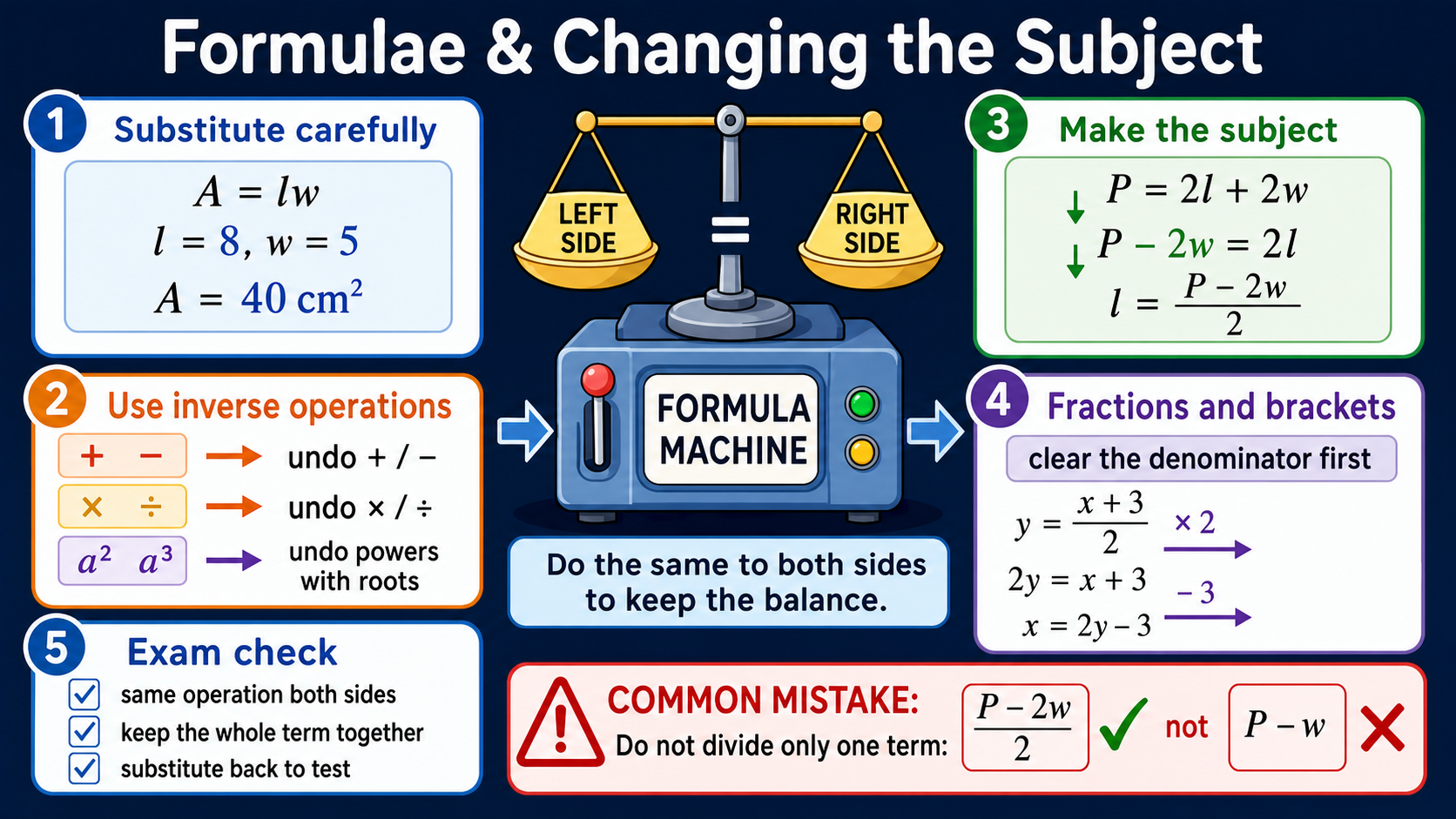
Formulae and changing the subject infographic
Before viewing
Before viewing, identify the current subject and the variable being made the new subject.
After viewing
After viewing, rearrange a simple formula and check by substituting numbers.
What you will learn
Key facts before you start
Why this matters
Formulae appear across GCSE Maths: area, volume, speed, density, pressure, interest and straight-line graphs all use them. Rearranging a formula lets you find a missing quantity without guessing.
The safest method is to treat the formula like an equation: do the same inverse operation to both sides until the required letter is isolated.
Prior knowledge
You should already be comfortable with:
Clear explanation
Substitute first, then calculate
Substitution means replacing each letter with a number. Write the substituted line before calculating so the method is clear.
The subject is the letter on its own
In the formula C = 2πr, C is the subject because it is already on its own. If a question says make r the subject, the final answer must start with r =.
Undo operations in reverse order
Work backwards from the operations around the letter. Addition and subtraction are usually undone before multiplication or division.
Clear brackets before isolating the letter
If the letter is inside a bracket, decide whether it is easier to divide first or expand first. Keep every step balanced.
Worked examples
Example 1: Substitute into a formula
Use P = 2l + 2w when l = 9 and w = 4.
P = 2 × 9 + 2 × 4 P = 18 + 8Reveal answer
Answer: P = 26.
Example 2: Make x the subject
Rearrange y = x + 7 to make x the subject.
Subtract 7 from both sides.Reveal answer
Answer: x = y − 7.
Example 3: Make m the subject
Rearrange F = ma to make m the subject.
Divide both sides by a.Reveal answer
Answer: m = Fa.
Example 4: Rearrange a two-step formula
Make p the subject of q = 4p − 9.
q + 9 = 4p q + 94 = pReveal answer
Answer: p = q + 94.
Quick checks
Choose an answer, then check your thinking.
1. In v = u + at, which letter is the subject?
2. Make a the subject of c = a + b.
3. Make x the subject of y = 5x.
Practice questions
Question 1
A rectangle has area A = bh. Use the formula to find A when b = 12 cm and h = 7 cm, including units.
Reveal answer and marking guidance
Answer: A = 84 cm².
Marking: Substitute to get A = 12 × 7, calculate accurately, and use square centimetres because this is an area.
Question 2
A taxi fare is modelled by C = 5n + 2, where n is the number of miles and C is the cost in pounds. Find C when n = 6.
Reveal answer and marking guidance
Answer: C = 32, so the cost is £32.
Marking: Substitute n = 6, multiply before adding, and interpret the result as pounds: 5 × 6 + 2 = 32.
Question 3
A temperature model uses y = x − 8. Rearrange the formula to make x the subject so the original temperature can be found from y.
Reveal answer and marking guidance
Answer: x = y + 8.
Marking: Add 8 to both sides to undo the subtraction and leave x on its own.
Question 4
The perimeter of a regular hexagon is p = 6a, where a is the side length. Make a the subject.
Reveal answer and marking guidance
Answer: a = p6.
Marking: Divide both sides by 6 and keep the formula general; do not substitute a number unless the question gives one.
Question 5
Make t the subject of d = 3t + 5.
Reveal answer and marking guidance
Answer: t = d − 53.
Marking: Subtract 5 first, then divide the whole of d − 5 by 3.
Question 6
Make r the subject of A = πr2.
Reveal answer and marking guidance
Answer: r = √Aπ.
Marking: Divide by π first, then take the positive square root because r is a length.
Question 7
Make h the subject of V = 13πr2h.
Reveal answer and marking guidance
Answer: h = 3Vπr2.
Marking: Multiply both sides by 3, then divide by πr2. Keep πr2 together as one factor.
Question 8
Use y = 2x2 − 3x when x = −4.
Reveal answer and marking guidance
Answer: y = 44.
Marking: Substitute with brackets: y = 2(−4)2 − 3(−4) = 32 + 12 = 44.
Question 9
Make x the subject of 3x + y = 2x − 5.
Reveal answer and marking guidance
Answer: x = −y − 5.
Marking: Subtract 2x from both sides to get x + y = −5, then subtract y from both sides.
Question 10
Make x the subject of ax + b = cx + d.
Reveal answer and marking guidance
Answer: x = d − ba − c, where a ≠ c.
Marking: Collect the x-terms first: ax − cx = d − b, then factorise to x(a − c) = d − b and divide by the whole of a − c.
Answers and marking guidance
The exact practice answers are hidden under each question so you can try first. For formulae, marks usually come from writing a clear substitution line, applying order of operations correctly, using balanced inverse operations when changing the subject, collecting like terms before moving on, keeping brackets or fraction bars around the whole expression, and checking that the requested letter is isolated in the final formula.
Common mistakes
- Substituting without brackets: negative values and powers often need brackets to avoid sign errors.
- Forgetting order of operations: multiply and square before adding unless brackets say otherwise.
- Stopping too early: the requested subject must be completely on its own.
- Dividing only one term: in t = (d − 5) ÷ 3, the whole d − 5 must be divided by 3.
- Losing the square root: undo squaring with a square root when a formula contains r2.
Extension challenge
Make x the subject of y = 4(2x − 3).
Reveal answer
Answer: x = y + 128.
Expand to y = 8x − 12, then y + 12 = 8x, so x = (y + 12) ÷ 8.
Exam-board guidance
Formulae and changing the subject are assessed by every GCSE Maths board. Questions may be pure algebra or may appear inside geometry, measures, graphs and real-life contexts.
AQA GCSE Maths
Focus on the shared method, notation and checking habit; wording and context can vary by route.
OCR GCSE Maths
Show clear method steps and use precise notation; question wording may vary by route.
Pearson Edexcel GCSE Maths
Keep working visible and check units or notation; contexts may vary by route.
Eduqas GCSE Maths
Use the same core skill in practical contexts, with clear reasoning and final checks.
WJEC Wales
Connect the method to the context and state what the result means.
CCEA GCSE Maths
Make each method step visible and keep notation, units and final checks clear.
Next lesson
Next, practise continuing patterns and finding nth-term formulae.