
Lesson overview
A key algebra topic for pattern, table and formula questions.
Sequence questions ask you to continue a pattern, describe how it grows, or find a formula for any term. The nth term is a position-to-term rule: it tells you the value of term n without listing every term first.
What you will learn
Key facts before you start
Visual summary
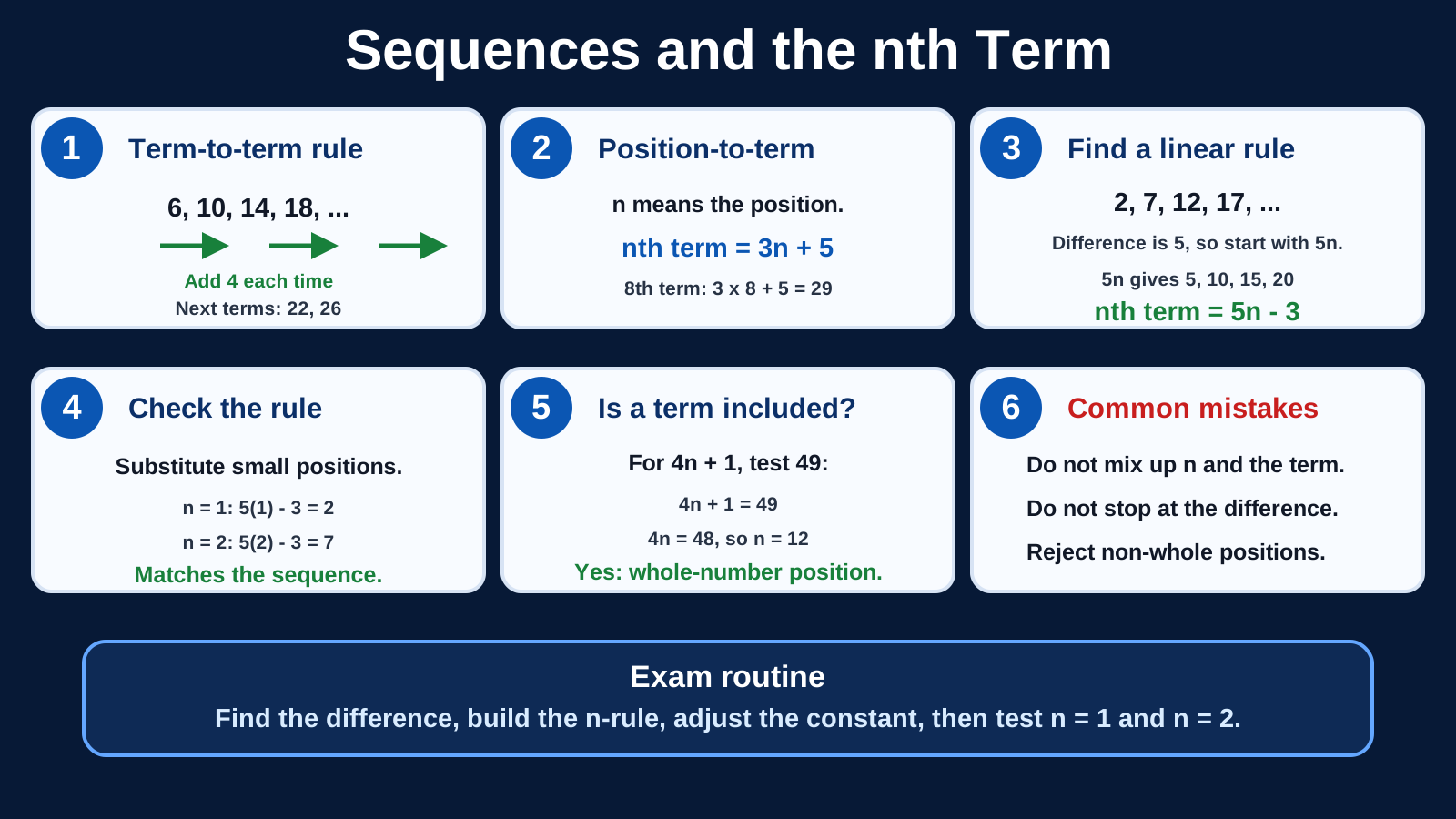
Sequences and the nth Term visual summary
Before viewing
Before viewing, find the first difference and predict the next term.
After viewing
After viewing, write the nth term for a simple linear sequence and test it.
Why this matters
Sequences are where algebra starts to describe a pattern instead of just one number. GCSE questions may show the pattern as a list, a table, a drawing, or a worded rule.
The important habit is to separate two ideas: a term-to-term rule tells you how to get from one term to the next, while an nth-term rule tells you the value at position n.
Prior knowledge
You should already be comfortable with:
Clear explanation
Term-to-term rules continue the list
A term-to-term rule starts with one term and tells you how to get the next one. For example, 4, 7, 10, 13 has the rule add 3 each time.
The nth term uses the position number
In an nth-term formula, n means the position of the term. If n = 1, you get the first term. If n = 10, you get the tenth term.
For a linear sequence, start with the common difference
A linear sequence has the same difference each time. The coefficient of n is the common difference.
Check the rule before you trust it
Substitute n = 1 and n = 2 into your rule. If those produce the first two terms, the rule is very likely correct for a linear sequence.
Worked examples
Example 1: Continue an arithmetic sequence
Find the next two terms of 6, 10, 14, 18, ...
The common difference is +4.Reveal answer
Answer: 22, 26.
Example 2: Use an nth-term formula
The nth term of a sequence is 3n + 5. Find the 8th term.
3 × 8 + 5 = 24 + 5Reveal answer
Answer: 29.
Example 3: Find a linear nth term
Find the nth term of 2, 7, 12, 17, ...
The common difference is 5, so start with 5n. 5n gives 5, 10, 15, 20, ... Subtract 3 to match 2, 7, 12, 17, ...Reveal answer
Answer: 5n − 3.
Example 4: Check whether a term is in a sequence
The nth term is 4n + 1. Is 49 in the sequence?
4n + 1 = 49 4n = 48 n = 12Reveal answer
Answer: Yes, 49 is the 12th term.
Quick checks
Choose an answer, then check your thinking.
1. What is the common difference in 9, 13, 17, 21, ...?
2. If the nth term is 6n − 1, what is the 5th term?
3. Which nth term matches 3, 8, 13, 18, ...?
Practice questions
Question 1
Find the next two terms of 5, 12, 19, 26, ...
Reveal answer and marking guidance
Answer: 33, 40.
Marking: Identify the common difference of +7, then add 7 twice.
Question 2
The nth term is 4n + 6. Find the 10th term.
Reveal answer and marking guidance
Answer: 46.
Marking: Substitute n = 10 to get 4 × 10 + 6 = 46.
Question 3
Find the nth term of 6, 10, 14, 18, ...
Reveal answer and marking guidance
Answer: 4n + 2.
Marking: The common difference is 4, so start with 4n. Add 2 to match the first term.
Question 4
Find the nth term of 11, 8, 5, 2, ...
Reveal answer and marking guidance
Answer: 14 − 3n.
Marking: The common difference is −3, so use −3n. Add 14 because −3n + 14 gives 11 when n = 1.
Question 5
The nth term is 7n − 4. Is 80 in the sequence?
Reveal answer and marking guidance
Answer: Yes. 80 is the 12th term.
Marking: Solve 7n − 4 = 80, so 7n = 84 and n = 12. Since n is a positive whole number, 80 is in the sequence.
Question 6
The first five terms are 2, 6, 12, 20, 30. This is a quadratic sequence. What are the first differences and second differences?
Reveal answer and marking guidance
Answer: First differences: 4, 6, 8, 10. Second differences: 2, 2, 2.
Marking: Subtract neighbouring terms to find the first differences, then subtract neighbouring first differences to show the constant second difference.
Question 7
A pattern has n squares in row 1 and n + 2 squares in row 2. Write a formula for the total number of squares in pattern n.
Reveal answer and marking guidance
Answer: 2n + 2.
Marking: Add the two rows: n + (n + 2) = 2n + 2. State that the formula gives the total number of squares.
Question 8
The nth term is 3n2 − 1. Find the 5th term and decide whether 74 is in the sequence.
Reveal answer and marking guidance
Answer: The 5th term is 74, so 74 is in the sequence.
Marking: Substitute n = 5: 3 × 52 − 1 = 75 − 1 = 74. This proves 74 is the 5th term.
Question 9
A tile pattern has 5 tiles in pattern 1, 9 tiles in pattern 2, 13 tiles in pattern 3 and 17 tiles in pattern 4. Find the nth term and the number of tiles in pattern 25.
Reveal answer and marking guidance
Answer: nth term = 4n + 1, so pattern 25 has 101 tiles.
Marking: The common difference is 4, so start with 4n. Add 1 to match the first term, then substitute n = 25: 4 × 25 + 1 = 101.
Question 10
The nth term of a sequence is 5n − 3. Is 94 in the sequence?
Reveal answer and marking guidance
Answer: No. 94 is not in the sequence.
Marking: Solve 5n − 3 = 94, so 5n = 97 and n = 19.4. Since n must be a positive whole number, 94 is not a term in the sequence.
Answers and marking guidance
The exact practice answers are hidden under each question so you can try first. For sequences, marks usually come from identifying the common difference, showing how that difference becomes the coefficient of n, adjusting the constant term correctly, substituting into the final rule to check it, and using positive whole-number positions when deciding whether a term belongs to a sequence.
Common mistakes
- Mixing up rule types: add 4 each time continues the sequence, but it is not an nth-term formula.
- Using the first term as the coefficient: the coefficient of n comes from the common difference in a linear sequence.
- Forgetting to adjust: 4n gives 4, 8, 12, ... so compare it with the actual sequence before writing the final rule.
- Checking only one term: substitute at least n = 1 and n = 2 when checking a linear nth term.
- Accepting decimal positions: a number is only in a sequence if the position n is a positive whole number.
Extension challenge
The sequence 4, 9, 16, 25, 36, ... is made from square numbers. Write a formula for the nth term.
Reveal answer
Answer: (n + 1)2.
The first term is 22, the second is 32, the third is 42, so the nth term is one more than n, squared.
Exam-board guidance
Sequences and nth terms are assessed by every GCSE Maths board. Questions may use lists, tables, diagrams, algebraic formulae or worded pattern contexts.
AQA GCSE Maths
Focus on the shared method, notation and checking habit; wording and context can vary by route.
OCR GCSE Maths
Show clear method steps and use precise notation; question wording may vary by route.
Pearson Edexcel GCSE Maths
Keep working visible and check units or notation; contexts may vary by route.
Eduqas GCSE Maths
Use the same core skill in practical contexts, with clear reasoning and final checks.
WJEC Wales
Connect the method to the context and state what the result means.
CCEA GCSE Maths
Make each method step visible and keep notation, units and final checks clear.
Next lesson
Next, build graph confidence with Coordinates and Straight-Line Graphs.