
Lesson overview
A core algebra and graph topic for every GCSE Maths board.
Straight-line graphs turn algebra into a picture. You need to read coordinates, plot points accurately, draw lines from equations, and interpret gradient as a rate of change.
Visual summary
Before viewing
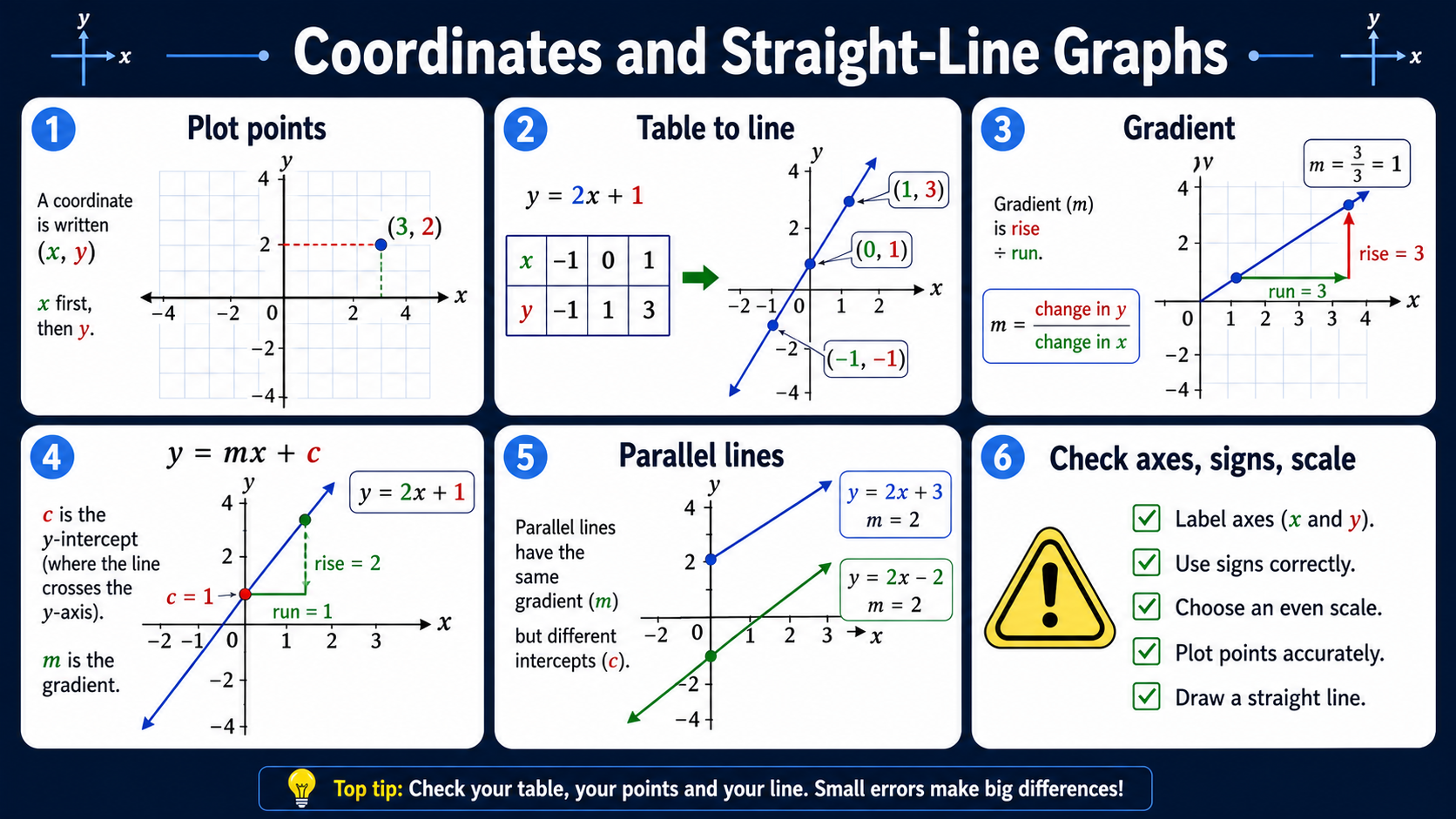
Before viewing, point to the gradient, y-intercept and one plotted coordinate.
After viewing
After viewing, identify m and c in one line equation and sketch its starting point.
What you will learn
Key facts before you start
Why this matters
Graphs appear across algebra, ratio, compound measures, science and real-life data. If you can move between an equation, a table and a graph, many GCSE questions become more manageable.
The key habit is accuracy: read the x-value first, choose a sensible scale, plot points carefully and check that the line matches the equation.
Prior knowledge
You should already be comfortable with:
Clear explanation
Coordinates are written as (x, y)
The x-coordinate tells you how far to move across. The y-coordinate tells you how far to move up or down. For (3, −2), move 3 right and 2 down.
Use a table of values to draw a line
For y = 2x + 1, choose some x-values, substitute each one, then plot the coordinate pairs.
Gradient means rise divided by run
The gradient tells you how steep the line is. A positive gradient slopes upwards from left to right. A negative gradient slopes downwards.
In y = mx + c, m and c have jobs
In y = mx + c, m is the gradient and c is the y-intercept. The y-intercept is where the line crosses the y-axis, so it is the y-value when x = 0.
Worked examples
Example 1: Plot a coordinate
Describe how to plot (−2, 4).
Move 2 left from the origin, then 4 up.Reveal answer
Answer: The point is in the top-left quadrant.
Example 2: Complete a table of values
Complete y = 3x − 2 for x = 0, 1, 2.
x = 0: y = −2 x = 1: y = 1 x = 2: y = 4Reveal answer
Answer: (0, −2), (1, 1), (2, 4).
Example 3: Find a gradient
Find the gradient of the line through (1, 2) and (4, 8).
Change in y = 8 − 2 = 6 Change in x = 4 − 1 = 3Reveal answer
Answer: Gradient = 6 ÷ 3 = 2.
Example 4: Read y = mx + c
For y = −4x + 7, state the gradient and y-intercept.
Reveal answer
Answer: Gradient = −4 and y-intercept = 7.
Quick checks
Choose an answer, then check your thinking.
1. In the coordinate (5, −3), what is the x-coordinate?
2. What is the y-intercept of y = 4x − 6?
3. A line goes through (0, 2) and (3, 8). What is its gradient?
Practice questions
Question 1
Write the x-coordinate and y-coordinate of (−4, 7).
Reveal answer and marking guidance
Answer: x = −4 and y = 7.
Marking: Use the order (x, y). The first number is x and the second number is y.
Question 2
For y = 2x − 3, find y when x = 5.
Reveal answer and marking guidance
Answer: y = 7.
Marking: Substitute x = 5: y = 2 × 5 − 3 = 7.
Question 3
Complete the coordinates for y = x + 4 when x = −2, 0 and 3.
Reveal answer and marking guidance
Answer: (−2, 2), (0, 4), (3, 7).
Marking: Substitute each x-value into y = x + 4 and write each result as a coordinate pair.
Question 4
Find the gradient of the line through (2, 3) and (6, 11).
Reveal answer and marking guidance
Answer: 2.
Marking: Change in y = 11 − 3 = 8 and change in x = 6 − 2 = 4, so gradient = 8 ÷ 4 = 2.
Question 5
State the gradient and y-intercept of y = −3x + 5.
Reveal answer and marking guidance
Answer: Gradient = −3 and y-intercept = 5.
Marking: Compare the equation with y = mx + c. The coefficient of x is the gradient and the constant is the y-intercept.
Question 6
A straight line has gradient 4 and crosses the y-axis at −1. Write its equation.
Reveal answer and marking guidance
Answer: y = 4x − 1.
Marking: Put m = 4 and c = −1 into y = mx + c.
Question 7
Find the equation of the line with gradient 12 that passes through (0, −3).
Reveal answer and marking guidance
Answer: y = 12x − 3.
Marking: Use y = mx + c with m = 12 and c = −3 because the point (0, −3) is the y-intercept.
Question 8
A line is parallel to y = −2x + 4 and passes through (0, 7). Write its equation.
Reveal answer and marking guidance
Answer: y = −2x + 7.
Marking: Parallel lines have the same gradient, so m = −2. The y-intercept is 7 because the line passes through (0, 7).
Question 9
Find the equation of the straight line through (−2, 5) and (4, −7).
Reveal answer and marking guidance
Answer: y = −2x + 1.
Marking: Change in y = −7 − 5 = −12 and change in x = 4 − (−2) = 6, so gradient = −2. Substitute (−2, 5): 5 = −2(−2) + c, so c = 1.
Question 10
A line is parallel to y = 3x − 4 and passes through (2, 5). Find its equation.
Reveal answer and marking guidance
Answer: y = 3x − 1.
Marking: Parallel lines have the same gradient, so m = 3. Substitute (2, 5) into y = 3x + c: 5 = 3 × 2 + c, so c = −1.
Answers and marking guidance
The exact practice answers are hidden under each question so you can try first. For coordinates and straight-line graphs, marks usually come from using the correct coordinate order, substituting x-values accurately, plotting points with a sensible scale, showing a table of values, calculating gradient as change in y divided by change in x, and using a known point to find the y-intercept when it is not given directly.
Common mistakes
- Swapping coordinates: (−4, 7) is not the same point as (7, −4).
- Using uneven axis scales: each square must represent the same step on one axis unless the scale is clearly labelled.
- Forgetting negative signs: y = −3x + 5 has a negative gradient, so it slopes down from left to right.
- Reading c as the x-intercept: in y = mx + c, c is the y-intercept.
- Drawing through one point only: use at least two correct points, and preferably three as a check.
Extension challenge
A line is parallel to y = 3x − 2 and passes through (0, 6). Write its equation.
Reveal answer
Answer: y = 3x + 6.
Parallel lines have the same gradient. The y-intercept is 6 because the line passes through (0, 6).
Exam-board guidance
Coordinates and straight-line graphs are assessed by every GCSE Maths board. Questions may ask for plotted points, tables of values, graph drawing, gradients, intercepts, equations of lines or practical graph interpretation.
AQA GCSE Maths
Focus on the shared method, notation and checking habit; wording and context can vary by route.
OCR GCSE Maths
Show clear method steps and use precise notation; question wording may vary by route.
Pearson Edexcel GCSE Maths
Keep working visible and check units or notation; contexts may vary by route.
Eduqas GCSE Maths
Use the same core skill in practical contexts, with clear reasoning and final checks.
WJEC Wales
Connect the method to the context and state what the result means.
CCEA GCSE Maths
Make each method step visible and keep notation, units and final checks clear.
Next lesson
Next, move into Simultaneous Equations.