
Lesson overview
A core algebra topic for solving two conditions together.
Simultaneous equations are used when two statements are both true at the same time. GCSE questions may give the equations directly, hide them in a worded problem, or show them as two straight lines on a graph.
What you will learn
Key facts before you start
Visual summary
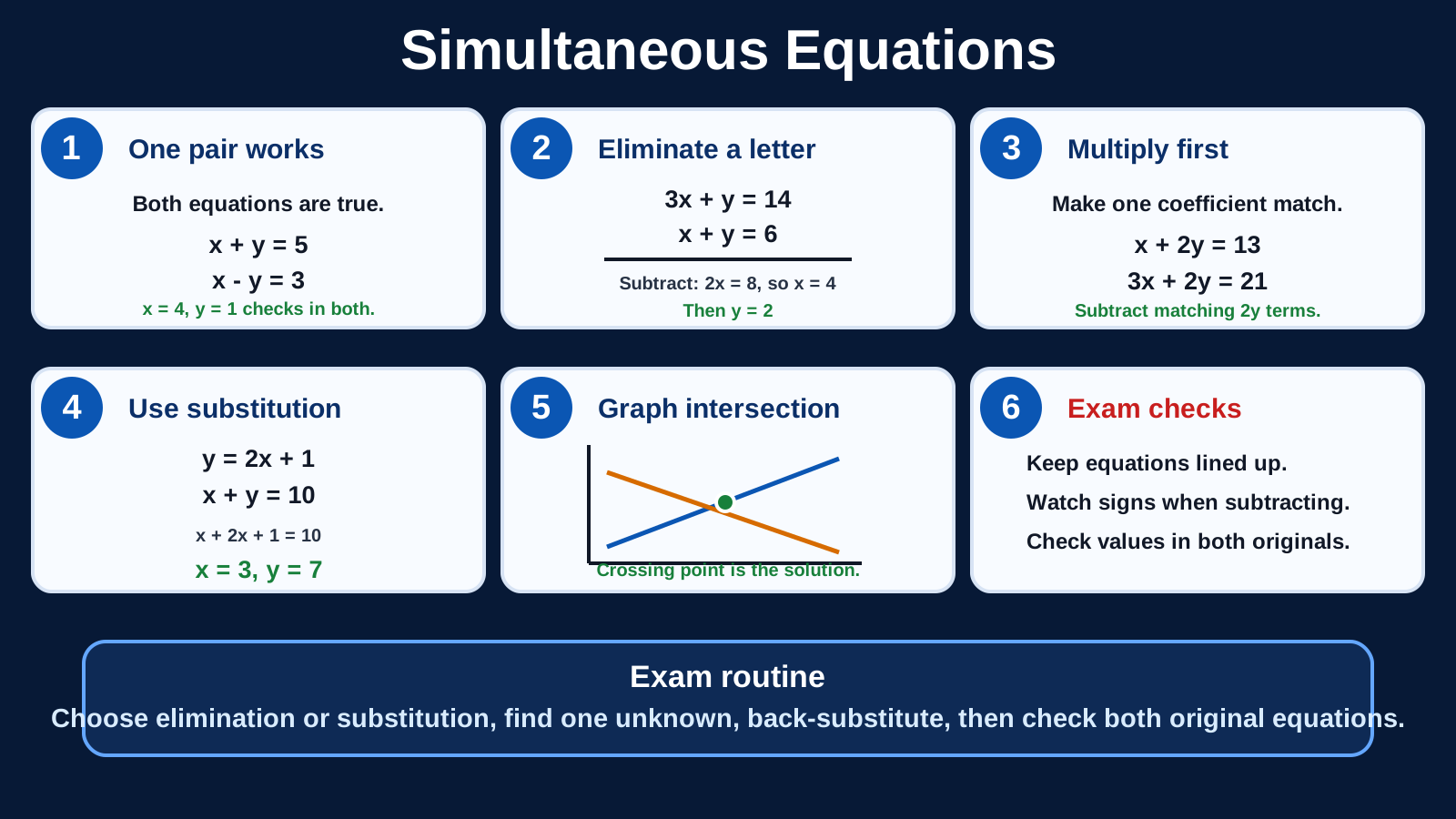
Simultaneous Equations visual summary
Before viewing
Before viewing, identify which variable can be eliminated first.
After viewing
After viewing, solve a pair of equations and substitute both values back to check.
Why this matters
Simultaneous equations let you solve problems with two unknowns, such as prices, ages, tickets, totals or straight-line intersections.
The best habit is to keep the equations lined up and write one small reason for each step. That makes sign errors easier to spot.
Prior knowledge
You should already be comfortable with:
Clear explanation
The answer is a pair of values
A simultaneous equation solution gives values for both unknowns. For example, x = 4 and y = 1 is only correct if it works in both equations.
Elimination removes one unknown
If the same number of x terms or y terms appears in both equations, add or subtract the equations so one unknown disappears.
Sometimes you multiply first
If the coefficients do not match, multiply one equation so a letter has the same coefficient in both equations.
Graphs solve simultaneous equations too
If two straight lines are drawn on the same axes, the solution is their intersection point. At that point, both equations have the same x and y values.
Worked examples
Example 1: Eliminate y
Solve 3x + y = 14 and x + y = 6.
Subtract the second equation from the first: 2x = 8 x = 4 4 + y = 6, so y = 2Reveal answer
Answer: x = 4 and y = 2.
Example 2: Add to eliminate
Solve 2x + 3y = 17 and 2x − 3y = 7.
Add the equations: 4x = 24 x = 6 12 + 3y = 17, so 3y = 5 and y = 5/3Reveal answer
Answer: x = 6 and y = 5/3.
Example 3: Substitute
Solve y = 2x + 1 and x + y = 10.
x + 2x + 1 = 10 3x = 9, so x = 3 y = 2 × 3 + 1 = 7Reveal answer
Answer: x = 3 and y = 7.
Example 4: Worded problem
Two adult tickets and one child ticket cost £19. One adult ticket and one child ticket cost £11. Find each price.
Let a be an adult ticket and c be a child ticket. 2a + c = 19 and a + c = 11 Subtract: a = 8, then c = 3Reveal answer
Answer: Adult ticket £8, child ticket £3.
Quick checks
Choose an answer, then check your thinking.
1. What does a simultaneous equation solution have to do?
2. Solve x + y = 9 and x − y = 3. What is x?
3. On a graph, where is the solution to two straight-line equations?
Practice questions
Question 1
Check whether x = 5 and y = 2 solves x + y = 7 and x − y = 3.
Reveal answer and marking guidance
Answer: Yes, it solves both equations.
Marking: Substitute into both equations: 5 + 2 = 7 and 5 − 2 = 3.
Question 2
Solve x + y = 12 and x − y = 4.
Reveal answer and marking guidance
Answer: x = 8 and y = 4.
Marking: Add the equations to get 2x = 16, so x = 8. Then 8 + y = 12, so y = 4.
Question 3
Solve 2x + y = 13 and x + y = 8.
Reveal answer and marking guidance
Answer: x = 5 and y = 3.
Marking: Subtract the second equation from the first to get x = 5, then substitute into x + y = 8.
Question 4
Solve 3x + 2y = 20 and x + 2y = 10.
Reveal answer and marking guidance
Answer: x = 5 and y = 2.5.
Marking: Subtract the second equation from the first to get 2x = 10, so x = 5. Then 5 + 2y = 10, so y = 2.5.
Question 5
Solve y = 3x − 2 and x + y = 10.
Reveal answer and marking guidance
Answer: x = 3 and y = 7.
Marking: Substitute y = 3x − 2 into x + y = 10 to get 4x − 2 = 10, so x = 3 and y = 7.
Question 6
Two notebooks and one pen cost £5. One notebook and one pen cost £3.20. Find the cost of one notebook and one pen.
Reveal answer and marking guidance
Answer: Notebook £1.80 and pen £1.40.
Marking: Let n be a notebook and p be a pen. 2n + p = 5 and n + p = 3.20. Subtract to get n = 1.80, then p = 1.40.
Question 7
Solve 2x + 3y = 12 and 5x + 2y = 19.
Reveal answer and marking guidance
Answer: x = 3 and y = 2.
Marking: Multiply the first equation by 2 and the second by 3 to make 4x + 6y = 24 and 15x + 6y = 57. Subtract to get 11x = 33, so x = 3, then substitute to get y = 2.
Question 8
The straight lines y = 2x + 1 and y = −x + 7 intersect. Find the intersection point.
Reveal answer and marking guidance
Answer: (2, 5).
Marking: Set 2x + 1 = −x + 7, so 3x = 6 and x = 2. Substitute into either equation to get y = 5, then give the answer as a coordinate pair.
Question 9
At a school concert, 3 adult tickets and 2 child tickets cost £31. Two adult tickets and 5 child tickets cost £39. Find the cost of one adult ticket and one child ticket.
Reveal answer and marking guidance
Answer: Adult ticket £7, child ticket £5.
Marking: Let a be an adult ticket and c be a child ticket. 3a + 2c = 31 and 2a + 5c = 39. Multiply by 5 and 2 to get 15a + 10c = 155 and 4a + 10c = 78, then subtract to get 11a = 77, so a = 7. Substitute to get c = 5.
Question 10
A cinema sells adult tickets and student tickets. Three adult tickets and four student tickets cost £54. Two adult tickets and five student tickets cost £50. Find the price of one adult ticket and one student ticket.
Reveal answer and marking guidance
Answer: Adult ticket £10 and student ticket £6.
Marking: Let a be an adult ticket and s be a student ticket. 3a + 4s = 54 and 2a + 5s = 50. Multiply by 2 and 3 to get 6a + 8s = 108 and 6a + 15s = 150, then subtract to get 7s = 42, so s = 6. Substitute to get a = 10.
Answers and marking guidance
The exact practice answers are hidden under each question so you can try first. For simultaneous equations, marks usually come from writing the two equations clearly, choosing a valid elimination or substitution step, preserving negative signs, substituting back to find the second unknown, and checking both values in the original equations. In worded problems, define the variables and include units such as pounds where needed.
Common mistakes
- Only checking one equation: the answer must work in both equations.
- Eliminating the wrong way: if signs are the same, subtract; if signs are opposite, add.
- Losing negative signs: write each line carefully when subtracting a whole equation.
- Forgetting to find the second unknown: solving for x is only half the answer.
- Not defining variables: in worded problems, state what x and y represent.
Extension challenge
Solve 4x + 3y = 29 and 2x − y = −3.
Reveal answer
Answer: x = 2 and y = 7.
Multiply the second equation by 3 to get 6x − 3y = −9, then add it to 4x + 3y = 29. This gives 10x = 20, so x = 2. Substitute into 2x − y = −3 to get y = 7.
Exam-board guidance
Simultaneous equations are assessed by every GCSE Maths board. Questions may ask for algebraic solving, a graph intersection, or equations formed from a real-life context.
AQA GCSE Maths
Focus on the shared method, notation and checking habit; wording and context can vary by route.
OCR GCSE Maths
Show clear method steps and use precise notation; question wording may vary by route.
Pearson Edexcel GCSE Maths
Keep working visible and check units or notation; contexts may vary by route.
Eduqas GCSE Maths
Use the same core skill in practical contexts, with clear reasoning and final checks.
WJEC Wales
Connect the method to the context and state what the result means.
CCEA GCSE Maths
Make each method step visible and keep notation, units and final checks clear.
Next lesson
Next, move into Quadratic Expressions and Equations.