
Electricity
Lesson overview
This lesson introduces the core physics idea, the useful equipment and the calculation or data skills used on this page.
What you will learn
Domestic safety examples supplied on this page
Use the kettle, lamp, plug and fuse examples to practise mains electricity calculations and safety reasoning.
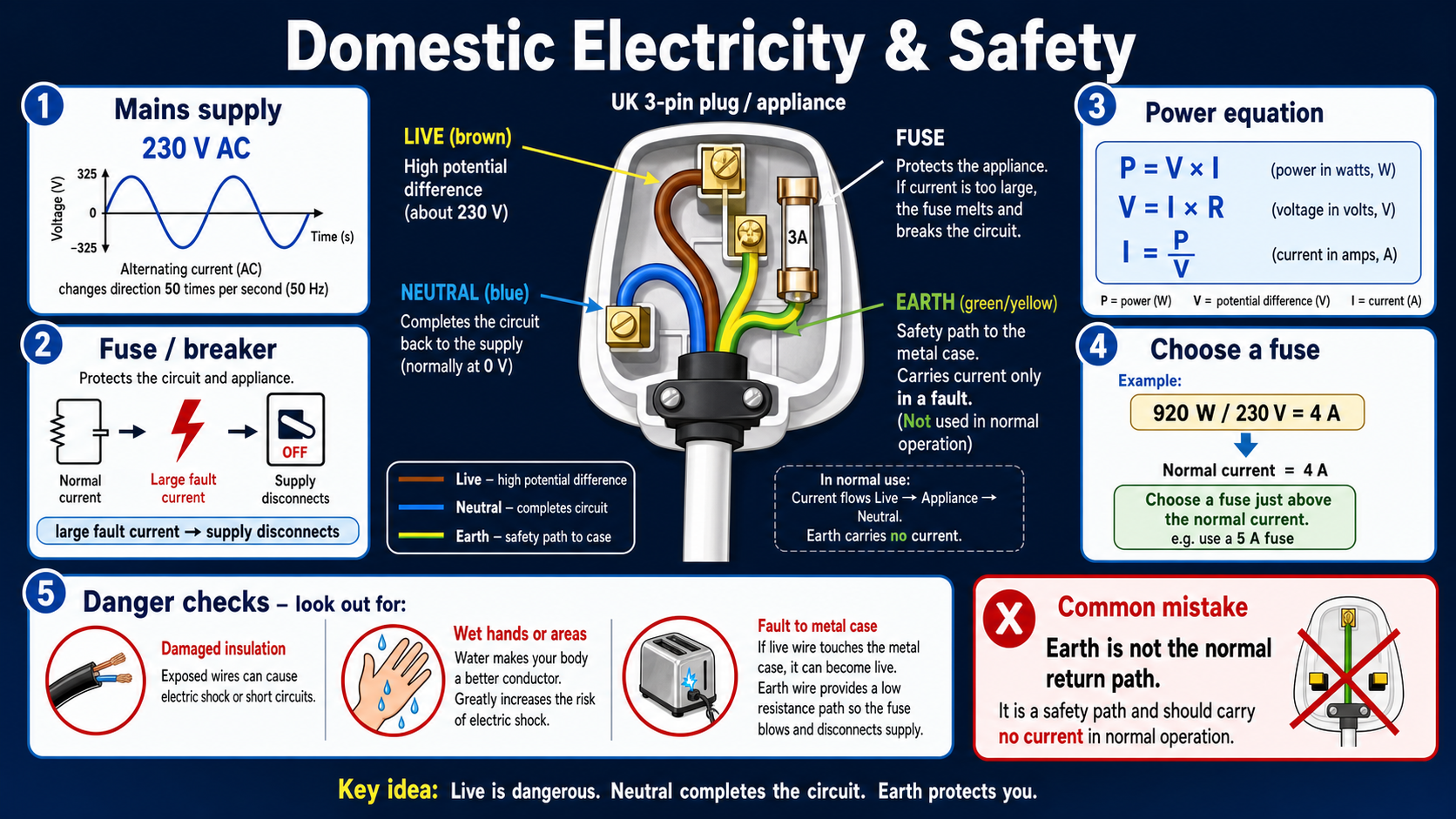
Domestic electricity and safety infographic
Clear explanation
UK mains electricity is an alternating potential difference. The live wire is dangerous because it is at a high potential difference relative to earth.
The neutral wire completes the circuit. The earth wire is a safety wire connected to metal cases so a fault can create a large current and operate the fuse or breaker.
Fuses and circuit breakers protect wiring by disconnecting the supply when current becomes too large.
Key diagram
Worked examples
Choosing a fuse current
A 920 W appliance runs from 230 V mains.
current = power ÷ potential difference
current = 920 ÷ 230 = 4 A
Quick checks
Choose an answer, then check your thinking.
1. Which wire is at high potential difference in normal use?
2. What does a fuse do when current is too large?
Practice questions
Question 1
A 1150 W heater runs from 230 V. Calculate current.
Reveal answer and marking guidance
Answer: 5 A.
Marking: Credit I = P ÷ V and 1150 ÷ 230 = 5 A.
Question 2
Why is the earth wire connected to a metal case?
Reveal answer and marking guidance
Answer: It provides a low-resistance path for fault current so the fuse or breaker disconnects the supply.
Marking: Credit fault current and disconnection.
Question 3
Why is touching mains equipment with wet hands dangerous?
Reveal answer and marking guidance
Answer: Water lowers resistance and can allow a larger current through the body.
Marking: Credit lower resistance and current through body.
Question 4
What is the neutral wire for?
Reveal answer and marking guidance
Answer: It completes the circuit and is close to earth potential in normal operation.
Marking: Credit completing circuit and low potential difference.
Practice ladder
Answers and marking guidance
The exact practice answers are hidden under each question so you can try first. For this lesson, marks come from using the correct physics model, choosing the right equation where needed, keeping units with values, and explaining changes with precise words such as transfer, resultant force, acceleration, evidence and uncertainty.
Common mistakes
- Calling the earth wire the normal return path.
- Choosing a fuse below the normal operating current.
- Forgetting mains is AC.
- Thinking plastic insulation conducts current safely.
Extension challenge
Explain how a fault in a metal-cased appliance should cause the fuse to operate.
Reveal answer
Example answer: A strong extension response names the physics model, uses accurate units and explains why the evidence supports the conclusion.
Exam-board guidance
Short board notes only. Learn the core physics above first.
AQA GCSE Physics
AQA GCSE Physics: often rewards clear physics explanations, correct equations, units and practical evidence for mains electricity, plugs, fuses and safety.
OCR GCSE Physics
OCR GCSE Physics: often values precise definitions, clear working, graph interpretation and links between models and evidence.
Pearson Edexcel GCSE Physics
Pearson Edexcel GCSE Physics: often combines the concept with equation use, data handling and practical interpretation.
Eduqas GCSE Physics
Eduqas GCSE Physics: learn the core explanation and practise applying it to unfamiliar contexts, data and practical questions.
WJEC Wales
WJEC Wales: often expects accurate terms, units and evidence-based explanations using the shared physics idea.
CCEA GCSE Physics
CCEA GCSE Physics: connect the idea to your current unit and use the same practical method language your class uses.
Next lesson
Next, continue with Static Electricity and Electric Fields.