
Electricity
Lesson overview
This lesson introduces the core physics idea, the useful equipment and the calculation or data skills used on this page.
What you will learn
Static charge examples supplied on this page
Use the balloon, hair, dust and spark examples to practise electron-transfer explanations.
Static electricity and electric fields infographic
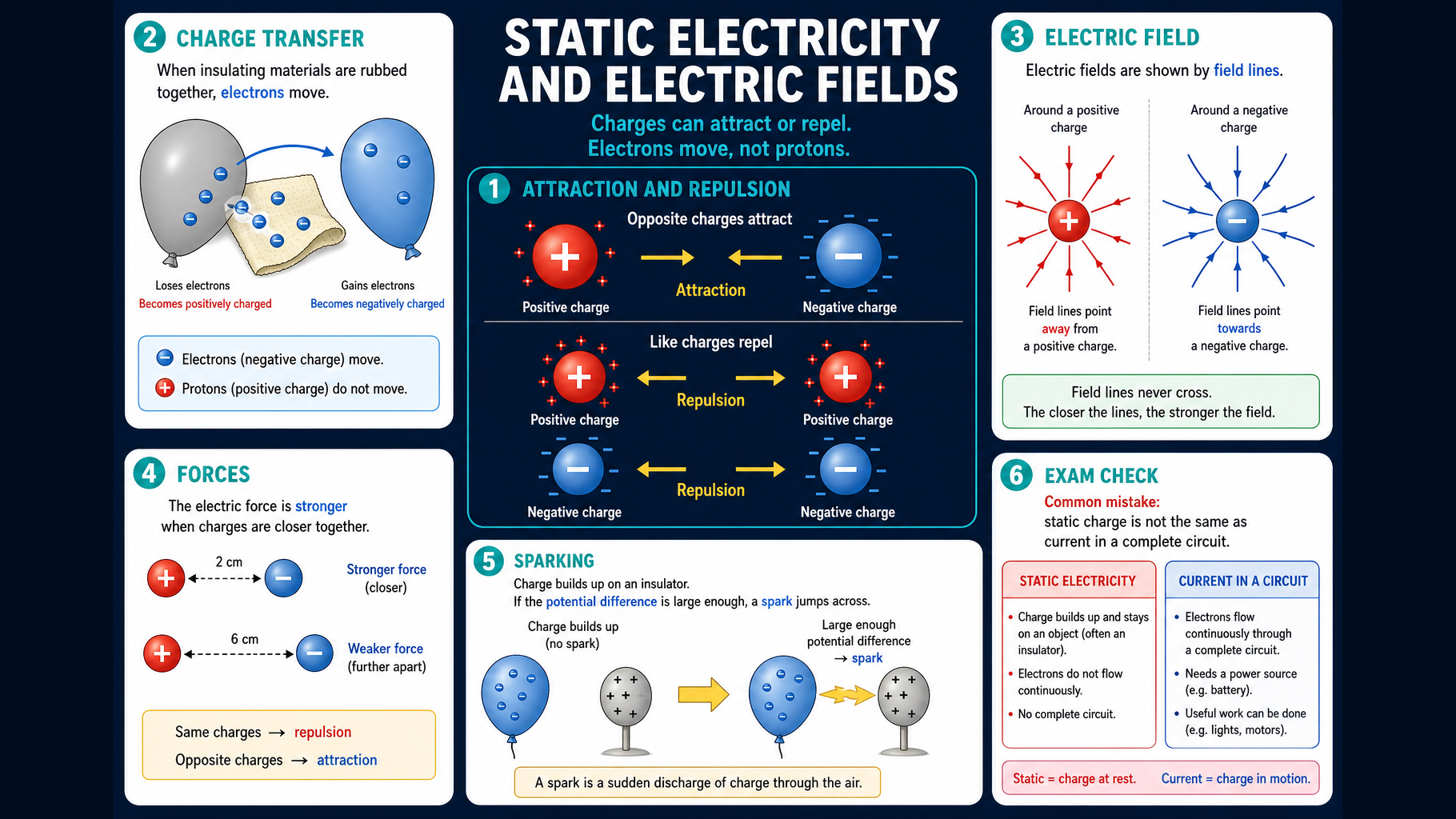
Clear explanation
Static electricity happens when insulating materials gain or lose electrons. The material gaining electrons becomes negatively charged; the material losing electrons becomes positively charged.
Like charges repel and unlike charges attract. Charged objects can also attract neutral objects by inducing charge separation.
A strong electric field can cause a spark when charge moves through the air, such as during lightning or a small shock from a charged object.
Key diagram
Worked examples
Balloon charged by rubbing
A balloon is rubbed on a jumper.
Electrons move from one material to the other.
The balloon gains electrons.
Quick checks
Choose an answer, then check your thinking.
1. What moves when objects become charged by friction?
2. What happens between two negative charges?
Practice questions
Question 1
A rod gains electrons. What charge does it have?
Reveal answer and marking guidance
Answer: Negative charge.
Marking: Credit electrons are negative.
Question 2
Why can a charged balloon stick to a neutral wall?
Reveal answer and marking guidance
Answer: It induces charge separation in the wall, causing attraction.
Marking: Credit induced separation and attraction.
Question 3
What is an electric field?
Reveal answer and marking guidance
Answer: A region where a charge experiences a force.
Marking: Credit force on charges in a region.
Question 4
Why can a spark jump across a small air gap?
Reveal answer and marking guidance
Answer: A strong electric field causes charge to move through the air.
Marking: Credit discharge through air.
Practice ladder
Answers and marking guidance
The exact practice answers are hidden under each question so you can try first. For this lesson, marks come from using the correct physics model, choosing the right equation where needed, keeping units with values, and explaining changes with precise words such as transfer, resultant force, acceleration, evidence and uncertainty.
Common mistakes
- Saying protons move between rubbed insulators.
- Thinking neutral objects cannot be attracted.
- Drawing field lines crossing each other.
- Forgetting electron gain gives negative charge.
Extension challenge
Draw field lines around a positively charged sphere and explain the direction using a positive test charge.
Reveal answer
Example answer: A strong extension response names the physics model, uses accurate units and explains why the evidence supports the conclusion.
Exam-board guidance
Short board notes only. Learn the core physics above first.
AQA GCSE Physics
AQA GCSE Physics: often rewards clear physics explanations, correct equations, units and practical evidence for static charge and electric fields.
OCR GCSE Physics
OCR GCSE Physics: often values precise definitions, clear working, graph interpretation and links between models and evidence.
Pearson Edexcel GCSE Physics
Pearson Edexcel GCSE Physics: often combines the concept with equation use, data handling and practical interpretation.
Eduqas GCSE Physics
Eduqas GCSE Physics: learn the core explanation and practise applying it to unfamiliar contexts, data and practical questions.
WJEC Wales
WJEC Wales: often expects accurate terms, units and evidence-based explanations using the shared physics idea.
CCEA GCSE Physics
CCEA GCSE Physics: connect the idea to your current unit and use the same practical method language your class uses.
Next lesson
Next, continue with Final GCSE Physics Exam Routine.