
Energy
Lesson overview
This lesson introduces the core physics idea, the useful equipment and the calculation or data skills used on this page.
What you will learn
Energy scenario bank
Use the phone, kettle, braking bicycle and falling ball scenarios below to practise naming the starting store, useful transfer and dissipated transfer.
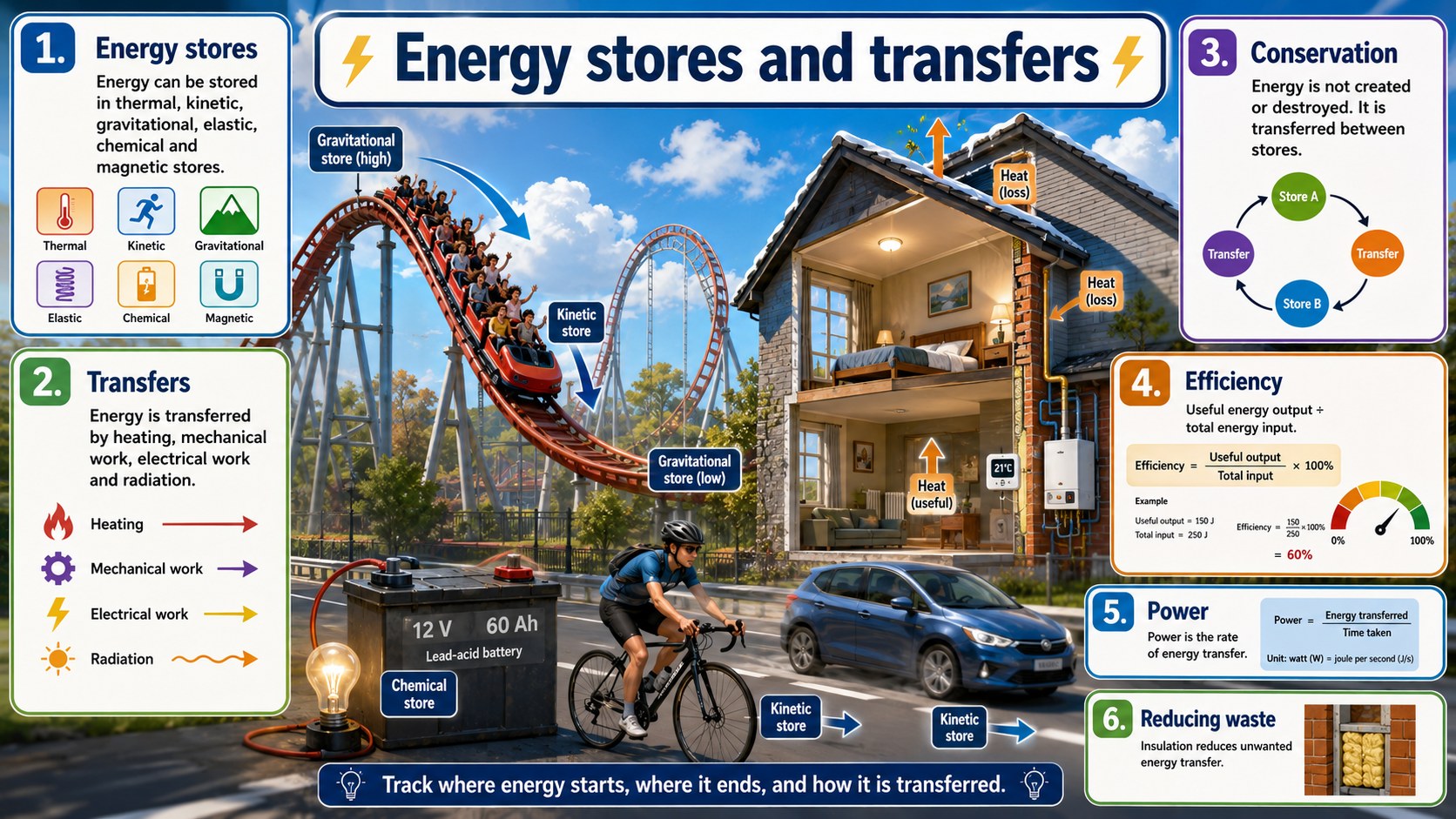
Energy stores and transfers infographic
Clear explanation
GCSE Physics does not treat energy as a substance that gets used up. Energy is stored in different ways and transferred between stores.
Useful transfer is the part that helps the device or process do its job. Dissipated energy is still conserved, but it spreads to less useful stores, often the thermal store of the surroundings.
Efficiency compares useful output with total input. It can be written as a decimal or percentage.
Key diagram
Worked examples
Kettle energy transfer
A kettle transfers 180 000 J electrically. 150 000 J is transferred usefully to the thermal store of the water.
Efficiency = useful energy output ÷ total energy input
Efficiency = 150 000 ÷ 180 000 = 0.833...
Quick checks
Choose an answer, then check your thinking.
1. A hot drink cools down on a desk. Where is energy mainly transferred?
2. A motor has 200 J input and 80 J useful output. What is its efficiency?
Practice questions
Question 1
A battery-powered torch transfers energy from which starting store?
Reveal answer and marking guidance
Answer: The chemical store of the battery.
Marking: Credit chemical store, with useful transfer by light and wasted transfer to thermal stores.
Question 2
A machine transfers 500 J in and 125 J usefully out. Calculate the efficiency as a percentage.
Reveal answer and marking guidance
Answer: 25%.
Marking: Credit 125 ÷ 500 = 0.25 and converting to 25%.
Question 3
A bicycle brake makes the wheel warmer. Explain the energy transfer.
Reveal answer and marking guidance
Answer: Kinetic energy is transferred mechanically and then to thermal stores of the brake, wheel and surroundings.
Marking: Credit kinetic store decreasing and thermal stores increasing.
Question 4
Why is 'energy is wasted' acceptable only if you explain what wasted means?
Reveal answer and marking guidance
Answer: Because the energy is not destroyed; it is dissipated to less useful stores, usually heating the surroundings.
Marking: Credit conservation plus the idea of less useful spreading.
Practice ladder
Answers and marking guidance
The exact practice answers are hidden under each question so you can try first. For this lesson, marks come from using the correct physics model, choosing the right equation where needed, keeping units with values, and explaining changes with precise words such as transfer, resultant force, acceleration, evidence and uncertainty.
Common mistakes
- Saying energy is used up rather than transferred or dissipated.
- Confusing a store, such as chemical, with a pathway, such as electrical.
- Dividing total input by useful output when calculating efficiency.
- Forgetting to convert a decimal efficiency into a percentage when asked.
Extension challenge
Draw a simple Sankey diagram for a kettle, then label useful energy and dissipated energy with approximate values.
Reveal answer
Example answer: A strong extension response names the physics model, uses accurate units and explains why the evidence supports the conclusion.
Exam-board guidance
Short board notes only. Learn the core physics above first.
AQA GCSE Physics
AQA GCSE Physics: often rewards clear physics explanations, correct equations, units and practical evidence for energy stores and transfers.
OCR GCSE Physics
OCR GCSE Physics: often values precise definitions, clear working, graph interpretation and links between models and evidence.
Pearson Edexcel GCSE Physics
Pearson Edexcel GCSE Physics: often combines the concept with equation use, data handling and practical interpretation.
Eduqas GCSE Physics
Eduqas GCSE Physics: learn the core explanation and practise applying it to unfamiliar contexts, data and practical questions.
WJEC Wales
WJEC Wales: often expects accurate terms, units and evidence-based explanations using the shared physics idea.
CCEA GCSE Physics
CCEA GCSE Physics: connect the idea to your current unit and use the same practical method language your class uses.
Next lesson
Next, continue with Forces and Motion Basics.