
Study skills
Lesson overview
This lesson introduces the core physics idea, the useful equipment and the calculation or data skills used on this page.
What you will learn
Starter question set supplied on this page
Use these short prompts to practise the habits that appear across physics questions: identify the quantity, choose the model, write the unit, then explain what changed.
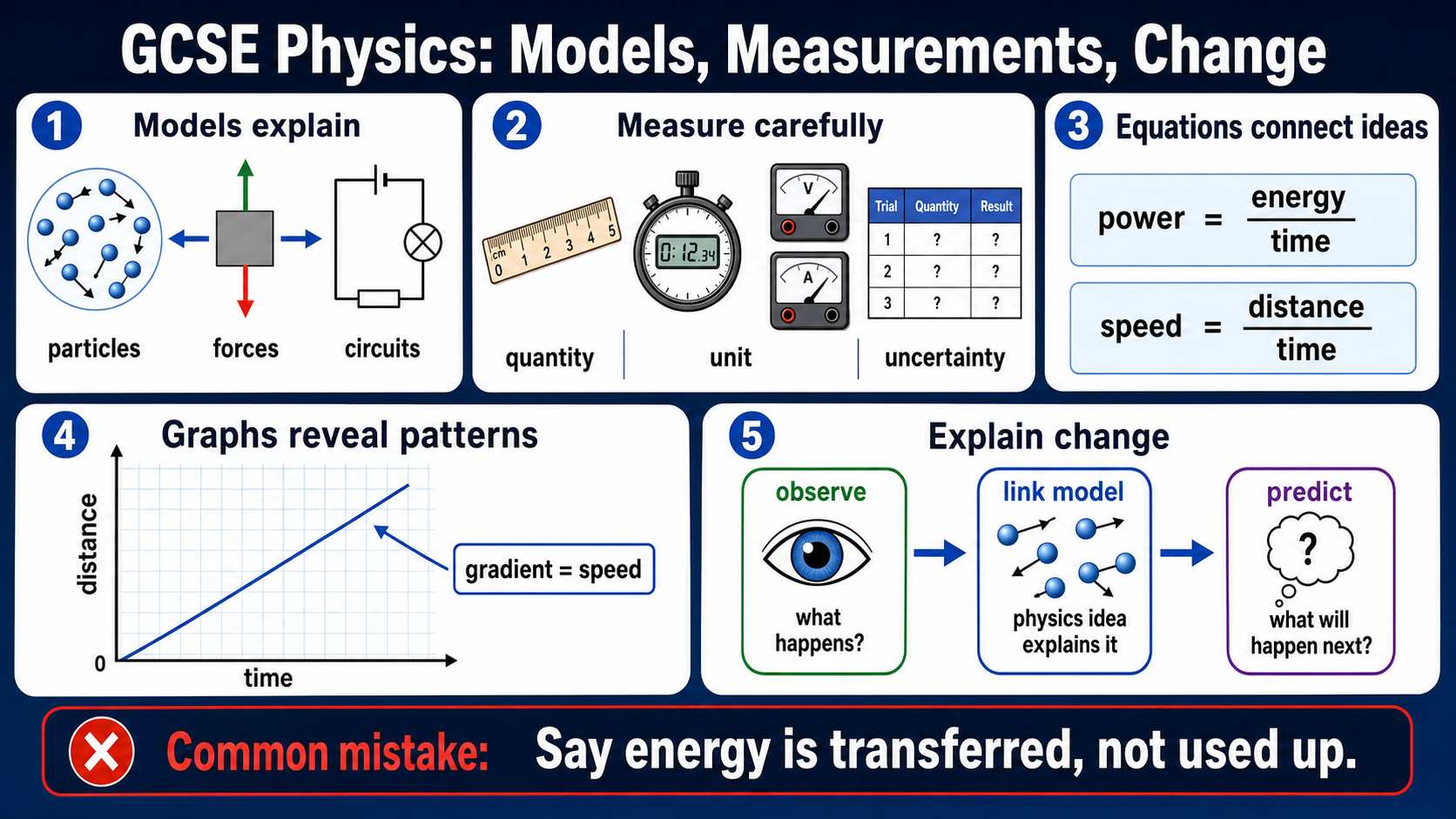
GCSE Physics models, measurements and change infographic
Clear explanation
Physics questions often ask you to connect an observed change with a model. A model is a useful way of representing the real world, such as particles, energy stores, forces or circuits.
The strongest answers keep three things together: the idea, the evidence and the unit. If a calculation gives 12 but the quantity is force, the final answer needs 12 N. If an explanation says energy has moved, it should say from where to where.
A calm physics routine is: underline the quantity, write the equation or model, substitute values with units, calculate, then check whether the answer is sensible.
Key graph
Worked examples
A force question asks for an explanation, not just a number
Question: A trolley speeds up when a student pushes it. Explain why.
A weak answer says: because it is pushed.
A stronger answer says: the push creates a resultant force forwards, so the trolley accelerates in the direction of that resultant force.
Quick checks
Choose an answer, then check your thinking.
1. A calculation answer is 24 and the quantity is energy. What should the final answer include?
2. Why do physics lessons use models such as particles, forces and circuits?
Practice questions
Question 1
A lamp transfers 600 J of energy in 20 s. What quantity can you calculate from energy transferred and time?
Reveal answer and marking guidance
Answer: Power.
Marking: Credit recognising that power links energy transferred and time. The later calculation would use power = energy transferred ÷ time.
Question 2
A graph has distance on the vertical axis and time on the horizontal axis. What does the gradient represent?
Reveal answer and marking guidance
Answer: Speed.
Marking: Credit linking gradient to change in distance divided by change in time.
Question 3
Name one thing a practical answer should mention besides the final result.
Reveal answer and marking guidance
Answer: A method, control variable, measurement uncertainty, repeat reading or safety point.
Marking: Credit any sensible practical feature that supports valid evidence.
Question 4
A pupil writes that energy is 'used up'. How could they improve that wording?
Reveal answer and marking guidance
Answer: Say that energy is transferred or dissipated, not destroyed.
Marking: Credit conservation of energy language and a clear destination such as the thermal store of the surroundings.
Practice ladder
Answers and marking guidance
The exact practice answers are hidden under each question so you can try first. For this lesson, marks come from using the correct physics model, choosing the right equation where needed, keeping units with values, and explaining changes with precise words such as transfer, resultant force, acceleration, evidence and uncertainty.
Common mistakes
- Writing numbers without units.
- Using an equation before identifying the quantity being asked for.
- Treating a model as a perfect copy of reality instead of a useful simplification.
- Saying energy is made, lost or used up instead of transferred or dissipated.
Extension challenge
Choose one physics question from school. Label it as calculation, explanation, graph or practical, then write the first two steps before solving it.
Reveal answer
Example answer: A strong extension response names the physics model, uses accurate units and explains why the evidence supports the conclusion.
Exam-board guidance
Short board notes only. Learn the core physics above first.
AQA GCSE Physics
AQA GCSE Physics: often rewards clear physics explanations, correct equations, units and practical evidence for core gcse physics study habits.
OCR GCSE Physics
OCR GCSE Physics: often values precise definitions, clear working, graph interpretation and links between models and evidence.
Pearson Edexcel GCSE Physics
Pearson Edexcel GCSE Physics: often combines the concept with equation use, data handling and practical interpretation.
Eduqas GCSE Physics
Eduqas GCSE Physics: learn the core explanation and practise applying it to unfamiliar contexts, data and practical questions.
WJEC Wales
WJEC Wales: often expects accurate terms, units and evidence-based explanations using the shared physics idea.
CCEA GCSE Physics
CCEA GCSE Physics: connect the idea to your current unit and use the same practical method language your class uses.
Next lesson
Next, continue with Energy Stores and Transfers.