
Practical skills
Lesson overview
This lesson introduces the core physics idea, the useful equipment and the calculation or data skills used on this page.
What you will learn
Infrared practical prompts supplied on this page
Use the Leslie cube and surface-card examples to practise method, variables and evaluation wording.
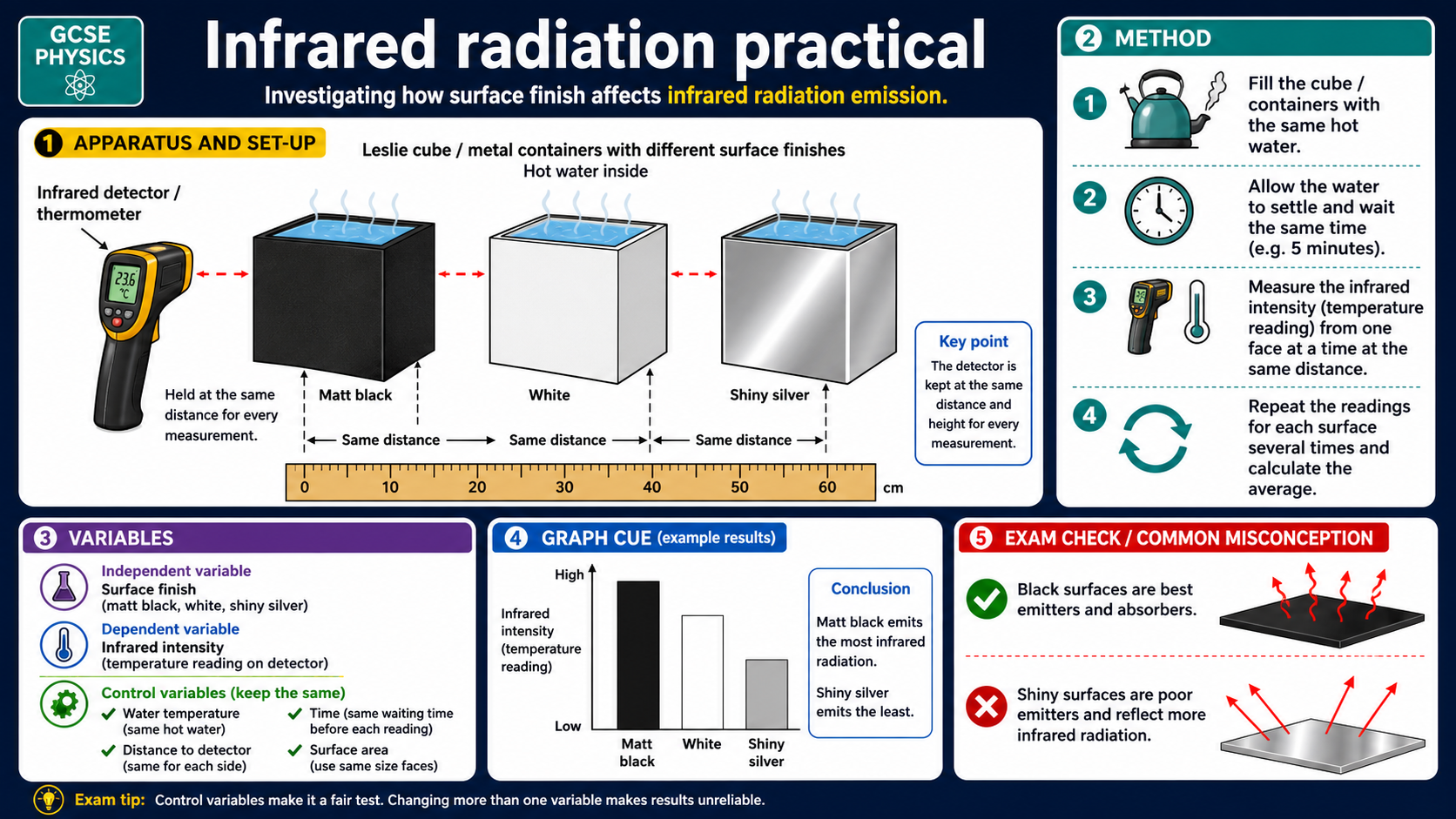
Infrared radiation practical infographic
Clear explanation
Infrared radiation transfers energy by electromagnetic waves. All warm objects emit infrared radiation, but different surfaces emit and absorb different amounts.
A typical investigation compares surfaces such as matt black, shiny silver, white and dull metal while keeping temperature, distance and detector position controlled.
Matt black surfaces are usually the best emitters and absorbers. Shiny light surfaces are usually poor emitters and absorbers but good reflectors.
Worked examples
Fair comparison of surfaces
A detector is placed the same distance from each side of a Leslie cube.
The cube is filled with hot water at the same temperature for each side.
The detector reading is compared for each surface.
Quick checks
Choose an answer, then check your thinking.
1. Which surface is usually the best infrared emitter?
2. What variable should be kept the same when comparing surfaces?
Practice questions
Question 1
Name the independent variable in an investigation comparing matt black and shiny silver surfaces.
Reveal answer and marking guidance
Answer: Surface type or surface finish.
Marking: Credit surface colour/texture.
Question 2
Name one control variable in a Leslie cube investigation.
Reveal answer and marking guidance
Answer: Distance from detector, temperature of the cube, detector angle or room conditions.
Marking: Credit a variable that affects infrared reading.
Question 3
Why should hot water be handled carefully?
Reveal answer and marking guidance
Answer: It can burn or scald, so eye protection and careful handling are needed.
Marking: Credit sensible thermal safety.
Question 4
Why might repeated readings improve the investigation?
Reveal answer and marking guidance
Answer: They help identify anomalies and support a more reliable mean.
Marking: Credit reliability and anomalies.
Practice ladder
Answers and marking guidance
The exact practice answers are hidden under each question so you can try first. For this lesson, marks come from using the correct physics model, choosing the right equation where needed, keeping units with values, and explaining changes with precise words such as transfer, resultant force, acceleration, evidence and uncertainty.
Common mistakes
- Changing detector distance between surfaces.
- Saying shiny silver is always the best emitter.
- Ignoring the starting temperature of the surface.
- Writing a conclusion without linking to evidence.
Extension challenge
Design a table for a Leslie cube investigation, including repeats and a mean detector reading for each surface.
Reveal answer
Example answer: A strong extension response names the physics model, uses accurate units and explains why the evidence supports the conclusion.
Exam-board guidance
Short board notes only. Learn the core physics above first.
AQA GCSE Physics
AQA GCSE Physics: often rewards clear physics explanations, correct equations, units and practical evidence for infrared radiation practical method and evaluation.
OCR GCSE Physics
OCR GCSE Physics: often values precise definitions, clear working, graph interpretation and links between models and evidence.
Pearson Edexcel GCSE Physics
Pearson Edexcel GCSE Physics: often combines the concept with equation use, data handling and practical interpretation.
Eduqas GCSE Physics
Eduqas GCSE Physics: learn the core explanation and practise applying it to unfamiliar contexts, data and practical questions.
WJEC Wales
WJEC Wales: often expects accurate terms, units and evidence-based explanations using the shared physics idea.
CCEA GCSE Physics
CCEA GCSE Physics: connect the idea to your current unit and use the same practical method language your class uses.
Next lesson
Next, continue with Sound, Ultrasound and Seismic Waves.