
Waves
Lesson overview
This lesson introduces the core physics idea, the useful equipment and the calculation or data skills used on this page.
What you will learn
Wave application scenarios supplied on this page
Use echo, ultrasound scan, sonar and earthquake examples to practise wave application explanations.
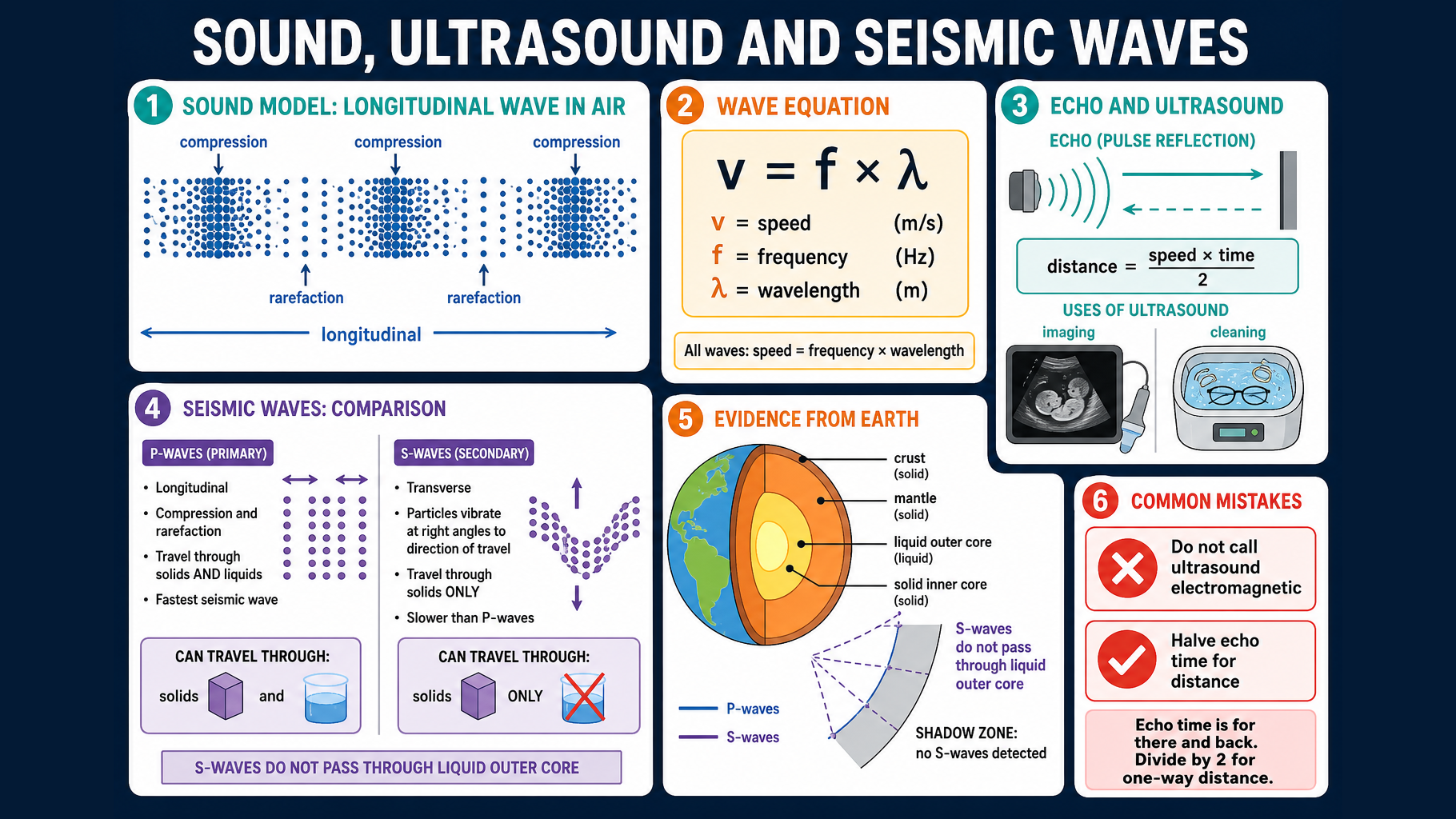
Sound, ultrasound and seismic waves infographic
Clear explanation
Sound is a longitudinal wave that needs a medium. It cannot travel through a vacuum because there are no particles to vibrate.
Ultrasound has a frequency above human hearing. Reflected ultrasound pulses can build images or measure distances using time delay.
Seismic P-waves and S-waves travel differently through Earth. S-waves do not travel through liquids, which provides evidence about Earth's outer core.
Worked examples
Echo distance
A sound pulse takes 0.40 s to travel to a wall and back.
The total journey is twice the distance to the wall.
If sound speed is 340 m/s, total distance = 340 x 0.40 = 136 m.
Quick checks
Choose an answer, then check your thinking.
1. Why can sound not travel through a vacuum?
2. Which seismic wave cannot travel through liquids?
Practice questions
Question 1
A sonar pulse returns after 0.20 s. The sound speed in water is 1500 m/s. How far away is the object?
Reveal answer and marking guidance
Answer: 150 m.
Marking: Credit total distance 1500 x 0.20 = 300 m, then halve for there-and-back journey.
Question 2
What is ultrasound?
Reveal answer and marking guidance
Answer: Sound with frequency above the upper limit of human hearing.
Marking: Credit frequency above about 20 kHz.
Question 3
Why are echoes useful in imaging or distance measurement?
Reveal answer and marking guidance
Answer: The reflected wave and its time delay show where a boundary or object is.
Marking: Credit reflection and time delay.
Question 4
What does the behaviour of S-waves suggest about Earth's outer core?
Reveal answer and marking guidance
Answer: The outer core is liquid because S-waves do not pass through it.
Marking: Credit S-wave evidence and liquid outer core.
Practice ladder
Answers and marking guidance
The exact practice answers are hidden under each question so you can try first. For this lesson, marks come from using the correct physics model, choosing the right equation where needed, keeping units with values, and explaining changes with precise words such as transfer, resultant force, acceleration, evidence and uncertainty.
Common mistakes
- Forgetting to halve echo distances.
- Calling sound transverse in air.
- Thinking ultrasound is electromagnetic radiation.
- Saying S-waves pass through liquids.
Extension challenge
Compare ultrasound scanning and X-ray imaging, including one advantage and one limitation of each.
Reveal answer
Example answer: A strong extension response names the physics model, uses accurate units and explains why the evidence supports the conclusion.
Exam-board guidance
Short board notes only. Learn the core physics above first.
AQA GCSE Physics
AQA GCSE Physics: often rewards clear physics explanations, correct equations, units and practical evidence for sound, ultrasound and seismic wave applications.
OCR GCSE Physics
OCR GCSE Physics: often values precise definitions, clear working, graph interpretation and links between models and evidence.
Pearson Edexcel GCSE Physics
Pearson Edexcel GCSE Physics: often combines the concept with equation use, data handling and practical interpretation.
Eduqas GCSE Physics
Eduqas GCSE Physics: learn the core explanation and practise applying it to unfamiliar contexts, data and practical questions.
WJEC Wales
WJEC Wales: often expects accurate terms, units and evidence-based explanations using the shared physics idea.
CCEA GCSE Physics
CCEA GCSE Physics: connect the idea to your current unit and use the same practical method language your class uses.
Next lesson
Next, continue with Practical: Reflection and Refraction.