
Practical skills
Lesson overview
This lesson introduces the core physics idea, the useful equipment and the calculation or data skills used on this page.
What you will learn
Ray practical tasks supplied on this page
Use the mirror and glass-block prompts to practise careful normal lines, angle measurement and ray tracing.
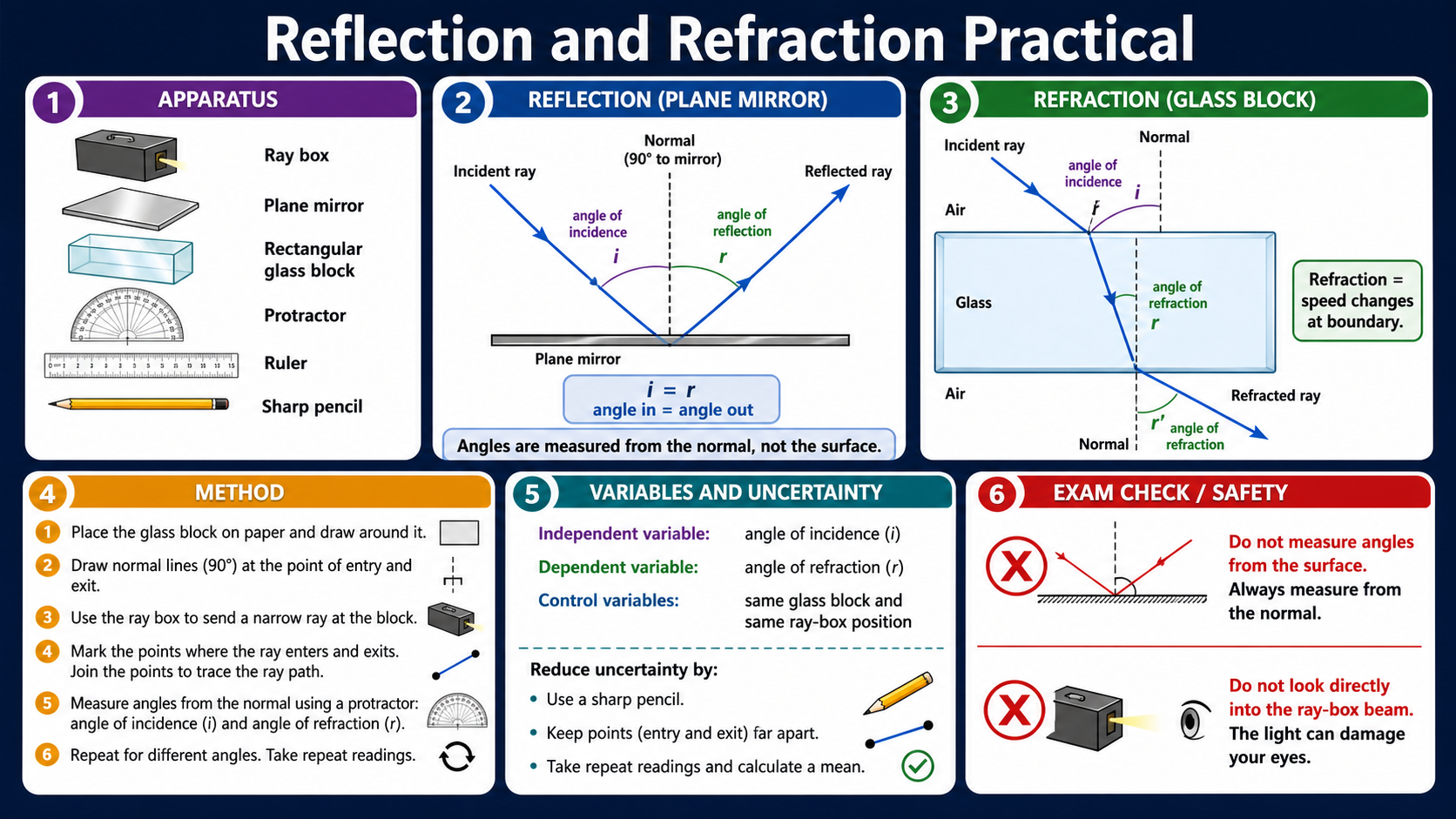
Reflection and refraction practical infographic
Clear explanation
For reflection from a plane mirror, the angle of incidence equals the angle of reflection. Both angles are measured from the normal, not from the mirror surface.
For refraction, a ray changes direction when it enters or leaves a material because its speed changes. A rectangular glass block lets you trace both entry and exit rays.
Good practical work uses a sharp pencil, clear normal line, repeated angle readings and careful alignment of the ray box.
Key diagram
Worked examples
Reflection angle
A ray hits a mirror at 35 degrees to the normal.
The law of reflection says angle of incidence equals angle of reflection.
The reflected ray is also 35 degrees to the normal.
Quick checks
Choose an answer, then check your thinking.
1. From what line are incidence and reflection angles measured?
2. What does the law of reflection state?
Practice questions
Question 1
A ray has angle of incidence 42 degrees at a plane mirror. What is the angle of reflection?
Reveal answer and marking guidance
Answer: 42 degrees.
Marking: Credit law of reflection.
Question 2
Why should angles be measured from the normal rather than the surface?
Reveal answer and marking guidance
Answer: The law of reflection and refraction angles are defined from the normal.
Marking: Credit correct reference line.
Question 3
Name one way to reduce uncertainty when tracing rays.
Reveal answer and marking guidance
Answer: Use a sharp pencil, mark points far apart, repeat readings or align the ray carefully.
Marking: Credit a practical improvement linked to measurement.
Question 4
Why should pupils avoid looking directly into a ray box beam?
Reveal answer and marking guidance
Answer: Bright light can be uncomfortable or unsafe for eyes.
Marking: Credit eye safety.
Practice ladder
Answers and marking guidance
The exact practice answers are hidden under each question so you can try first. For this lesson, marks come from using the correct physics model, choosing the right equation where needed, keeping units with values, and explaining changes with precise words such as transfer, resultant force, acceleration, evidence and uncertainty.
Common mistakes
- Measuring angles from the mirror surface.
- Drawing the normal after measuring the ray angles.
- Using thick pencil lines that make ray positions unclear.
- Forgetting the ray bends again as it leaves the glass block.
Extension challenge
Design a results table for a reflection practical with repeated angle readings and a mean angle of reflection.
Reveal answer
Example answer: A strong extension response names the physics model, uses accurate units and explains why the evidence supports the conclusion.
Exam-board guidance
Short board notes only. Learn the core physics above first.
AQA GCSE Physics
AQA GCSE Physics: often rewards clear physics explanations, correct equations, units and practical evidence for reflection and refraction practical method.
OCR GCSE Physics
OCR GCSE Physics: often values precise definitions, clear working, graph interpretation and links between models and evidence.
Pearson Edexcel GCSE Physics
Pearson Edexcel GCSE Physics: often combines the concept with equation use, data handling and practical interpretation.
Eduqas GCSE Physics
Eduqas GCSE Physics: learn the core explanation and practise applying it to unfamiliar contexts, data and practical questions.
WJEC Wales
WJEC Wales: often expects accurate terms, units and evidence-based explanations using the shared physics idea.
CCEA GCSE Physics
CCEA GCSE Physics: connect the idea to your current unit and use the same practical method language your class uses.
Next lesson
Next, continue with Red-shift and the Expanding Universe.