
Space
Lesson overview
This lesson introduces the core physics idea, the useful equipment and the calculation or data skills used on this page.
What you will learn
Cosmology evidence prompts supplied on this page
Use the spectrum and galaxy prompts to practise explaining red-shift without saying the galaxy itself turns red.
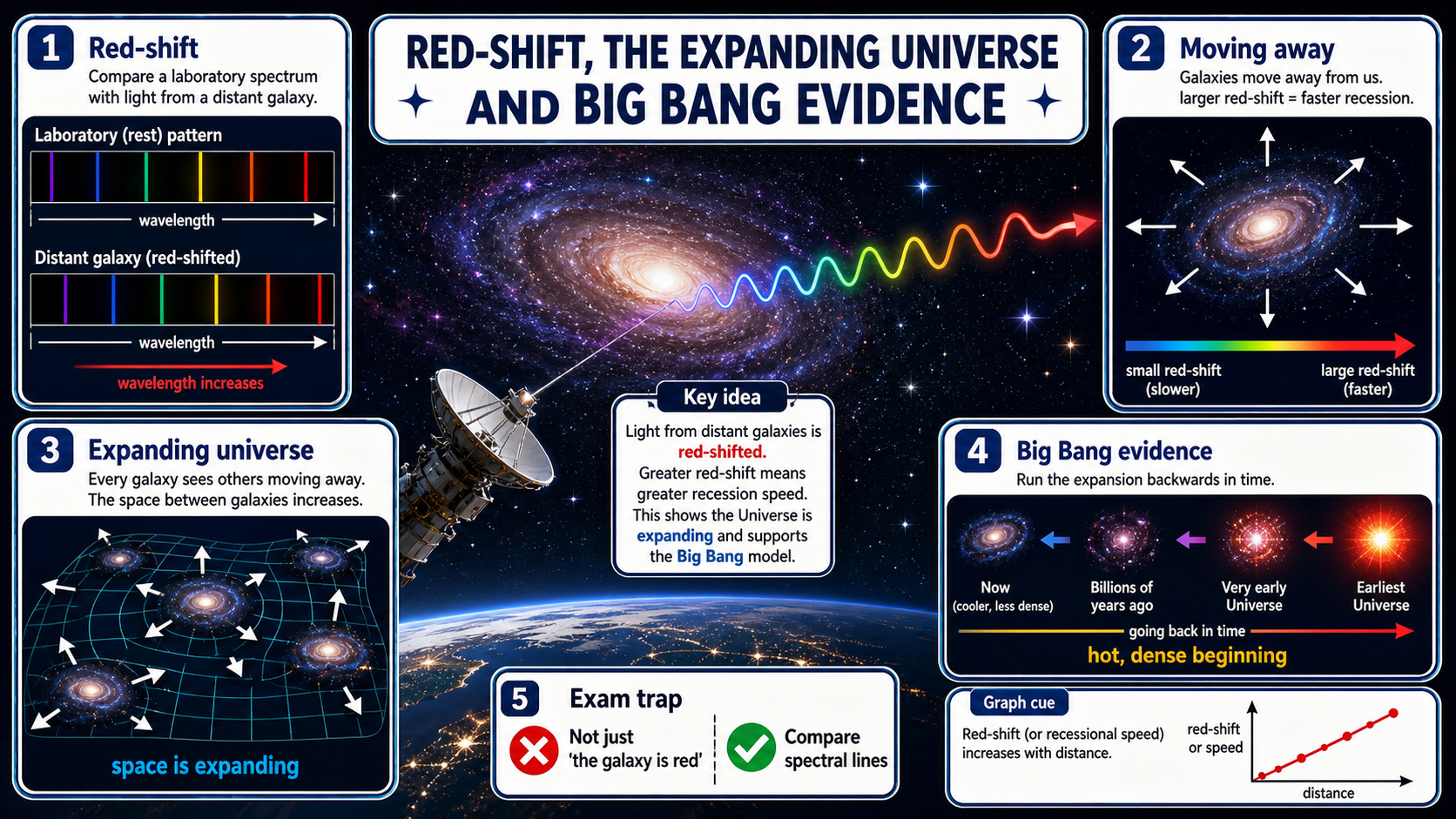
Red-shift, the expanding universe and Big Bang evidence infographic
Clear explanation
Red-shift means light from a distant galaxy is shifted towards longer wavelengths compared with light from the same elements measured in a laboratory.
If a galaxy is moving away, its observed wavelengths are stretched. A larger red-shift suggests a greater recession speed.
The pattern that distant galaxies show red-shift is evidence that space is expanding. Running that expansion backwards supports the idea that the universe began in a much hotter, denser state.
Key diagram
Worked examples
Interpreting a shifted spectral line
A hydrogen line appears at a longer wavelength in light from a distant galaxy than in a laboratory spectrum.
Longer observed wavelength means red-shift.
Red-shift suggests the galaxy is moving away from us.
Quick checks
Choose an answer, then check your thinking.
1. What does red-shift mean in GCSE Physics?
2. What does a greater red-shift usually suggest?
Practice questions
Question 1
A spectral line from a distant galaxy is shifted towards longer wavelength. Name the effect.
Reveal answer and marking guidance
Answer: Red-shift.
Marking: Credit red-shift or redshift.
Question 2
Explain why red-shift supports the idea that galaxies are moving away.
Reveal answer and marking guidance
Answer: The observed wavelengths are stretched compared with laboratory values, which suggests recession.
Marking: Credit longer wavelength and moving away.
Question 3
Why is 'the galaxy is red' a weak explanation?
Reveal answer and marking guidance
Answer: Because red-shift is about the wavelength of light increasing, not the actual colour of the galaxy.
Marking: Credit distinction between spectrum shift and object colour.
Question 4
How does red-shift evidence support the Big Bang model?
Reveal answer and marking guidance
Answer: If space is expanding now, then in the past the universe was smaller, hotter and denser.
Marking: Credit expansion backwards and hot dense early universe.
Practice ladder
Answers and marking guidance
The exact practice answers are hidden under each question so you can try first. For red-shift, marks come from comparing observed spectral lines with laboratory wavelengths, stating that wavelength has increased, linking larger red-shift to greater recession speed, and using the expanding-universe evidence carefully rather than saying galaxies simply turn red.
Common mistakes
- Saying red-shift means the galaxy is red.
- Forgetting that wavelength increases.
- Treating one galaxy as enough evidence for the whole model.
- Saying expansion means galaxies move through space like ordinary objects only.
Extension challenge
Compare red-shift evidence with one other piece of evidence for the Big Bang model, such as cosmic microwave background radiation if your course covers it.
Reveal answer
Example answer: A strong extension response names the physics model, uses accurate units and explains why the evidence supports the conclusion.
Exam-board guidance
Short board notes only. Learn the core physics above first.
AQA GCSE Physics
AQA GCSE Physics: often rewards clear physics explanations, correct equations, units and practical evidence for red-shift, expansion and big bang evidence.
OCR GCSE Physics
OCR GCSE Physics: often values precise definitions, clear working, graph interpretation and links between models and evidence.
Pearson Edexcel GCSE Physics
Pearson Edexcel GCSE Physics: often combines the concept with equation use, data handling and practical interpretation.
Eduqas GCSE Physics
Eduqas GCSE Physics: learn the core explanation and practise applying it to unfamiliar contexts, data and practical questions.
WJEC Wales
WJEC Wales: often expects accurate terms, units and evidence-based explanations using the shared physics idea.
CCEA GCSE Physics
CCEA GCSE Physics: connect the idea to your current unit and use the same practical method language your class uses.
Next lesson
Next, continue with Atomic Models and Evidence.