
Practical skills
Lesson overview
This lesson introduces the core physics idea, the useful equipment and the calculation or data skills used on this page.
What you will learn
Specific heat capacity method supplied on this page
Use the metal block data and method prompts to practise calculation, graph use and evaluation.
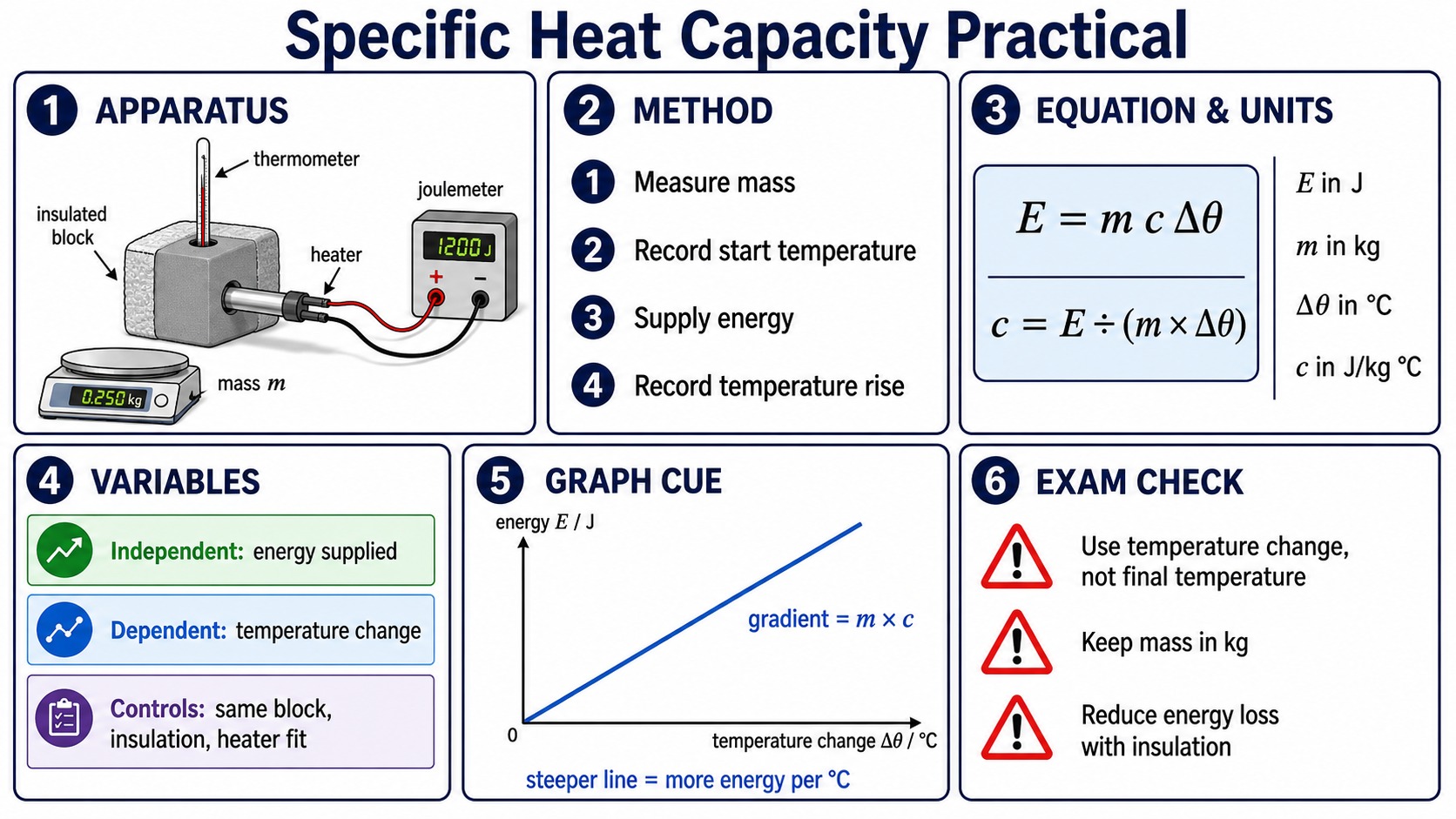
Specific heat capacity practical infographic
Clear explanation
This practical measures how much energy is needed to raise the temperature of a material. You measure the mass, supply energy with an electrical heater and record the temperature rise.
Energy can be measured directly with a joulemeter or calculated from potential difference, current and time. The temperature change must be the final temperature minus the starting temperature.
Insulation reduces energy transfer to the surroundings. Repeats and a graph of energy against temperature change can make the result more reliable.
Key graph
Worked examples
Calculating specific heat capacity
A 1.5 kg block receives 13 500 J and warms by 10 degrees Celsius.
c = energy ÷ (mass x temperature change)
c = 13 500 ÷ (1.5 x 10) = 900
Quick checks
Choose an answer, then check your thinking.
1. Why is insulation used around the block?
2. Which temperature value goes into the equation?
Practice questions
Question 1
A 2 kg block receives 8000 J and warms by 5 degrees Celsius. Calculate specific heat capacity.
Reveal answer and marking guidance
Answer: 800 J/kg degrees Celsius.
Marking: Credit c = 8000 ÷ (2 x 5) = 800 J/kg degrees Celsius.
Question 2
Name the independent variable if a student plots energy supplied against temperature change.
Reveal answer and marking guidance
Answer: Energy supplied.
Marking: Credit the variable deliberately increased or recorded on the x-axis if that method is used.
Question 3
Give one source of uncertainty in this practical.
Reveal answer and marking guidance
Answer: Energy lost to surroundings, thermometer resolution, poor thermal contact or timing uncertainty.
Marking: Credit a realistic source linked to the method.
Question 4
Why should the heater fit closely into the block?
Reveal answer and marking guidance
Answer: To transfer energy to the block efficiently and reduce energy lost elsewhere.
Marking: Credit better thermal contact and reduced unwanted transfer.
Practice ladder
Answers and marking guidance
The exact practice answers are hidden under each question so you can try first. For this lesson, marks come from using the correct physics model, choosing the right equation where needed, keeping units with values, and explaining changes with precise words such as transfer, resultant force, acceleration, evidence and uncertainty.
Common mistakes
- Using final temperature instead of temperature change.
- Forgetting the mass in the equation.
- Ignoring energy transfer to the surroundings.
- Writing specific heat capacity without units.
Extension challenge
Explain how a graph of energy supplied against temperature change could be used to find specific heat capacity from the gradient.
Reveal answer
Example answer: A strong extension response names the physics model, uses accurate units and explains why the evidence supports the conclusion.
Exam-board guidance
Short board notes only. Learn the core physics above first.
AQA GCSE Physics
AQA GCSE Physics: often rewards clear physics explanations, correct equations, units and practical evidence for specific heat capacity practical method and evaluation.
OCR GCSE Physics
OCR GCSE Physics: often values precise definitions, clear working, graph interpretation and links between models and evidence.
Pearson Edexcel GCSE Physics
Pearson Edexcel GCSE Physics: often combines the concept with equation use, data handling and practical interpretation.
Eduqas GCSE Physics
Eduqas GCSE Physics: learn the core explanation and practise applying it to unfamiliar contexts, data and practical questions.
WJEC Wales
WJEC Wales: often expects accurate terms, units and evidence-based explanations using the shared physics idea.
CCEA GCSE Physics
CCEA GCSE Physics: connect the idea to your current unit and use the same practical method language your class uses.
Next lesson
Next, continue with Practical: I-V Characteristics.